Aa
  • Read, Watch, Listen
  • TJI Series
  • Community Action
  • Events
  • Zedi
Follow us and continue the conversation
  • LinkedIn
  • Instagram
  • FaceBook
  • X
  • YouTube
Test yourself with the TJI Quiz!

Adjust size of text

Aa

Follow us and continue the conversation

  • LinkedIn
  • Instagram
  • FaceBook
  • X
  • YouTube

Your saved articles

You haven't saved any articles

What are you looking for?

Original reporting, insightful analysis and diverse views, delivered straight to your inbox

  • LinkedIn
  • Instagram
  • FaceBook
  • X
  • YouTube
Your support fuels our mission to inform, entertain and inspire.

The Jewish Independent is bound by the Standards of Practice of the Australian Press Council. If you believe the Standards may have been breached, you may approach The Jewish Independent or make a complaint to the Australian Press Council in writing at www.presscouncil.org.au. The Council may also be contacted on 1800 025 712.

  • Our Story
  • Contact us
  • Our Team
  • Support us
  • Guidelines
  • Pitch your idea
  • Republishing us
  • Community Action
  • Our Awards
  • LinkedIn
  • Instagram
  • FaceBook
  • X
  • YouTube
Aboriginal FlagTorres Strait Islanders Flag

The Jewish Independent acknowledges Aboriginal and Torres Strait Islander peoples as the Traditional Owners and Custodians of Country throughout Australia. We pay our respects to Elders past and present, and strive to honour their rich history of storytelling in our work and mission.

© The Jewish Independent 2026All Rights Reserved
Website design and development by Your Creative, MelbourneTerms & ConditionsPrivacy Policy
HomeRead, Watch, ListenWorld
World

Why do Israeli Jews want to teach Muslim children in Berlin?

Mati Shemoelof
Print this

Published: 21 May 2021

Last updated: 4 March 2024

MATI SHEMOELOF talks to the Israeli expat behind a program to help both Jews and Muslims drop their suspicions and prejudices against ‘the other’

YONATAN WEIZMAN IS AN ISRAELI Jew who, since 2018, has managed an organisation called Shalom Rollberg, in which Jewish and Israeli volunteers educate and empower children of Muslim immigrants in the Rollberg district of Neukölln in Berlin.

Today, the Rollberg neighbourhood is an area with the highest percentage of Muslim residents in the city. “Shalom Rollberg” engages with about 150 kids a year, offering them lessons in everything from English to yoga for girls and women, skateboard, kung fu and art. Some are one on one lessons. And all of it is provided by just 18 Jewish volunteers.

When did you emigrate to Berlin? Why?

Ten years ago, I moved here for the best reasons of all: Love. I met my Polish wife when she went to “Yad Vashem” in order to honour her Polish grandparents who were “Righteous Among the Nations”. Funnily enough, I also have Polish roots.

You also live in the Rollberg neighbourhood? What is so unique about it?

Rollberg neighbourhood is primarily built out of social public housing. So the people who live here are chosen according to social-economic criteria. It started back in the seventies. Over the years, the government has put refugees from Lebanon, then Palestinian refugees, Balkan refugees and later, refugees from the Syrian and Afghanistan wars.

The result is that you have a population that is very homogeneous with similar faiths and languages. But there are also downsides: For instance, I heard kids from the neighbourhood saying that “we don’t like any gays in our neighbourhood”.

Why do Israeli Jews want to teach Muslim children in Neukölln?
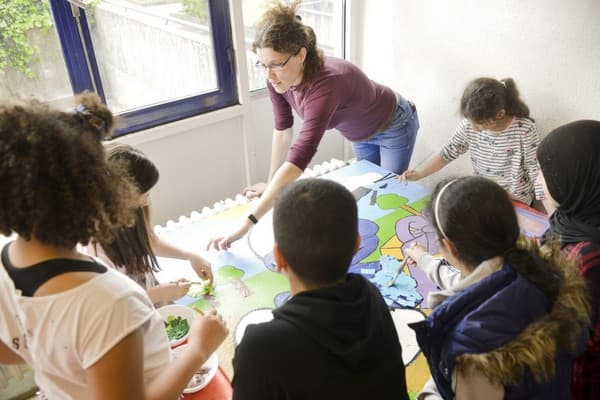
We want to introduce the kids of the neighbourhood to Jews. Israeli Jews volunteer with us in order to meet their “other”: Palestinians, Lebanese, Syrians, Muslims in general. It integrated me into the society in which I live. I had kids from the neighbourhood who babysat my kids.

An Israeli volunteer teacher with Muslim children

So how do you deal with the Israeli-Arab conflict in those meetings?

A family that is living in over-crowded house, with parents fighting to make a living and a place in society – they need help and relief. When that relief comes from somebody who is “the enemy”, that could really change the dynamics.

What do you do when a younger kid tries to provoke you?

Let’s say some kid says, “you kill my family”. I’m not there to change their opinions. I’m certainly not there to challenge what their parents or an Imam said. It is not my place. I am there to offer them an alternative by the virtue of being there.  

A teenage girl asked me in an English class, “why did you kill Arafat?” [Editor’s note: this is one of several conspiracy theories that circulated after his death] This indicates that she sees me as a representation of the State of Israel. Great question. We talked about it. The very fact that she is engaging and asking me a question without an accusatory tone is progress.

In one of your former interviews, I read that you were injured while fighting against Palestinians inside Gaza.

My experience in military service took me on a certain trajectory. It was very much a kick in the head. I come to realise that my past determines who I am. My work at Shalom Rollberg intensified this process. I may not believe in God. But I am Jewish, and I will always be seen as a Jew.

So how do the Rollberg refugees treat you as a Jew?

A kid I like named Abdulkarim left a small note on my desk. It says, “Yonatan, why aren’t you ever in your office? It is silly. Let’s meet”. He is a kid who arrived from Syria. In Israel, I grew up to learn that Syria is the big enemy from the north.

But Abdulkarim is now in Germany. And what he experienced in Syria and later on the refugee camps in Turkey, no-one should experience. His family made it here, but at a great cost: Not all of them arrived. From what his mother told me, they were taught that the Israelis were the bad guys.

A few months later, I found myself having dinner at his family house with my wife and kids, eating the same kind of food that I would have eaten back home. It all felt strangely familiar, which  was a very good sign. We have a lot in common, Muslims and Jews, Arabs, and Israelis. Actually, we have more in common than the Israelis do with the Germans.

How has the coronavirus influenced your organization?

It threw a wrench in the gears, big-time. We haven’t had a group lesson for more than a year. All these kids are stuck home for a long time, between the same four walls, without external stimulation and very little school. And I see kids here wilt.

And financially?

We are a voluntary organisation entirely based on charitable donations and would be more then grateful if anyone would like to support us financially or otherwise. 

Photo: Yonatan Weizman (courtesy)

You might also like
  • UK far left is complicit in antisemitic stabbings
    Colin Shindler
  • Interfaith relations after Bondi 
    Ralph Genende
  • Between Melbourne, Warsaw and Tel Aviv, where was I at home this week?
    Sidra Kranz Moshinsky
logomark.67a07ee3
We believe in the free flow of information

Republish our articles for free, online or in print, by using our Creative Commons licence

You might also like

    Jewish word map
    FeatureArts & Culture

    Was the barmi a shemozzle? How Australians use Jewish words 

    Caroline Hendy & Emma Breslow 1
    Mamdani Preston
    OpinionWorld

    From NY to Melbourne, local politicians are whipping up hate 

    Nomi Kaltmann 3
    Protest
    AnalysisIsrael

    Western ‘Palestinianism’ colonises everything – and hurts Palestinians

    Andres Spokoiny 3

About the author

Mati Shemoelof

Mati Shemoelof

Mati Shemoelof is a poet and an author. His writing includes seven poetry books, plays, articles and fiction, which have won significant recognition and prizes. He has written a radio play for German radio WDR. A German edition of his bi-lingual poems was published by AphorismA Verlag.

More from the author

ReflectionIsrael

An Israeli abroad: grieving, alienated, ashamed

OpinionWorld

Israeli expats are becoming Diaspora Jews

OpinionWorld

The surprising trend among anxious Jewish parents in Berlin

OpinionWorld

How do Germans views Israelis who live among them?