Published: 17 July 2020
Last updated: 4 March 2024
PRIME MINISTER LEVI ESHKOL was furious when he heard that men and women were being separated at the Western Wall by a mehitza (a traditional Jewish partition) after the reunification of Jerusalem following the Six-Day War.
“Fences, mehitzas and enclosures – these are fundamentally insulting and depressing things,” he told cabinet members at a meeting on August 13, 1967, to discuss a host of sensitive issues that continue to dog Israel to this day.
“It’s a sacred, historic place, and it’s also sacred to secular Jews,” Eshkol told fellow cabinet members. “It’s a place to which different Jews and non-Jews will come, and it would be better that we act respectfully there,” he said.
Health Minister Yisrael Barzilai concurred. “Regretfully, they are behaving as if it belonged to only one section,” he said, referring to the ultra-Orthodox, or Haredi, community. “Of course it belongs to the religious, but also to the nonreligious … albeit in a different manner, but to the same extent,” he added.
FULL STORY ‘Fences are insulting’: Israel’s government once opposed sex segregation at the Western Wall (Haaretz)
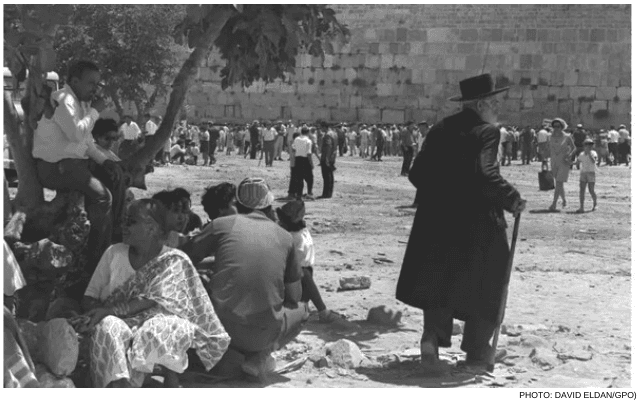
Photo: The Western Wall Plaza in July 1967, just prior to the holy site being divided into prayer sections for men and women (David Eldan/GPO)