Aa
  • Read, Watch, Listen
  • TJI Series
  • Community Action
  • Events
  • Zedi
Follow us and continue the conversation
  • LinkedIn
  • Instagram
  • FaceBook
  • X
  • YouTube
Test yourself with the TJI Quiz!

Adjust size of text

Aa

Follow us and continue the conversation

  • LinkedIn
  • Instagram
  • FaceBook
  • X
  • YouTube

Your saved articles

You haven't saved any articles

What are you looking for?

Original reporting, insightful analysis and diverse views, delivered straight to your inbox

  • LinkedIn
  • Instagram
  • FaceBook
  • X
  • YouTube
Your support fuels our mission to inform, entertain and inspire.

The Jewish Independent is bound by the Standards of Practice of the Australian Press Council. If you believe the Standards may have been breached, you may approach The Jewish Independent or make a complaint to the Australian Press Council in writing at www.presscouncil.org.au. The Council may also be contacted on 1800 025 712.

  • Our Story
  • Contact us
  • Our Team
  • Support us
  • Guidelines
  • Pitch your idea
  • Republishing us
  • Community Action
  • Our Awards
  • LinkedIn
  • Instagram
  • FaceBook
  • X
  • YouTube
Aboriginal FlagTorres Strait Islanders Flag

The Jewish Independent acknowledges Aboriginal and Torres Strait Islander peoples as the Traditional Owners and Custodians of Country throughout Australia. We pay our respects to Elders past and present, and strive to honour their rich history of storytelling in our work and mission.

© The Jewish Independent 2026All Rights Reserved
Website design and development by Your Creative, MelbourneTerms & ConditionsPrivacy Policy
HomeRead, Watch, ListenIsrael
Israel

‘A meeting of two crises’: a country at war and a singer who felt washed up

Michael Visontay
Print this

Published: 21 September 2023

Last updated: 5 March 2024

MATTI FRIEDMAN has chronicled the story of how Leonard Cohen’s strange, impromptu tour in ’73 became a pathway into the memory of the War for Israelis.

In 2016 Matti Friedman asked his publisher for a favour. The Canadian-Israeli journalist wanted to write a book about Leonard Cohen’s Yom Kippur War tour and its almost mythological impact on Israelis. “But I couldn’t write the book without asking Cohen about it and I didn’t know how to contact him. Then I realised that my Canadian publisher was also Leonard Cohen’s publisher.

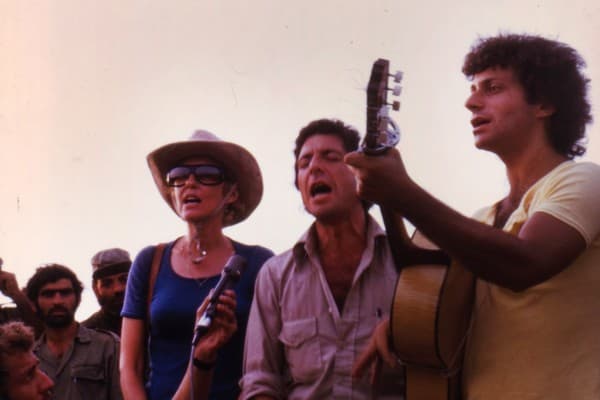
Hs editor agreed to approach Cohen and set up an interview. Friedman was thrilled; the idea had been stewing inside him for seven years and this would be the first, giant step. He wrote a summary of the book, attached a famous photo of Cohen standing next to Ariel Sharon, surrounded by soldiers to jog his memory, sent it off and went to bed.

When he woke the next morning, there was an email from his editor and the subject line had two words: “Holy Shit”.

The email contained a link to Leonard Cohen's obituary.

Friedman was flattened. Cohen had not spoken about the tour to media or friends at the time and now his only chance to ask the singer about it had evaporated, literally overnight. “I thought, ‘I’ve got no book: what am I supposed to do?’”
The Jewish Independent

Friedman did what every good journalist does. He started digging until he found something, a footnote in a Cohen biography that led him to an unpublished manuscript the singer wrote about his experience on that tour. It was fictionalised – Cohen was a poet, after all – but unmistakably based on the tour.

The singer was dead, but Friedman had found a way to get inside his head, unmediated, from beyond the grave. “It was unfiltered and it was exactly what I was looking for. It was divine intervention,” he says.

That manuscript was the foundation: enhanced by six years of granular research and hundreds of interviews, it became his book Who By Fire, which tells the story of how Cohen came to visit Israel in the middle of a war, and how his tour subsequently morphed into a touchstone of the Israeli consciousness.

“The Yom Kippur War left a deep scar in the country's psyche and Leonard Cohen is kind of a pathway into the memory of the war,” he says. “The book talks to that trauma.”

Israelis now have an almost religious attachment to Leonard Cohen, as though 1973 was some sort of pilgrimage-mission. But the hype has obscured some mundane detail and hard facts. Why did the brooding poet-singer, a poster boy for seventies romantic spiritualism, decide to drop into Israel smack bang in the middle of a brutal war?

“It was basically a meeting of two crises,” says Friedman. “A country in crisis and an artist experiencing a deep personal and creative crisis. Cohen, despite being one of the big names of that era, had hit a wall and thought he had nothing left to say.

“He had announced that he was retiring from the music business and he was despondent. He was living with a woman on a Greek island [Hydra]; they had a child but it was a relationship that wasn't going very well.

The country was preoccupied with not losing this war and the fact that this Canadian poet was wandering around was not at the front of anyone's mind.

“Cohen felt trapped by all this baggage. He was 39, which is a prime age for a male midlife crisis. I think he is both drawn to be with Jewish people at a time of crisis, and he also needs a way out of his own crisis. The war in Israel suggests an escape route, and he jumps on it.”

Yet the tour did not come entirely out of the blue. Many people forget that Cohen had performed in Israel the year before, so the country was already on his radar. He gave two chaotic performances, which were filmed and made into a documentary, titled Bird On a Wire. The tour led Cohen to call Israel his “myth home”, hinting at a spiritual connection that might draw him back.

But 1973 was not a tour in the conventional sense. “He was not organised in any way. He comes by himself, there was no entourage, he comes without a guitar, which suggests that he was not intending to play music.

“He is pretty clear that he didn't think he was going to be playing. He was going to go to a kibbutz, he tells people he wants to pick grapefruit, and he bums around the country for a couple of days, until he's recognised by some Israeli musicians and then the story of the tour takes shape.”

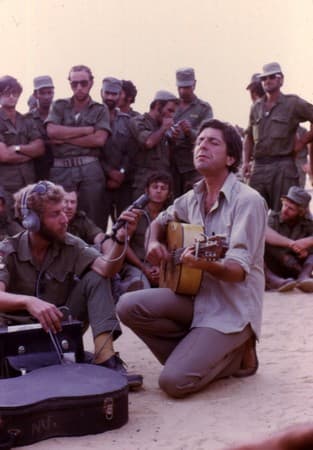
The enduring images from this visit are of Cohen singing in the open, almost enveloped by soldiers. So how many impromptu “performances” did he actually give? “One of the wild parts of this story is that there are no records of it,” says Friedman. “The country was preoccupied with not losing this war and the fact that this Canadian poet was wandering around was not at the front of anyone's mind.”

Pressed to offer a ballpark figure, he says: “I would say dozens of performances. I think it's safe to say he played dozens of these shows and was seen ultimately by several thousand soldiers.”

The Jewish Independent

Fifty years on, the tour clearly had a great impact on Cohen. The following year he wrote the song that gave Friedman’s book its name, Who By Fire, whose lyrics were adapted from the Yom Kippur liturgy, and Friedman later discovered the manuscript that bore witness to its effect on him.

Leonard Cohen toured Israel a few times afterwards and developed a large fan base. But Friedman believes it took another 35 years, until his 2009 world tour, which would prove to be his last, that the Yom Kippur story took root. “He was on a kind of resurrection tour and it ended in Israel. The last concert was in Tel Aviv and 50,000 people were there. It was a huge event, impossible to get tickets and the phone lines crashed when tickets went on sale.

“Cohen famously ended the concert with the priestly blessing – the blessing of the Cohanim. It was a very memorable moment and I think probably that's when it clicked for Israelis. Before that it had never quite been on people's radar.”

Friedman believes it took another 35 years, until Cohen's 2009 world tour, that the Yom Kippur story took root.

Friedman says he read a story in the newspaper “and that's when I learned about the 1973 tour. I never heard about it before. So if we have to date [the beginnings of the book], I would say it was 2009.”

Friedman spent years interviewing soldiers and others who saw Cohen, deciphered his notebooks and spent hours buried himself in archives. He gives particular thanks to a librarian in Canada, Chris Long from McMaster University Library in Ontario, who unearthed Cohen’s manuscript, a discovery that gave the book its voice.

The Jewish Independent

When Who By Fire was released in Israel last year, the response was “passionate”, Friedman says. In North America, where Cohen’s reputation is more niche (he’s not quite up there with Dylan), it was also well received, but less intense, which is understandable since those countries don’t have the same connection with the war.

In another sign of Cohen’s enduring resonance in Israel, Friedman has been invited to give a concert tour of sorts to commemorate the 50th anniversary of the Yom Kippur War. “It's a concert built around the story of the book, with three Israeli musicians performing Cohen and me telling parts of the story”.

The memorialisation will be capped off the day after Yom Kippur (September 26), when Friedman will do an Zoom event, in English. “It's going to be a month with a lot of Cohen and Yom Kippur content.”

Who By Fire: Leonard Cohen In The Sinai, is published Spiegel & Grau.

LISTEN TO COHEN SING WHO BY FIRE

Min photo: Leonard Cohen performing in front of soldiers, with Ariel Sharon on his right (Yakovi Doron)

All other photos: Isaac Shokal

You might also like
  • Jewish Futurism? We’ve been practising it for millennia 
    Renata Zimbarg
  • Nobody wants this, but as a student rabbi I can’t look away
    Merissa Nathan Gerson
  • Jonah’s unfinished story echoes louder after October 7
    Leah Justin
logomark.67a07ee3
We believe in the free flow of information

Republish our articles for free, online or in print, by using our Creative Commons licence

You might also like

    altalena
    Israel Votes 2026OpinionIsrael

    The Altalena should be a warning, not a political weapon

    Shahar Burla 1
    ISRAEL-LGBTQ-PRIDE-PARADE-PALESTINIAN-CONFLICT-HOSTAGES
    NewsIsrael

    LGBT asylum seekers caught between Palestinian violence and Israeli bureaucracy

    Jarod Rhine-Davis
    Segalovitz Abbas
    Israel Votes 2026AnalysisIsrael

    Segalovitz decision to join Arab party is a paradigm change for Israel

    Eetta Prince-Gibson

About the author

Michael Visontay

More from the author

NewsAustralia

Matt Chun’s hate speech prompts change in arts funding policy

AnalysisAustralia

Mishandled antisemitism education is not just ineffective, it’s dangerous

FeatureLifestyle

Where Shtisel meets The Jetsons

ReviewIsrael

Beinart’s utopian vision ignores awkward truths