Aa
  • Read, Watch, Listen
  • TJI Series
  • Community Action
  • Events
  • Zedi
Follow us and continue the conversation
  • LinkedIn
  • Instagram
  • FaceBook
  • X
  • YouTube
Test yourself with the TJI Quiz!

Adjust size of text

Aa

Follow us and continue the conversation

  • LinkedIn
  • Instagram
  • FaceBook
  • X
  • YouTube

Your saved articles

You haven't saved any articles

What are you looking for?

Original reporting, insightful analysis and diverse views, delivered straight to your inbox

  • LinkedIn
  • Instagram
  • FaceBook
  • X
  • YouTube
Your support fuels our mission to inform, entertain and inspire.

The Jewish Independent is bound by the Standards of Practice of the Australian Press Council. If you believe the Standards may have been breached, you may approach The Jewish Independent or make a complaint to the Australian Press Council in writing at www.presscouncil.org.au. The Council may also be contacted on 1800 025 712.

  • Our Story
  • Contact us
  • Our Team
  • Support us
  • Guidelines
  • Pitch your idea
  • Republishing us
  • Community Action
  • Our Awards
  • LinkedIn
  • Instagram
  • FaceBook
  • X
  • YouTube
Aboriginal FlagTorres Strait Islanders Flag

The Jewish Independent acknowledges Aboriginal and Torres Strait Islander peoples as the Traditional Owners and Custodians of Country throughout Australia. We pay our respects to Elders past and present, and strive to honour their rich history of storytelling in our work and mission.

© The Jewish Independent 2026All Rights Reserved
Website design and development by Your Creative, MelbourneTerms & ConditionsPrivacy Policy
HomeRead, Watch, Listen
Feature

An hour’s drive from Tel Aviv: from Jewish day school to Ramallah nightlife

Sharon Offenberger
Print this

Published: 2 November 2021

Last updated: 4 March 2024

In the second in a series, SHARON OFFENBERGER remembers singing Hallelujah, eating za'atar-flavoured popcorn and waiting for shawarma at 4am

THE FIRST TIME I went to Ramallah, an Italian friend with diplomatic license plates drove me across during Ramadan. Like Thelma and Louise, we held hands as we reached “the other side” - a street sign marked Ramallah the only evidence of our achievement.

Actually, it’s Ram Allah – meaning God’s hill.

I’d been managing a peacebuilding program for several years as part of an unusual career step, working for the European Union in Israel. With my German surname, Australian accent and fluent Hebrew, I confused everyone. This confusion usually worked in my favour in a region that is quick to judge people based on their identity.

I had travelled to various parts of the Palestinian territories for work but I hadn’t been out socially, and my European and Palestinian colleagues was determined to change that. I bought a long dress for the occasion because I had no modest clothing appropriate for hot mid-August evenings.

We arrived at the Orjuwan restaurant for a delicious iftar buffet (50 shekels!) and sat for hours speaking in soft tones. My friends didn’t mention my Israeli identity to the others at the table and I didn’t volunteer it either. I was conscious of bringing attention to my loud laugh. It was a nice night, but it was no Tel Aviv.

Israeli citizens need a permit from the IDF to enter Area A, the parts of the occupied Palestinian territories that the Palestinian Authority has full civil and security control under the Oslo Accords. All the major Palestinian cities fall in Area A.

In Area B, the PA has civilian control and the IDF has security control, and in Area C – well that’s the wild west, making up 60% of the geography that the Palestinians claim for a future state and yet controlled fully by Israel. The A-B-C division was set up as an interim arrangement under the Oslo Accords, but more than two decades later, looks more like alphabet soup.

Big red signs remind us along the way that our entry to Area A is forbidden and dangerous - and did we mention against the law? These may be the only street signs Israelis obey. Kind of.

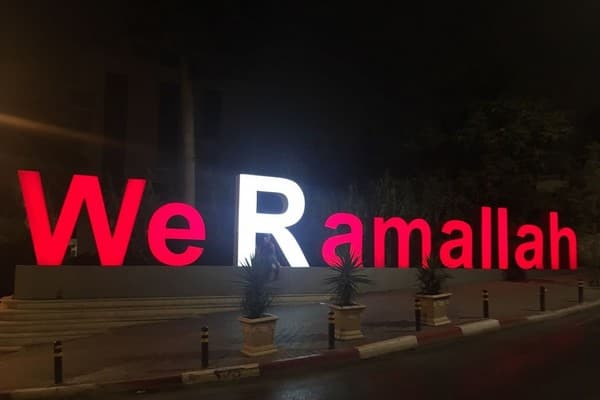
Ramallah at night (Lonely Planet)

Permits are usually only received hours before travel, as it will depend on the ongoing security assessment, I was told by young soldiers who answered the civil administration phone lines. I could picture them scrolling through Instagram with long manicured nails as I waited on hold.

Permits are provided for daytime hours only, so are not useful for dinner with colleagues or a wild night out. In fact, the permit serves as a kind of waiver that the State is not responsible if you get in trouble while in Area A.

Since there is no protection like protectzia (meaning that I had high-up contacts) I made sure a few key numbers were safely stored in my phone and overlooked the fact that I rarely had phone reception in Ramallah.

Uber just means my cousin’s friend or my friend’s cousin. 'It’s much cheaper,' my friend said, 'but maybe don’t speak in Hebrew'.

For the next year, I agreed only to travel in diplomatic vehicles that were able to pass through the Ofer checkpoint without being stopped. Holding my breath a little and preparing a backstory as we returned, I wondered what it would be like to face off with an 18-year-old soldier from my people. I was not Israeli enough to come up with a great excuse on the fly while intoxicated, but I was Australian enough to start slurring and oversharing.

Then I started to go more often, parking my car in French Hill in East Jerusalem, where a Palestinian taxi driver with yellow Israel license plates would pick me up. Yellow plates can travel on both sides – they’re gold. We would chat in basic Hebrew most of the way. Once my friend booked me an “Uber” driver, even though there’s no Uber.

Uber just meant my cousin’s friend or my friend’s cousin. "It’s much cheaper," my friend said, “but maybe don’t speak in Hebrew”. So yes, I got into a car with an unknown driver, likely untraceable and ignored the possible national implications of an Uber ride gone pear-shaped in the Palestinian heartland. I held my phone closely.

The author in front of a bullet-scarred street sign

Once inside the car I heard the driver humming to a song by the popular Israeli singer Eyal Golan, as he was listening to Hebrew radio. I relaxed and complained about new settlement building to ingratiate myself as we drove.

Ramallah has two kinds of nightlife. Walking around downtown in the evenings, you’ll find large families eating out and going for an evening stroll, maybe stopping for some yummy knaffe. They are dressed very smartly as they wander in and out of congested traffic on insufficient footpaths. Bereted police officers helped direct cars.

Road rules are something of a suggestion. It was crowded but not badly, and the shops were open late. Suspended between traditional and modern in everything from the architecture to fashion, Ramallah is far cleaner and more orderly than Jaffa, where I lived. When I spoke of gun violence in my neighbourhood, they were horrified. Apparently, I was from the slums compared to the people on God’s Hill.

The Jewish Independent

But it was late at night when the fun really began. It didn’t take long for me to become enamoured with a night out in Ramallah. As alcohol consumption increased, I was no longer concerned with what I wore, or how much attention I drew during very late nights. “I love coming to Ramallah – it’s like going overseas” I slurred at a party.

Ramallah is far cleaner and more orderly than Jaffa, where I lived. When I spoke of gun violence in my neighbourhood, they were horrified.

“We love coming to Tel Aviv” was the response I received from whoever I happened to be with dancing with. Ramallah nights were fun because the eating, drinking and dancing happened at the same place. If space didn’t allow, dancing moved onto chairs and tables.

Often the music was entirely in Arabic, and here is where I will make my only generalisation - Arabs know all the words to all their songs. Every one of them. Cavorting to tunes about Falastin (Arabic for Palestine and usually the only word I could pick up), I faked a few exotic moves. Everyone was super-friendly, affectionate and occasionally a bit handsy.

They called me Shushu, as Sharon (like Ariel Sharon) evoked difficult memories. With little Arabic but fully fluent in the international language of drunkenness, I moved with my friends from bar to bar, and the conversation moved from politics to sex, and the laughter got louder and louder.

I have a video of me singing Hallelujah over G&Ts and zaatar-flavoured popcorn. The nights almost always involved waiting for shawarma under fluorescent lights at 4am. Breakfast followed at 1pm, after some unrestful sleep.

It was late at night when the fun really began. As alcohol consumption increased, I was no longer concerned with what I wore. 'I love coming to Ramallah – it’s like going overseas', I slurred at a party.

For a non-alcoholic society, Palestinians sure have perfected the hangover breakfast. Eggs, chips, falafel and lafeh bread with sides of hummus and labneh. If only they had Berocca to wash it down with.

Journeying back to my car in Jerusalem took only about an hour but felt long and exposed, in the piercing light of day, driving through Kfar Aqab which technically is part of the Jerusalem municipality, but is behind the separation wall​ and therefore, not.

That means the roads are in terrible disrepair and there are no ascertainable building codes, with apartment towers being built window to window. But they can get them some golden licence plates.

When I returned home, I paused at the difference between those clean Ramallah streets and the littered laneways near my home in gentrified Jaffa. Jaffa residents - Arab and Jewish alike- are very proud of their city. But if they saw how tidy it was there up on God’s Hill, they might start feeling as if they are living in God’s rubbish bin.

Photo: Dancing in a Ramallah nightclub (Visit Palestine.tech)

You might also like
  • Australia to increase sanctions against West Bank settlements
    Deborah Stone
  • LGBT asylum seekers caught between Palestinian violence and Israeli bureaucracy
    Jarod Rhine-Davis
  • Israel is cementing its control over the West Bank and East Jerusalem while the world is distracted
    Martin Kear
logomark.67a07ee3
We believe in the free flow of information

Republish our articles for free, online or in print, by using our Creative Commons licence

You might also like

    Alerts over antisemitic threats and attacks in Europe and US

    TJI Wrap
    Copy of Politica Podcast Social Tiles (600 x 400 px)
    Israel Iran WarPodcastIsrael

    Politica – Israeli Politics Explained

    The Jewish Independent 1
    Australia’s Prime Minister Albanese Speaks After Bondi Shootings
    News

    What PM, Premier, Police say about Bondi antisemitic attack

    The Jewish Independent 1

About the author

Sharon Offenberger

Sharon Offenberger

Sharon Offenberger was raised in Melbourne and made aliyah in 2004. She spent over 15 years in various roles for the European Union, including managing the peacebuilding program, communications officer and spokesperson. She moved with her family in 2020 to Bellingen, NSW where she works as a writer and communications consultant.

More from the author

FeatureArts & Culture

Why we had to make Pita with Vegemite

Israel

The Contenders: a visual guide to Israel’s political blocs

OpinionIsrael

The film tells a hellish story but Tantura was my heaven

OpinionAustralia

Holocaust remembrance is different in regional Australia