Aa
  • Read, Watch, Listen
  • TJI Series
  • Community Action
  • Events
  • Zedi
Follow us and continue the conversation
  • LinkedIn
  • Instagram
  • FaceBook
  • X
  • YouTube
Test yourself with the TJI Quiz!

Adjust size of text

Aa

Follow us and continue the conversation

  • LinkedIn
  • Instagram
  • FaceBook
  • X
  • YouTube

Your saved articles

You haven't saved any articles

What are you looking for?

Original reporting, insightful analysis and diverse views, delivered straight to your inbox

  • LinkedIn
  • Instagram
  • FaceBook
  • X
  • YouTube
Your support fuels our mission to inform, entertain and inspire.

The Jewish Independent is bound by the Standards of Practice of the Australian Press Council. If you believe the Standards may have been breached, you may approach The Jewish Independent or make a complaint to the Australian Press Council in writing at www.presscouncil.org.au. The Council may also be contacted on 1800 025 712.

  • Our Story
  • Contact us
  • Our Team
  • Support us
  • Guidelines
  • Pitch your idea
  • Republishing us
  • Community Action
  • Our Awards
  • LinkedIn
  • Instagram
  • FaceBook
  • X
  • YouTube
Aboriginal FlagTorres Strait Islanders Flag

The Jewish Independent acknowledges Aboriginal and Torres Strait Islander peoples as the Traditional Owners and Custodians of Country throughout Australia. We pay our respects to Elders past and present, and strive to honour their rich history of storytelling in our work and mission.

© The Jewish Independent 2026All Rights Reserved
Website design and development by Your Creative, MelbourneTerms & ConditionsPrivacy Policy
HomeRead, Watch, ListenIsrael
AnalysisIsrael

Widespread destruction as IDF carries out large-scale operation in Hebron

A Palestinian attack prompted a widespread IDF operation, raising concerns that Israel is using collective punishment and displacement in the West Bank
Ben Lynfield
Print this
Hebron IDF destruction

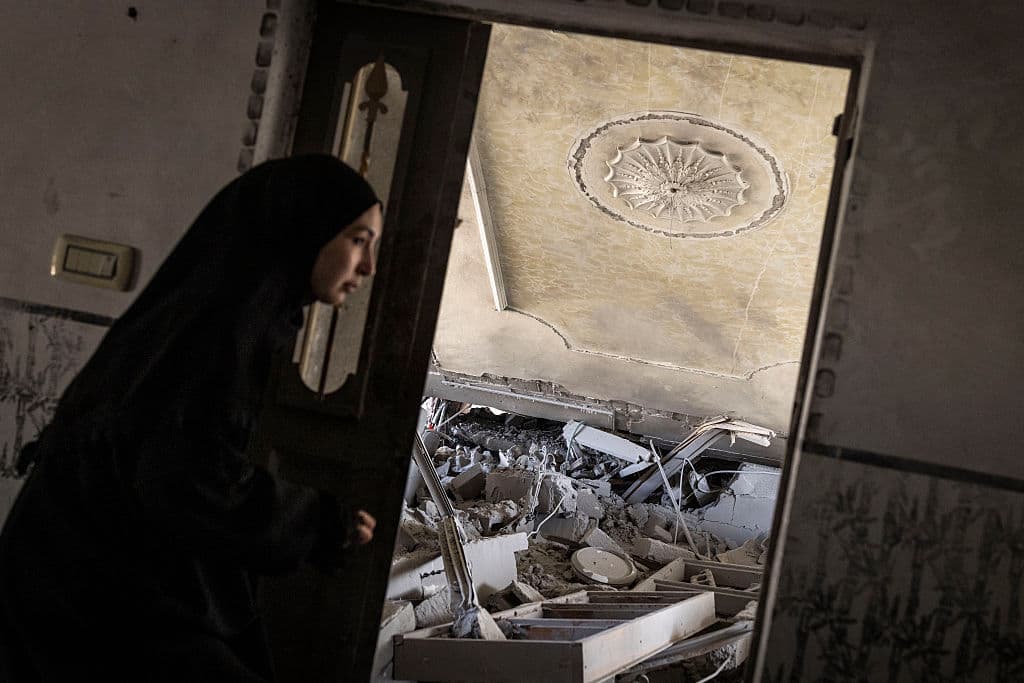
A young Palestinian woman inspects the damage inside an apartment that was blown up by Israeli forces in the Deir Baha area of Hebron (John Wessels/AFP via Getty Images)

Published: 5 November 2026

Last updated: 5 November 2026

While Israelis were distracted by the elections, the IDF mounted a massive operation in Hebron that may have dire implications for West Bank Palestinians.

It was the first time since October 7 that Israel has carried out mass displacement inside a West Bank city or in the southern part of the occupied territory.

The operation was sparked by a Palestinian attack at a checkpoint on October 23 that killed two soldiers and wounded three others. After the attack, Prime Minister Benjamin Netanyahu and Defense Minister Israel Katz showed up at the scene and vowed that the area that was home to the two assailants, both killed during their assault, would be destroyed.

At first, the action seemed like an appeal to the right-wing base days before the election. But in practice, the operation came to resemble the expulsions of Palestinians by the IDF in the northern part of the West Bank nearly two years ago.

UN Human Rights chief, Volker Türk, said the recent Hebron action raised serious concerns of ethnic cleansing

In fact, no one was killed because the IDF encountered no resistance. An estimated 3,300 people were forcibly displaced from their homes, but they were able to return when the operation ended after 11 days.

There was nothing there and the army knew there was nothing there

Hebron mayor Yousef Al-Jabari

Troops pulled out with little to show except the destruction and ill will they generated. Israeli soldiers destroyed 15 structures, including the homes of the two assailants, according to the Hebron municipality, which said the operation damaged 327 shops and businesses and disrupted schooling for 80,000 students.

The result for the residents of Hebron's Ein Deir Bahha and al-Jallada neighbourhoods was markedly different from the estimated 33,000 residents of three northern West Bank refugee camps who were expelled in January 2025 and have been barred from returning.

The same restrictions are now being applied in Gaza, where Palestinians are being pushed and concentrated into a shrinking area so that the IDF can control an expanding zone encompassing 70 per cent of the decimated coastal enclave.

“With no civilians and no civilian infrastructure, you can keep this military zone in a very secure and clean way,” Maj-Gen (retired) Giora Eiland, former head of Israel’s National Security Council, explained to The Jewish Independent. “If there is no civilian population there, you can build a line of positions and treat anyone coming there as a potential enemy.”

“A very similar approach is taken in Lebanon,” he said, referring to the fact that in the part of southern Lebanon occupied by the IDF, Shiite residents seen as cover for Hezbollah have been forced by the IDF to flee northwards, with their villages destroyed so they cannot come back.

The Hebron operation hints at pressure being intensified by the IDF against Palestinian civilians in the West Bank, where settler terrorism backed by the state and IDF is already wiping out herding communities in rural areas.

“What we saw in Hebron can take place anywhere, the army can do it in various places,” says Palestinian political analyst Jehad Harb. “With the Beduin communities, settler attack is the main means of expulsion. In Hebron, the army does it all with the collective punishment of an entire neighbourhood. In the future, the army can prevent return, and this becomes a way of forced migration from the area.”

Menachem Klein, emeritus professor of political science at Bar-Ilan University, discerns the same trajectory. “This was not mainly about the elections, it was an opportunity to continue the policy implemented in the northern West Bank,” Klein said. “You make a small step [of expulsion] now, and you look for the next opportunity to take a big step.”

The army said the operation was focused in the vicinity that was home to the two assailants and that Hamas wielded influence there. But troops did not uncover the infrastructure the IDF said it was looking for. Despite combing hundreds of homes, the yield was only four guns, according to Haaretz. The IDF spokesman said troops arrested dozens of suspects, while Hebron mayor Yousef Al-Jabari said 140 people were arrested and that most of those had been released.

“This is a civilian area, there was no firing, it’s just women and people living in their houses. There was nothing there, and the army knew there was nothing there,” Al-Jabari told The Jewish Independent.

In Al-Jabari’s view, the goals of the operation were “pressure on the people, collective punishment and election campaigning for Netanyahu.”

He said that the 3300 expelled people mostly stayed with relatives. “The municipality gave them food, nutrition and milk for children.”

“The Israelis don’t want Palestinians in Hebron or outside of Hebron,” he stressed, but then added: “The new government, whether it’s Eisenkot or Netanyahu, must believe in peace and coexistence.”

But Harb, the Ramallah analyst, argues that Israel is constantly expanding its collective punishments. “Now it’s more blatant and more severe. In the past, there were curfews to prevent movement, there were revocations of work permits of families and then of villages. Now the army is destabilising people’s lives by forcing them to leave their homes. Even one day disrupts the natural course of life. The longer it goes on, the longer the suffering. In the future, they won’t let people back.”

Harb said that Israel has learned from the Hebron operation that it can get away with long expulsions from cities. “They were checking the Palestinian reaction, and there were no demonstrations. And the international community was preoccupied with whether there would be a new war with Iran.”

Klein believes the far-right Netanyahu cabinet, if it continues in power, will take advantage of any opportunity to apply the Gaza model to the West Bank population in keeping with the avowed ideology of Religious Zionism party leader Bezalel Smotrich that the Palestinians must be decisively defeated. Smotrich has unveiled a plan to concentrate the Palestinians in disjointed enclaves on only 18 per cent of the West Bank.

“Deportation of the Gaza population out of the Strip did not work, so now you will have a 30 per cent concentration zone of Palestinians there. In the West Bank, you have a similar situation. Jordan is not ready to take in the Palestinians, and Israel does not want to destroy the peace treaty. So meanwhile you create a concentration zone.”

Even the advent of a government led by Yashar party leader Gadi Eisenkot would not necessarily move Israel away from harsh collective punishments and “concentration zones” in the West Bank, Klein argues.

“On the basis of the alternative coalition’s campaign, I do not expect a dramatic change,” Klein said. “Maybe things will be slower, and they will speak of a long-term strategy of coming to terms with a Palestinian entity. But in the campaign, they didn’t promote alternatives on a range of policies, including the Palestinian front.”

You might also like
  • Record spike in settler violence ahead of election
    Ben Lynfield
  • Synagogue and Jewish-owned shops damaged in French riots
    Ilan Bloom
  • A Gazan doctor’s journey of hope
    Deea Okasha
logomark.67a07ee3
We believe in the free flow of information

Republish our articles for free, online or in print, by using our Creative Commons licence

You might also like

    Gadi Eisenkot
    Israel Votes 2026EditorialIsrael

    Normality or Sparta: Israel’s choice could hardly be clearer

    The Jewish Independent 1
    Orly Erez-Likhovski at High Court
    InterviewIsrael

    Fighting for a better Israel 

    Peter Kohn
    Resilience
    AnalysisIsrael

    Traumatech Nation: How Israel became a mental health leader

    Maayan Hoffman

About the author

Ben Lynfield

Ben Lynfield

Ben Lynfield covered Israeli and Palestinian politics for The Independent and served as Middle Eastern affairs correspondent at The Jerusalem Post. He writes for publications in the region and has contributed to the Christian Science Monitor, Foreign Policy and the New Statesman.

More from the author

AnalysisIsrael

Historic step forward for Arab Israelis

Israel

Record spike in settler violence ahead of election

FeatureIsrael

Security fears and incitement drive young voters toward far-right

AnalysisIsrael

Terror plot to kill hundreds of Arab Israelis thwarted