Aa
  • Read, Watch, Listen
  • TJI Series
  • Community Action
  • Events
  • Zedi
Follow us and continue the conversation
  • LinkedIn
  • Instagram
  • FaceBook
  • X
  • YouTube
Test yourself with the TJI Quiz!

Adjust size of text

Aa

Follow us and continue the conversation

  • LinkedIn
  • Instagram
  • FaceBook
  • X
  • YouTube

Your saved articles

You haven't saved any articles

What are you looking for?

Original reporting, insightful analysis and diverse views, delivered straight to your inbox

  • LinkedIn
  • Instagram
  • FaceBook
  • X
  • YouTube
Your support fuels our mission to inform, entertain and inspire.

The Jewish Independent is bound by the Standards of Practice of the Australian Press Council. If you believe the Standards may have been breached, you may approach The Jewish Independent or make a complaint to the Australian Press Council in writing at www.presscouncil.org.au. The Council may also be contacted on 1800 025 712.

  • Our Story
  • Contact us
  • Our Team
  • Support us
  • Guidelines
  • Pitch your idea
  • Republishing us
  • Community Action
  • Our Awards
  • LinkedIn
  • Instagram
  • FaceBook
  • X
  • YouTube
Aboriginal FlagTorres Strait Islanders Flag

The Jewish Independent acknowledges Aboriginal and Torres Strait Islander peoples as the Traditional Owners and Custodians of Country throughout Australia. We pay our respects to Elders past and present, and strive to honour their rich history of storytelling in our work and mission.

© The Jewish Independent 2026All Rights Reserved
Website design and development by Your Creative, MelbourneTerms & ConditionsPrivacy Policy
HomeRead, Watch, ListenIsrael
Israel Votes 2026AnalysisIsrael

Historic step forward for Arab Israelis

Arab citizens achieved a record number of seats at Israel's election, significantly reducing Netanyahu's chances of forming a government
Ben Lynfield
Print this
Arab election joint list

Supporters of Israel’s Arab-led Joint List political alliance cheer at the alliance’s campaign headquarters in Nazareth as election results come in (Ahmad Gharabli/AFP via Getty Images)

Published: 29 October 2026

Last updated: 30 October 2026

Arab citizens used their ballots during Israel’s election Tuesday to strike back against four years of spiralling discrimination by the Netanyahu government, stunning even themselves by electing a record number of representatives to the Knesset.

With most of the votes counted Wednesday, the two Arab lists – the Joint List and Ra’am – were projected to add up to 19 seats in the 120-member Knesset, compared to 10 for Arab parties during the last election in 2022. The results were seen by many as a historic step forward for the minority, which makes up a fifth of the country’s population and has suffered from an increase in anti-Arab racism since October 7, 2023.

But it was uncertain the impressive advance could be translated into commensurate political power given the stated refusal of Gadi Eisenkot and most Zionist opposition leaders to rely in any way on Arab parties. It is even possible Eisenkot could strike a deal with Netanyahu to form an all Zionist National Unity government, rather than go into coalition with the Arab parties.

Still, analysts said the Arab vote had greatly reduced Netanyahu’s chances to form the next government and, in the sweetest part of the election for many Arabs, effectively removed the extremist national security minister Itamar Ben-Gvir and his Jewish Power party.

“This is very big,” said Hitam Waked, a member of the directorate of the Histadrut Labour Union. Waked has personal experience of the difficulties Arab Israelis have faced in recent years: she says she was dismissed from her job after she posted a call on social media to end the Gaza war.

Waked spoke to The Jewish Independent at the headquarters of the Joint List, the largest Arab political grouping, after news came that it had reached 12 seats, two more than the most optimistic predictions. Ra’am tallied seven seats according to projections. As the news came, she was visibly moved.

“Now I understand that the Holy One Blessed Be He understands what we have been through during these years of outrages and oppressions and very difficult lives. In every place they pursued us, in every place. We have been through a different kind of war. They oppressed us everywhere to cause us to immigrate. We hope this result will bring us a little security.”

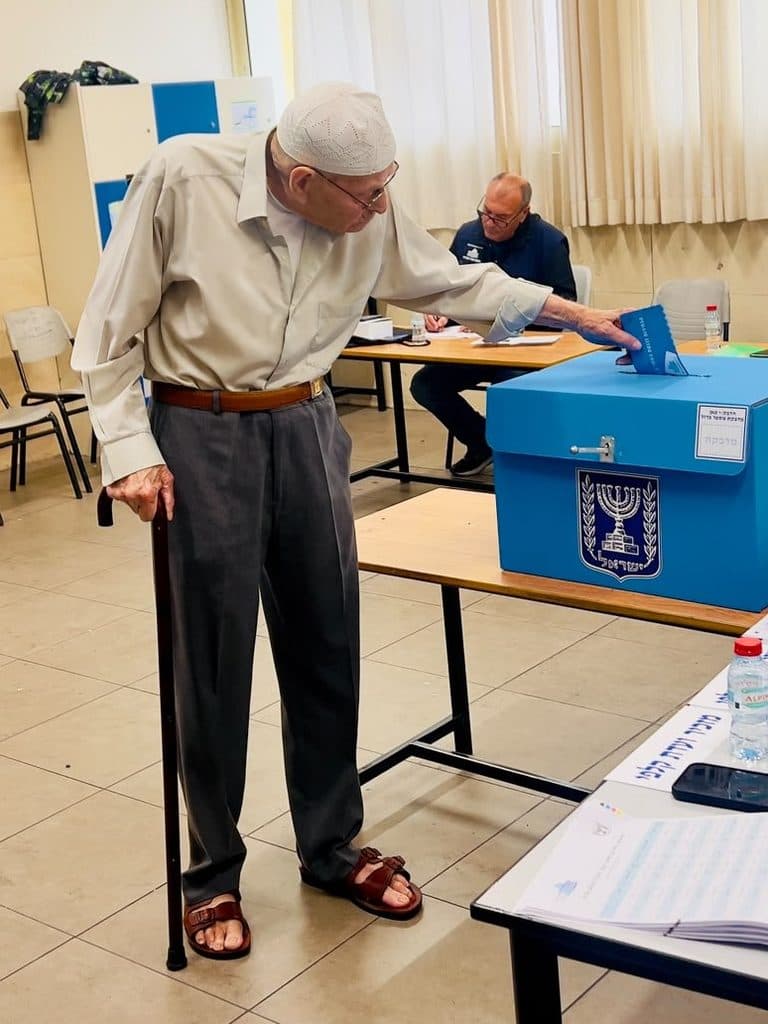
Earlier, at the polling station at Sharq school in Nazareth, a hunched elderly woman supported by a relative waited to vote, and a 97-year-old man with a cane inserted his sealed envelope in the blue ballot box. They were part of what turned out to be the highest Arab turnout since 1999.

Given the tensions of the day, the atmosphere at the Nazereth polling station was surprisingly relaxed: coffee was offered at a picnic table, and young children scampered and laughed nearby.

A 97-year-old Arab voter casts his ballot in Nazareth (Suha Salman-Mousa)

The voting at the school was not without glitches. The ballot slips from which voters chose were only in Hebrew letters, without Arabic even for the Arab parties. The Central Elections Committee brought in the proper slips after a complaint.

The push to turn out the Arab vote was strong. Volunteers from the Jewish-Arab group Standing Together, flagged cars near the Basilica of the Annunciation to ensure their drivers stopped to vote.

For Arab voters, the key motivation was to stop the return of Benjamin Netanyahu and his Religious Zionist coalition partners, Itamar Ben-Gvir and Bezalel Smotrich, to protect their relatives in the West Bank and Gaza from increased violence.

There are also strong concerns about rampant violence and organised crime in Arab areas, Israeli authorities demolishing homes in East Jerusalem in record numbers, and threats by Smotrich to “Judaize” the Galilee.

“This is definitely the most important election in my lifetime,” said Suha Salman-Mousa, director of the Mossawa Center, an NGO that promotes equality for Arab citizens. She was on the watch at the school for any irregularities. “If Netanyahu forms the government, it will be way more extreme than today,” she said.

She fears another Netanyahu term would be characterised by heightened incitement, more home demolitions, and a further shrinking of freedom of expression. “The biggest concern is the rise in organised crime. [National Security Minister] Ben Gvir is doing nothing to stop this.” Salman-Mousa is also worried about a restart of the war with Iran and a further increase in West Bank settler violence.

“If Eisenkot forms the government, the first positive thing is that Netanyahu will lose power and control, as will those around him,” she said.

Ben-Gvir ratcheted up his incitement against Arab citizens during the election campaign. Netanyahu also weighed in on election day with a dire warning about long lines at polling stations in Arab areas. The Arabs were about to take over the country, he implied in a bid to stir up the base.

Those gathered at the modest Joint List headquarters Tuesday night included overseas Arab citizens, who, like Jewish counterparts, had returned from abroad to vote. People were optimistic because they knew turnout had been high. But they were not prepared for the very robust showing they would soon find out from the exit polls to be shown on large screens.

At 10pm the hall fell silent, but not for long. When the screens showed that the Joint List was projected for 12 seats and Ra’am was en route to seven, it erupted into rhythmic clapping, ululating and whistling. “Ben-Gvir Go Home”, the list’s supporters repeatedly shouted. The list’s Knesset members clasped hands and danced. Then the chants celebrating Ben-Gvir’s setback switched to Arabic.

Well aware that Jewish Israelis would be closely watching the Joint List, which includes left-wing Jewish legislator Ofer Kassif, the group’s head, Yousef Jabareen, chose Israel Channel 13 for his first interview. He also made separate remarks in Hebrew. “The Joint List is a large and powerful list that cannot be ignored in any political scenarios,” he said.

However, Ahmed Tibi, another senior Joint List leader, struck a less certain tone than Jabareen during an interview with Army Radio Wednesday. “We extend a hand to everyone who wants to change the realities, to bring down the government and to pave the way for an alternative government,” he said. “The question is whether there is an arm extended by the other side.”

Salim Brake, a political scientist at the Open University, believes Israeli politics and society are so “torn up” that it will be impossible to maintain a stable government for long and that there will be a need for another election. In his analysis, Eisenkot will not budge from his refusal to depend on Arab parties.

“He will get support from Arab members of Knesset, but he cannot run for election another time with such a government because this will destroy his chances.” Brake explained that Naftali Bennett, prime minister under a government that briefly ousted Netanyahu, lost substantial support for including in his coalition Mansour Abbas, the head of Ra’am.

“Depending on Arabs is dangerous in terms of Jewish public opinion,” Brake said. “There is very strong racism against Arabs here.” 

You might also like
  • Israel’s election fails to deliver a clear path to a government
    Shahar Burla
  • Normality or Sparta: Israel’s choice could hardly be clearer
    The Jewish Independent
  • Fighting for a better Israel 
    Peter Kohn
logomark.67a07ee3
We believe in the free flow of information

Republish our articles for free, online or in print, by using our Creative Commons licence

You might also like

    Young Israelis
    Israel Votes 2026FeatureIsrael

    Security fears and incitement drive young voters toward far-right

    Ben Lynfield 1
    Israel cabinet knesset
    Israel Votes 2026Israel

    Where are the women in this election campaign?

    Eetta Prince-Gibson
    U.S. President Donald Trump speaks with Israel's Prime Minister Benjamin Netanyahu in the Knesset
    Israel Votes 2026AnalysisIsrael

    Do Israelis care that Trump has endorsed Netanyahu?

    Ruth Eglash

About the author

Ben Lynfield

Ben Lynfield

Ben Lynfield covered Israeli and Palestinian politics for The Independent and served as Middle Eastern affairs correspondent at The Jerusalem Post. He writes for publications in the region and has contributed to the Christian Science Monitor, Foreign Policy and the New Statesman.

More from the author

Israel

Record spike in settler violence ahead of election

FeatureIsrael

Security fears and incitement drive young voters toward far-right

AnalysisIsrael

Terror plot to kill hundreds of Arab Israelis thwarted