Aa
  • Read, Watch, Listen
  • TJI Series
  • Community Action
  • Events
  • Zedi
Follow us and continue the conversation
  • LinkedIn
  • Instagram
  • FaceBook
  • X
  • YouTube
Test yourself with the TJI Quiz!

Adjust size of text

Aa

Follow us and continue the conversation

  • LinkedIn
  • Instagram
  • FaceBook
  • X
  • YouTube

Your saved articles

You haven't saved any articles

What are you looking for?

Original reporting, insightful analysis and diverse views, delivered straight to your inbox

  • LinkedIn
  • Instagram
  • FaceBook
  • X
  • YouTube
Your support fuels our mission to inform, entertain and inspire.

The Jewish Independent is bound by the Standards of Practice of the Australian Press Council. If you believe the Standards may have been breached, you may approach The Jewish Independent or make a complaint to the Australian Press Council in writing at www.presscouncil.org.au. The Council may also be contacted on 1800 025 712.

  • Our Story
  • Contact us
  • Our Team
  • Support us
  • Guidelines
  • Pitch your idea
  • Republishing us
  • Community Action
  • Our Awards
  • LinkedIn
  • Instagram
  • FaceBook
  • X
  • YouTube
Aboriginal FlagTorres Strait Islanders Flag

The Jewish Independent acknowledges Aboriginal and Torres Strait Islander peoples as the Traditional Owners and Custodians of Country throughout Australia. We pay our respects to Elders past and present, and strive to honour their rich history of storytelling in our work and mission.

© The Jewish Independent 2026All Rights Reserved
Website design and development by Your Creative, MelbourneTerms & ConditionsPrivacy Policy
HomeRead, Watch, ListenAustralia
AnalysisAustralia

The evidence gap: how do we know what works in antisemitism education?

We know what feels good to teach, but we don't know much about whether it changes behaviour. Educators have been unclear about what they are trying to achieve, and how to measure success
Andrew Jakubowicz
Print this
SJM education students

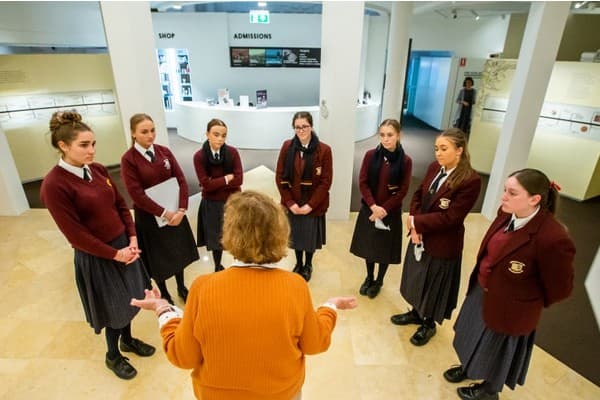
Student education at the Sydney Jewish Museum (courtesy SJM)

Published: 29 July 2026

Last updated: 31 July 2026

What can we pin down about what works in education to reduce antisemitism and build social cohesion? What does evidence, rather than ideology, illuminate?

The (Gonski) Antisemitism Education Taskforce was part of the package adopted by the Federal Government after the Bondi murders in December 2025. No one claimed then that education would have prevented the two gunmen from acting as they did, nor would it have stopped the Australian gunman who carried out the Christchurch mosque shootings some years earlier.

Rather, the government package reacted to the mixture of fury, fear and frustration expressed by Jewish community members and their spokespeople at what they identified as the failure of governments to adequately address the rising level of antisemitism. This took the form of behaviours in the real world, such as synagogue attacks, physical and verbal harassment, anti-Israel demonstrations, graffiti in Jewish neighbourhoods, and intimidation on the streets and in universities, especially of Jewish young people.

It also included behaviour in the online world: doxxing, the weaponisation of cancel culture, the spreading of disinformation and misinformation, one-sided or inflammatory coverage in parts of the media, and an explosion in conspiracy theories, which merged political criticism of Israel with traditional antisemitic tropes to create poisoned pools of online interaction.

Now the Federal Government has responded to the Islamophobia envoy’s report, A National Response to Islamophobia – which also has major recommendations on education. Drawing on the recommendations of the Human Rights Commission study of racism at universities, it is moving to a common educational strategy that engages all racisms, including those directed at First Nations, as well as antisemitism and Islamophobia, not forgetting the racism and xenophobia encountered by Australians from all over the non-British world. Experiences from the Jewish community can help inform all of these challenges.

What we think we know

Frankly, there is not much evidence about what works in the educational realm to reduce the extent and impact of that constellation of elements making up the universe of antisemitism. A German study earlier this year reviewed nearly 4,000 studies worldwide, of which only six used evaluation methods to empirically test for outcomes that reduced antisemitism.

Australia has been well served with documentation of the prevalence of antisemitism, even if definitional issues have somewhat overwhelmed practical implementation and have so far apparently precluded any serious evaluation of the longer-term impact of interventions.

Put simply, we know what feels good to declaim; we don't know much about what works. In part, this is because we have not been clear about what we are trying to achieve, and even less clear about how we would know if it was actually being achieved. In practice, the measure most often used seems to be the rate of complaints made by affected Jewish people.

This gap in our knowledge underpins calls for the prohibition of certain kinds of content, calls that are sometimes made with little tolerance for dissent. Policies are enunciated, but there is no evidence that Jewish participants in educational institutions are experiencing reductions in their fear, fury or frustration as a consequence. Nor, at the sharp end of what speech should be protected and what should be prohibited, is there any overarching agreement – within the Jewish community, let alone more widely – on how to navigate that intersection.

For the university sector, the Human Rights Commission's Respect at Uni report reached an important insight: that what is needed is both a widespread grounding in antiracist understanding and behaviour, and community-specific programs, which engage with the lived experience of targeted communities, alongside strategies to build bridges between all Australians.

The evaluations of emotional and attitude change among student participants, undertaken by Together for Humanity, the largest school program of its kind, reached similar conclusions. The emphasis in both is on knowledge built through engagement with different others – sharing lived experience across boundaries.

Blueprint Institute's 2024 survey of 510 public school staff concluded that programs should identify geographic hotspots through better data, match locally chosen interventions to those hotspots, and have the Federal Government track and counter the disinformation campaigns feeding the problem online. It is a prevalence study, not an evaluation – a distinction worth holding onto, since so much of this field mistakes the first for the second.

What actually holds up

The strongest finding in this whole area comes from outside antisemitism research specifically. A meta-analysis of 515 studies found that structured contact with a group you hold a prejudice against reliably reduces the prejudice.

The Gandel Holocaust Knowledge and Awareness in Australia Survey 2021, run by Deakin University researchers across 3,522 Australians, found that people with higher Holocaust awareness also held warmer views towards Muslims, Hindus, Buddhists, asylum seekers and First Nations Australians. Knowledge came mainly from specific school courses and museum visits, not from education levels generally, and only one Australian in 10 had ever visited a Holocaust museum.

That would make antisemitism education part of the civic infrastructure of our whole multicultural country, aimed at everyone, including the many schools that will tell you they have no Jewish students and therefore no problem to solve.

Monocultural schools are most likely to harbour prejudicial attitudes towards others, unless these challenges have been specifically identified and addressed. The Social Cohesion Education Hub, launched in late June 2026, contains over 50 projects.

As yet, the Hub does not include information that suggests any of them have been evaluated, although the Federal Government has flagged this hub as a potential resource for wider antiracism education.

Some basic guard rails

Decades of research and practice with both Jewish and non-Jewish young people, updated to reflect the growing body of institutional and legal experience since 2023, indicate:

• Humanise before historicise. Establish Jewish humanity, culture, and diversity before engaging with persecution and genocide. Don't introduce Jews as perennial victims. Students who encounter Jewish people as fully human before encountering them as victims develop more durable empathy. Use the same approach when engaging with non-Jewish cultures and peoples.

• Connect past to present. Every effective program explicitly maps historical forms of antisemitism onto their contemporary manifestations. Leaving this connection implicit is one of the most common and consequential failures in Holocaust education.

• Prioritise structured empathy over information delivery. Perspective-taking, testimony, equal-status contact, and imagined contact consistently outperform factual instruction alone in producing attitudinal change.

• Pre-bunk rather than debunk. Teaching the logic and mechanics of conspiracy and hate speech before students encounter it is more effective and safer than reactive refutation.

• Sustain and mandate. Single events do not produce durable change. Effective programs are curriculum-integrated, repeated across year levels, and mandated rather than optional.

• Separate speech from conduct. The most defensible institutional policies regulate harassment, intimidation, and obstruction – not political viewpoint or claimed knowledge – and apply those rules consistently regardless of which side of a debate a person is on.

• Evaluate rigorously. The greatest single gap in the field remains the absence of systematic outcome evaluation. Practitioners should build assessment of attitudinal and behavioural change into program design, not treat it as an afterthought.

• Partner with communities. Programs co-designed with Jewish community organisations – and, where relevant, Christian, Palestinian and Muslim community organisations on the free-speech dimension – are more accurate, more responsive to contemporary concerns, and better received than externally designed curricula.

You might also like
  • Confronting Richard Flanagan and the myth of the Israel lobby
    Mary Garden
  • Facing a new year with the knowledge life can be better
    The Jewish Independent
  • Court decision fails to understand when ‘Fuk Israel’ becomes antisemitic
    Jeremie Bracka
logomark.67a07ee3
We believe in the free flow of information

Republish our articles for free, online or in print, by using our Creative Commons licence

You might also like

    Royal Commission final
    Royal CommissionNewsAustralia

    Strategies for cohesion final focus of Royal Commission hearings

    Peter Kohn 1
    Albanese Bondi
    Royal CommissionAnalysisAustralia

    Prime minister’s absence exposes weakness in Royal Commission hearings

    Michael Visontay
    Generation Change: Rachel Moshel
    Generation ChangeInterviewArts & Culture

    Rachel Moshel: Creating a space for Jewish art and joy

    Gideon Cohen

About the author

Andrew Jakubowicz

Andrew Jakubowicz

Andrew Jakubowicz is Emeritus Professor of Sociology at the University of Technology Sydney. He is a participant in the Antisemitism Task Force Stakeholder groups; this article emerged from his work on preparing for those discussions.

More from the author

AnalysisAustralia

Relationships, not rules: beyond social cohesion to genuine multiculturalism

ReviewArts & Culture

Smugglers, racketeers, prostitutes? No, my family, fresh from Shanghai

Comments

No comments on this article yet. Be the first to add your thoughts.