Aa
  • Read, Watch, Listen
  • TJI Series
  • Community Action
  • Events
  • Zedi
Follow us and continue the conversation
  • LinkedIn
  • Instagram
  • FaceBook
  • X
  • YouTube
Test yourself with the TJI Quiz!

Adjust size of text

Aa

Follow us and continue the conversation

  • LinkedIn
  • Instagram
  • FaceBook
  • X
  • YouTube

Your saved articles

You haven't saved any articles

What are you looking for?

Original reporting, insightful analysis and diverse views, delivered straight to your inbox

  • LinkedIn
  • Instagram
  • FaceBook
  • X
  • YouTube
Your support fuels our mission to inform, entertain and inspire.

The Jewish Independent is bound by the Standards of Practice of the Australian Press Council. If you believe the Standards may have been breached, you may approach The Jewish Independent or make a complaint to the Australian Press Council in writing at www.presscouncil.org.au. The Council may also be contacted on 1800 025 712.

  • Our Story
  • Contact us
  • Our Team
  • Support us
  • Guidelines
  • Pitch your idea
  • Republishing us
  • Community Action
  • Our Awards
  • LinkedIn
  • Instagram
  • FaceBook
  • X
  • YouTube
Aboriginal FlagTorres Strait Islanders Flag

The Jewish Independent acknowledges Aboriginal and Torres Strait Islander peoples as the Traditional Owners and Custodians of Country throughout Australia. We pay our respects to Elders past and present, and strive to honour their rich history of storytelling in our work and mission.

© The Jewish Independent 2026All Rights Reserved
Website design and development by Your Creative, MelbourneTerms & ConditionsPrivacy Policy
HomeRead, Watch, ListenAustralia
AnalysisAustralia

Australia never convicted a Nazi but the investigations were not a waste 

A new book assesses the legacy of the Special Investigations Unit which investigated Nazis who found refuge in Australia.
Graham Blewitt
Print this
montage of newspaper clippings

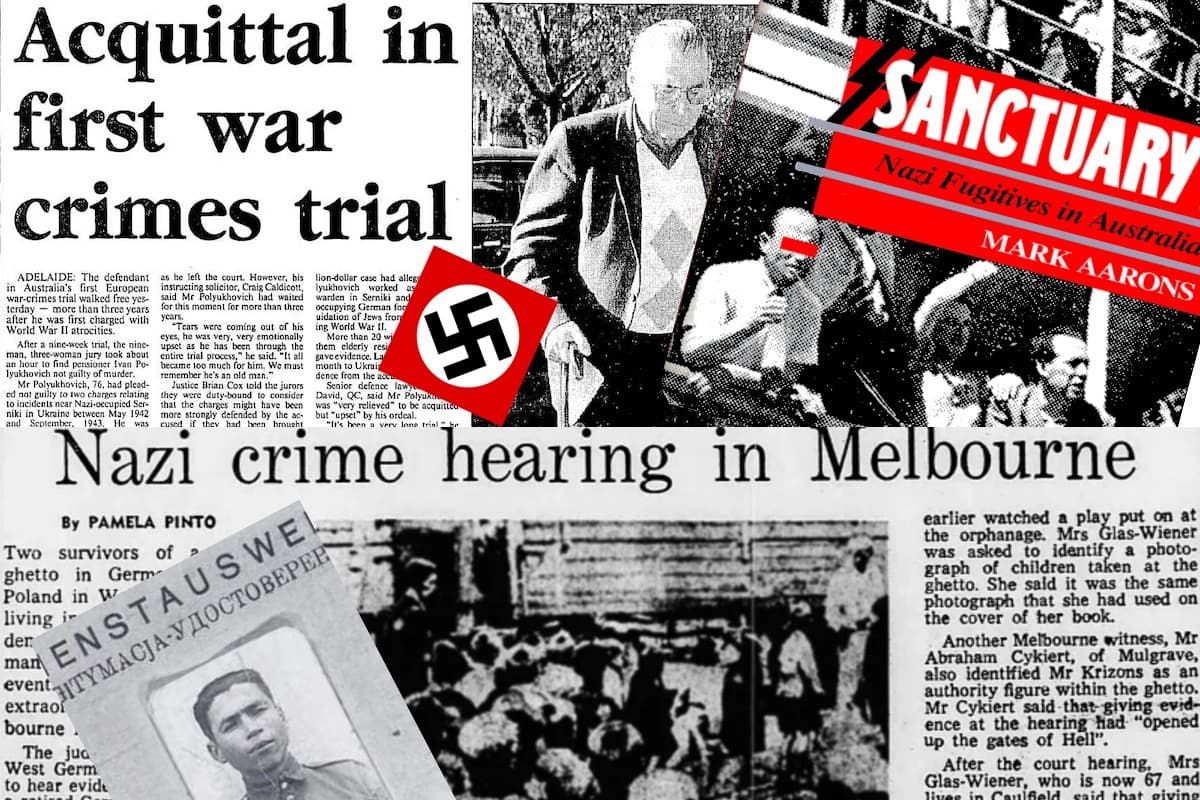
The Special Investigations Unit investigated Nazis in Australia but never achieved a conviction. (Montage TJI)

Published: 19 August 2025

Last updated: 20 August 2025

 On numerous occasions I have been confronted with the argument that the Special Investigations Unit (SIU) was a waste of time, effort and money because no convictions were recorded as a result of its work. 

If the number of convictions was the only barometer to gauge the success of the SIU, then it was less than successful, but this is an oversimplified way to judge the importance and impact of the initiative. Such an approach is not the proper test. 

The SIU clearly established that it was possible to investigate crimes committed on the other side of the world over forty-five years beforehand. It also established that it was possible to gather sufficient evidence to bring criminal prosecutions in this country, in the ordinary Australian criminal courts, and for such cases to be presented before a jury. 

In doing so, it also established the feasibility of undertaking historical research in archives throughout the world, many of which had never been visited by Western historians. The unit was able to negotiate an agreement with the Soviet Union to allow Soviet citizens to travel outside the USSR to testify in Australia – a world first. The SIU also demonstrated its ability to undertake exhumations, recovering over a thousand bodies, victims of the Nazi genocide in Ukraine. 

There was a time when Nazi collaborators living in Australia were wondering when the SIU knock on the door would come

Most importantly, the SIU developed the skills and experience of those involved in the process, paving the way for them to participate in other war crimes tribunals.  

With a degree of bias, I would say the SIU was a tremendous success despite the lack of courtroom convictions. On the question of convictions, too, I have no doubt that the Wagner case was the strongest of the three cases commenced by the unit. Had it gone to trial, it would surely have resulted in a conviction. Similarly, if the case of Karlis Ozols had not been stymied by the federal government, it would have been a landmark prosecution of a major Nazi war criminal who took refuge in this country.  
For these reasons, I am of the firm opinion that the SIU was neither a failure nor a waste of time and money. Australia should be proud that, for a brief period in our legal history, we stood up and did the right thing. There was a time when Nazi collaborators living in Australia were wondering when the SIU knock on the door would come.  

To this day, it remains my firm opinion that it is incumbent on the Australian government to create a permanent independent, fully staffed and funded war crimes unit in this country to investigate all war criminals living here, regardless of where their crimes were committed. This would ensure that the expertise and institutional knowledge developed by the staff of such a unit would not be dispersed and evaporate, as was the case with the SIU/WCPSU. 

In this regard, I still endorse the recommendations made in the final SIU report to government. These include:  

  1. That the provisions of the War Crimes Act 1945, as amended, be extended to include war crimes and crimes against humanity whenever and wherever committed by persons who are or who become Australian citizens or residents.  
     
    It is difficult to see any justification for continuing to confine the operation of the Act to war crimes committed in Europe during the Second World War. The number and scope of armed conflicts in the world since 1945 together with the fact that Australian immigrants are drawn from a multitude of nationalities indicate that, despite immigration screening procedures, alleged war criminals from other theatres of war will have entered Australia. 
  1. That the Government establishes a permanent war crimes unit, similar to the SIU, to enforce the expanded operation of the war crimes legislation. From the experiences of the SIU it has been demonstrated that a dedicated organisation, with investigative, historical, legal and other technical skills, is required to undertake the unique task of war crimes investigations.  
     
    The task of the war crimes unit would be to carry out investigations into specific allegations of war criminals living in Australia. Further, the unit would perform a pro-active role in cooperating with organisations throughout the world to identify war criminals, to prevent such persons entering Australia and to take appropriate action in cases where alleged war criminals have entered Australia. 
  1. That the Government raises and supports in the United Nations the creation of a permanent international tribunal with jurisdiction to try war crimes and crimes against humanity. 
  1. That the Government makes a clear policy statement regarding its determination to prevent persons involved in war crimes or crimes against humanity from seeking refuge in Australia.  Consistent with this statement it is also recommended that the Government ensure that immigrants entering Australia are sufficiently screened to prevent the entry of persons involved in such crimes.  
     
    To assist this process it is recommended that the Government pass or amend appropriate legislation requiring prospective immigrants to declare in writing that they have never been involved in war crimes or crimes against humanity. Further they should be notified in writing that in the event such declaration be proved false, then in addition to any appropriate action that may be taken in respect of prosecutions for such crimes, either in Australia or in the country where they were committed, deportation from Australia for making such false statement may result. 
     
    In respect of persons seeking to receive Australian citizenship, they should be required to make similar declarations and to acknowledge that revocation of citizenship may result from a proven false declaration, in addition to any other action that may be taken. 
  1. That the Government takes steps to honour its obligations under the Convention on the Prevention and Punishment of the Crime of Genocide by making genocide a crime, and punishable as such, in Australia.  

This article is extracted from Nazis in Australia: The Special Investigations Unit, 1987–1994, edited by Mark Aarons and Graham Blewitt and published by BlackInc.

Nazis in Australia is a new book which assesses the work of the Special Investigations Unit (Image: supplied).
You might also like
  • Confronting Richard Flanagan and the myth of the Israel lobby
    Mary Garden
  • Facing a new year with the knowledge life can be better
    The Jewish Independent
  • No action to stop Hezbollah ally beaming antisemitic and anti-Israel content into Australia
    Michael Visontay
logomark.67a07ee3
We believe in the free flow of information

Republish our articles for free, online or in print, by using our Creative Commons licence

You might also like

    Tame
    Australia

    Tame apologises – but with little grace

    Deborah Stone
    Royal Commission final
    Royal CommissionNewsAustralia

    Strategies for cohesion final focus of Royal Commission hearings

    Peter Kohn 1
    Beinart Doogue 600
    Israel Hamas WarNewsAustralia

    Beinart takes a wrecking ball to Israel

    Michael Visontay 1

About the author

Graham Blewitt

Graham Blewitt

Graham Blewitt AM was a public prosecutor and National Crime Authority (Australia) officer, the Special Investigations Unit deputy director (1988–1991) and director (April 1991–June 1992), and the head of the War Crimes Prosecution Support Unit (Australia) (1992–1994). He was later the deputy prosecutor for the International Criminal Tribunal for the former Yugoslavia in The Hague.

Comments1

  • Avatar of Howard Nathan

    Howard Nathan19 August at 08:33 am

    We became a shelter for avowed and ofter unknown, anti-Communists. At that time the Immig Dept was under the spell of rampant anti Com. civil servants. Funtioning in response to the infiltration of what is now DFAT. by so-called Com-Sympats. The Com technique was to keep in place at the top of the dept tree, the Anglo-Celt hierarchs,. But have them served by Com Party implants whose memo’s offered alternatives, but really only one option. All on both sides now swept away by a better educated and tolerant civil service.