Aa
  • Read, Watch, Listen
  • TJI Series
  • Community Action
  • Events
  • Zedi
Follow us and continue the conversation
  • LinkedIn
  • Instagram
  • FaceBook
  • X
  • YouTube
Test yourself with the TJI Quiz!

Adjust size of text

Aa

Follow us and continue the conversation

  • LinkedIn
  • Instagram
  • FaceBook
  • X
  • YouTube

Your saved articles

You haven't saved any articles

What are you looking for?

Original reporting, insightful analysis and diverse views, delivered straight to your inbox

  • LinkedIn
  • Instagram
  • FaceBook
  • X
  • YouTube
Your support fuels our mission to inform, entertain and inspire.

The Jewish Independent is bound by the Standards of Practice of the Australian Press Council. If you believe the Standards may have been breached, you may approach The Jewish Independent or make a complaint to the Australian Press Council in writing at www.presscouncil.org.au. The Council may also be contacted on 1800 025 712.

  • Our Story
  • Contact us
  • Our Team
  • Support us
  • Guidelines
  • Pitch your idea
  • Republishing us
  • Community Action
  • Our Awards
  • LinkedIn
  • Instagram
  • FaceBook
  • X
  • YouTube
Aboriginal FlagTorres Strait Islanders Flag

The Jewish Independent acknowledges Aboriginal and Torres Strait Islander peoples as the Traditional Owners and Custodians of Country throughout Australia. We pay our respects to Elders past and present, and strive to honour their rich history of storytelling in our work and mission.

© The Jewish Independent 2026All Rights Reserved
Website design and development by Your Creative, MelbourneTerms & ConditionsPrivacy Policy
HomeRead, Watch, ListenAustralia
DebateAustraliaIsrael

Sanctions must influence, not just perform disapproval

There are three key questions which Australia should ask before joining the international rush to sanction West Bank settlements
Adam Slonim
Print this
Penny Wong

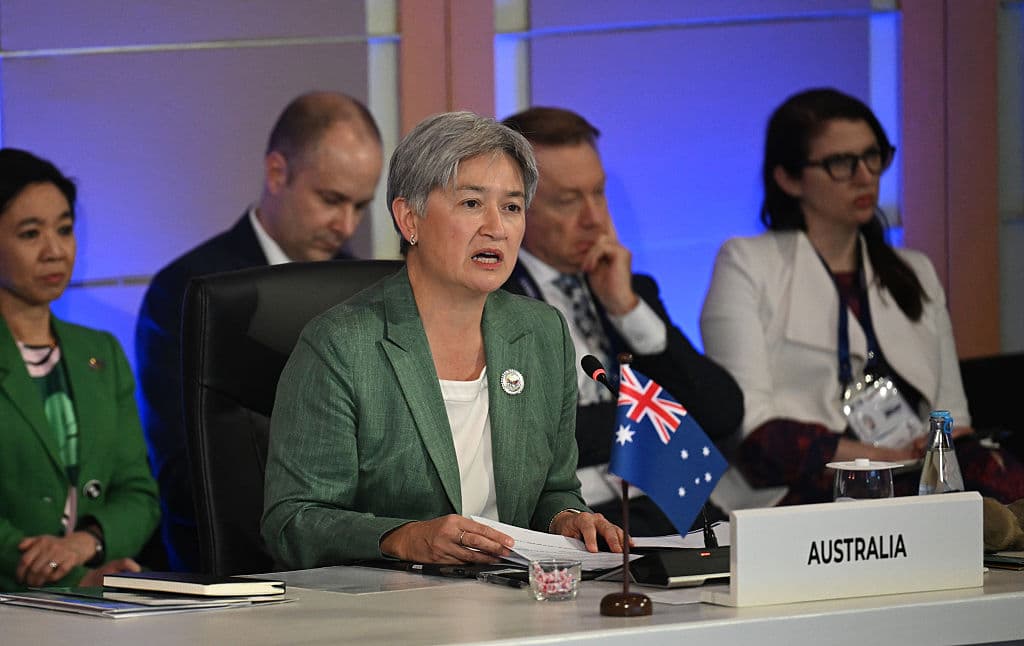
Australia’s Foreign Minister Penny Wong speaks during the ASEAN Post-Ministerial Conference (Ted Aljibe – Pool/Getty Images)

Published: 15 September 2026

Last updated: 15 September 2026

Sanctions have acquired the moral glamour of action. They allow a government to demonstrate that it has heard the outrage, identified the offender and imposed a price. The announcement is made. The names are published. The virtue is visible.

Whether anything changes is a more difficult question.

Australian Foreign Minister Penny Wong has confirmed that Australia is considering further targeted sanctions intended to deter Israeli settlement expansion and violence in the West Bank. Wisely, she has declined to follow Britain, France and Canada into a blanket prohibition on trade connected with Israeli settlements. The proposed Australian targets have not yet been publicly identified. That distinction between carefully directed sanctions and the wider punishment of a country is not merely technical. It should be the centre of the debate.

There should be no indulgence toward violent West Bank Jewish extremists. Palestinians have been attacked, intimidated and driven from their homes by extremists who too often appear confident that the state will not restrain them. Australians who support Israel should be able to say this without qualification or embarrassment. Friendship does not require silence.

Australia has already sanctioned Israeli ministers Itamar Ben-Gvir and Bezalel Smotrich, together with Britain, Canada, New Zealand and Norway, over what the governments described as incitement of violence against Palestinians. If credible evidence points to additional individuals or organisations, Australia has every right to act. Those who commit violence, finance it or organise it should face personal consequences.

But sanctions should be an instrument, not an emotion.

Before imposing them, the Australian government should answer three questions. What precise behaviour is Australia trying to change? Who will actually bear the cost? And what Australian interest might be damaged in return?

Australia is better served by an Israel kept close enough to influence than by an Israel pushed further into isolation

Targeted sanctions can meet those tests. Travel bans and asset freezes imposed upon identifiable perpetrators draw a defensible line between Israel and the conduct of particular Israelis. They say that support for Israel does not mean accepting every action taken in its name. They can also provide an off-ramp: stop the conduct and the restrictions can be reconsidered.

Broader economic and diplomatic measures are different. They are likely to be largely symbolic because Australia possesses limited economic leverage over Israel. Yet symbolism travels in both directions. What Canberra intends as a rebuke to one Israeli policy may be received in Jerusalem as another step in the abandonment of Israel itself.

Britain’s experience should provide a warning. Its restrictions on trade with settlements produced an immediate Israeli response, including the closure of Britain’s consulate in East Jerusalem and the exclusion of British political figures. British ministers insist that intelligence cooperation will continue, and it may. Security agencies are generally more pragmatic than politicians. But it is naïve to assume that a diplomatic relationship can be repeatedly struck without trust, access and cooperation eventually being affected.

Australia should be particularly wary of that price. Israel is not a formal Australian treaty ally. It is, however, a significant intelligence, security and technological partner. Much of that relationship is necessarily invisible. Occasionally, the curtain lifts.

In 2017, Islamic State operatives developed a plan to destroy an Etihad Airways flight leaving Sydney for Abu Dhabi. The explosive device, concealed inside a meat grinder, was to be placed in the luggage of an unwitting passenger. Hundreds of people could have been killed.

The following year, then Home Affairs Minister Peter Dutton confirmed that intelligence supplied by Israel’s Unit 8200 had directly assisted ASIO in disrupting the conspiracy. He said the Israeli information “led directly to dealing with this issue” and described the relationship between Israeli intelligence, ASIO and the Australian Federal Police as important. The two Australian conspirators were subsequently convicted and sentenced to 40 and 36 years.

Israeli services have also assisted counterterrorism investigations in Europe and elsewhere, although claims concerning secret operations must always be treated carefully. Governments advertise their successes and conceal their failures.

The argument is not that intelligence cooperation grants Israel immunity. No state purchases moral exemption by providing useful information. Australia must remain free to criticise Israeli governments, oppose settlement expansion and act against extremists. The point is that foreign policy requires us to hold more than one truth at a time. Israel can pursue policies Australia considers ill-advised while remaining a country whose intelligence, cyber expertise and regional knowledge materially serve Australian interests.

That is what distinguishes strategy from solidarity theatre.

Australia is better served by an Israel kept close enough to influence than by an Israel pushed further into isolation. A trusted partner can be challenged privately and publicly. Ministers can be told that settlement violence is unacceptable, that annexation would be disastrous and that Palestinian political rights cannot be postponed indefinitely. Diplomatic access makes such pressure possible. Estrangement produces moral satisfaction but little leverage.

Consistency matters too. If Australia sanctions Israeli extremists, it should apply the same determination to Palestinian organisations and officials who finance terrorism, glorify the murder of civilians or incite violence against Jews. This is not “whataboutism.” It is the minimum standard for a credible sanctions regime: the conduct, rather than the identity of the perpetrator, must determine the response.

There should also be a defined purpose and a path back. Sanctions without conditions for removal cease to be incentives and become permanent declarations of hostility. Canberra should state what those sanctioned must do, how compliance will be assessed and when each designation will be reviewed. Otherwise, punishment becomes policy’s substitute for thinking.

Penny Wong is right to resist a blanket trade ban. She should preserve that discipline as the government considers its next steps. Sanction proven perpetrators of violence where the evidence warrants it. Oppose settlement expansion clearly. Protect the possibility of two states. But keep diplomatic, technological and intelligence channels open, and avoid measures that collapse the distinction between extremists, governments and an entire country.

Australia’s purpose should be to influence Israel, not to perform its own disapproval.

The easiest policy is to join an international procession and call it leadership. The harder task is to condemn what deserves condemnation while preserving a relationship that has protected Australian lives and may do so again. That is not moral timidity. It is the sober recognition that in foreign affairs, righteousness also carries a price – and responsible governments count it before they send the bill.

READ ANOTHER VIEWPOINT

Sanctioning settlements is a defence of Israel, not an attack (Elisheva Madar, TJI)

You might also like
  • Mind the mentality: not every rejection is antisemitism
    Nomi Kaltmann
  • ‘Israel is systemically eliminating Palestinian collective life’:  Israeli human rights report
    Deborah Stone
  • Tame apologises – but with little grace
    Deborah Stone
logomark.67a07ee3
We believe in the free flow of information

Republish our articles for free, online or in print, by using our Creative Commons licence

You might also like

    neo-nazis white supremacists corowaTEST
    Royal CommissionOpinionAustralia

    Antisemitism, homophobia and a radical response to both

    Dennis Altman
    Lobby
    OpinionAustralia

    Confronting Richard Flanagan and the myth of the Israel lobby

    Mary Garden 9
    Pro-Palestine Rally Outside Foreign Commonwealth Development Office
    AnalysisWorld

    UK’s dramatic policy change on Israel-Palestine

    Colin Shindler 3

Comments

No comments on this article yet. Be the first to add your thoughts.

About the author

Adam Slonim

Adam Slonim

(He/Him)

Adam Slonim is Director of the Middle East Policy Forum, a founder of Labor Friends of Israel, and is writing a book on the Gaza War, “The Gaslighting of Israel”.

More from the author

OpinionAustralia

The case for leaving graffiti up for a while

DebateAustralia

The one minority whose self-definition of prejudice is rejected

OpinionIsrael

The story isn’t the smashed statue, it’s the response