Aa
  • Read, Watch, Listen
  • TJI Series
  • Community Action
  • Events
  • Zedi
Follow us and continue the conversation
  • LinkedIn
  • Instagram
  • FaceBook
  • X
  • YouTube
Test yourself with the TJI Quiz!

Adjust size of text

Aa

Follow us and continue the conversation

  • LinkedIn
  • Instagram
  • FaceBook
  • X
  • YouTube

Your saved articles

You haven't saved any articles

What are you looking for?

Original reporting, insightful analysis and diverse views, delivered straight to your inbox

  • LinkedIn
  • Instagram
  • FaceBook
  • X
  • YouTube
Your support fuels our mission to inform, entertain and inspire.

The Jewish Independent is bound by the Standards of Practice of the Australian Press Council. If you believe the Standards may have been breached, you may approach The Jewish Independent or make a complaint to the Australian Press Council in writing at www.presscouncil.org.au. The Council may also be contacted on 1800 025 712.

  • Our Story
  • Contact us
  • Our Team
  • Support us
  • Guidelines
  • Pitch your idea
  • Republishing us
  • Community Action
  • Our Awards
  • LinkedIn
  • Instagram
  • FaceBook
  • X
  • YouTube
Aboriginal FlagTorres Strait Islanders Flag

The Jewish Independent acknowledges Aboriginal and Torres Strait Islander peoples as the Traditional Owners and Custodians of Country throughout Australia. We pay our respects to Elders past and present, and strive to honour their rich history of storytelling in our work and mission.

© The Jewish Independent 2026All Rights Reserved
Website design and development by Your Creative, MelbourneTerms & ConditionsPrivacy Policy
HomeRead, Watch, ListenAustralia
Australia

Escaping Kabbalah cult, professor finds purpose in corporate ethics

Miriam Cosic
Print this

Published: 31 January 2023

Last updated: 5 March 2024

MIRIAM COSIC meets Sydney academic DEBBIE HASKI-LEVENTHAL, who has channelled the lessons from her distressing childhood into a book designed to help others forge a meaningful life.

Mention Kabbalah to people who aren't Jewish and celebrities such as Madonna and Demi Moore spring to mind. The Kabbalah Centre in New York became famous after Madonna joined, bringing other non-Jewish and female followers with her. A red string worn around the wrist soon became a fashionable accessory.

For Debbie Haski-Leventhal, now a professor at Macquarie University in Sydney, the name has a very different connotation. It conjures an inescapable cult, with all the demeaning and imprisoning conditions that cults usually have.

Haski-Leventhal grew up in Israel in a family that wore its religion lightly until it suffered the worst that can befall a family. When Haski-Leventhal's mother Ziva was pregnant with her, her brother was diagnosed with cancer. Ziva was devastated and lost interest in both her pregnancy and her newborn. When Haski-Leventhal was three years old, her brother died and the family was bereft.

"Growing up with a grieving family is frighteningly dreadful," she writes in her new book, Make it Meaningful. Her mother was a mess but embarked on a search for answers in her blighted world. She saw an ad for the Kabbalah Centre, then a tiny organisation founded by Philip Berg in Tel Aviv to bring enlightenment to a wider audience. It only had a few visitors and he spent time helping Ziva. She eventually joined the group, bringing her reluctant husband with her.

"I remember the day my mother told us we were now religious. We had been what is often referred to in Israel as "traditionalist" up to this point - meaning my parents used to celebrate the Jewish holidays, such as Yom Kippur and Passover, but not much else. Then when I was five, we suddenly had a whole new set of rules that had to be kept."
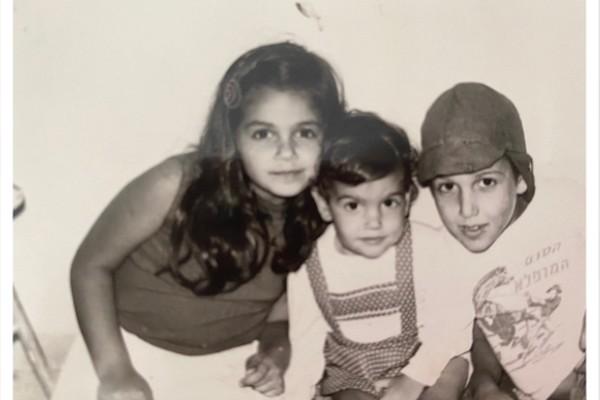
Debbie Heski-Leventhal (centre) as a young girl, with her elder sister and brother

The rest of her description of growing up in the cult makes for distressing reading. Her eventual disillusion hurt as much as angered her. She watched the Bergs - the “Rav” as Phil came to be known, and his wife Karen - change as their small group morphed into an organisation with centres all over the world, selling that little piece of red string with the symbolic knots for $US40 on its website. She watched the growth of a top-down hierarchy that treated its followers almost as servants.

"When I went to buy my first pair of jeans - until then I only wore long dresses - I felt as if I were walking in the street naked."

The public proselytising required of all members soon lost its glamour. Sent overseas to work in other countries teaching strangers, she found her foreign service lonely, demeaning and depressing. And she realised eventually that the mysticism she was commanded to embrace was meaningless. "In retrospect," she writes, "the Rav had created his own religious mishmash by combining the ancient wisdom of Kabbalah with some New Age ideas and a little Buddhism, sprinkled with some concepts from physics and quantum physics.

When she makes her break away from it all, at 18, the reader can't help but cheer. "I still remember the first time I turned on the light on Shabbat. It’s not that I was shocked that I wasn’t hit immediately by lightning, but I was surprised that I didn’t feel anything," she writes.

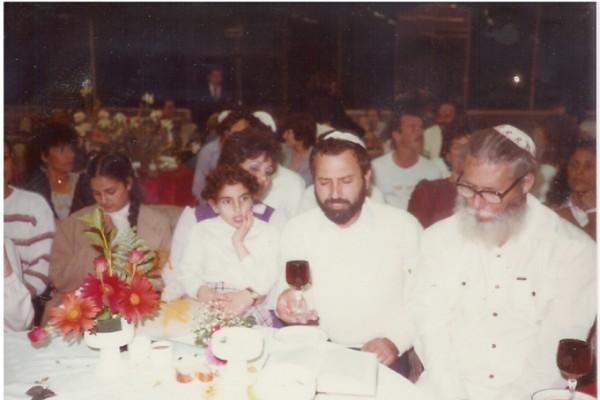
Heski-Leventhal and family at the Kabbalah Centre

"Months later, when I went to buy my first pair of jeans (until then I only wore long dresses and skirts), baggy and loose as they were, I felt as if I were walking in the street naked. I could not comprehend how people were not staring at me, so exposed did I feel."

And yet this story is only the introduction to Haski-Leventhal's book, the true purpose of which lies in its title.

In leaving the cult, Haski-Leventhal had to combat its dire psychological effect on her by embarking on her own search for meaning. "I decided to go and obtain a degree in philosophy," she says now. "Studying philosophy and starting to understand how people impart meaning into their life was one thing. But it was the extracurricular activity of volunteering that really helped me to decide to focus in my career on pro-social behaviour - firstly as a volunteer, then a volunteer coordinator and finally as a volunteer manager."

Her next academic step was to study management, focusing on non-profit organisations and volunteering.

"I've seen so much abuse that it would have been easy to focus on the bad stuff. But I made a conscious decision to focus on the positive aspects of humanity, and that first translated into volunteerism.

“I've seen so much abuse, so much manipulation and taking advantage of people's vulnerability, it would have been very easy for me to focus on the bad stuff. But I made a very conscious decision to focus on the positive aspects of humanity, and that first translated into volunteerism.

"The second phase was to focus on the positive aspects of businesses because I saw the immense power that corporations had on our lives and on the planet. This is how I came to study management. It was never just about studying management. I don't have an MBA."

Haski-Leventhal moved here in 2008 after marrying an Australian man who was studying in Israel. She is now a professor in the Department of Management at Macquarie University in Sydney, where she specialises in volunteering, corporate social responsibility and corporate citizenship, among other things. She adds, with considerable irony in her voice, that she is now the director of the MBA program there. "My vision is to turn it into an MBA with a positive impact, but that's another story," she says.

Her book is about the individual, the individual in a business environment and businesses in society, all stirred in together. None of the subjects makes sense without the previous step: how can one become interested in society-wide meaning and ethical business practices unless one is already involved in the search for meaning and an understanding of ethics in one's own life? What would ethical business practices in society even mean, if a business owner had no sense of the good in her own business practices?

The book works on each and all of these levels. It makes interesting reading for a person seeking philosophical business understanding, as well as for someone in business trying to translate personal ethics into a business environment she has influence over. Haski-Leventhal has penetrating things to say about the loneliness that dogs individuals and the absolute priority of the profit motive in transnational corporations.

"I saw the immense power that corporations had on our lives and on the planet. This is how I came to study management. I don't have an MBA."

She says she didn't want it to be a self-help book, but rather a book of ideas that grew out of her own development. Nor did she want to write a memoir, but rather use her experience as a jumping-off point. "I thought I could use my story to help people through their journey, so they don't have to do it so alone."

Since the book is designed for a broad audience, it took some courage to reveal her story. Early on in her teaching about volunteering, she started the course lectures with some reflections on her journey to date, mentioning that she came from Israel. "I stopped after two occasions when Muslim students got up and walked out on me, which was very hurtful," she writes in the book.

Being an Israeli is obviously a substantial part of her identity, but she often found herself hiding it after encountering negative attitudes. But that meant she couldn't bring the whole of herself to work: "I had to be brave and take this risk," she writes.

And the smallest personal references in the book lead to fascinating ideas for the reader to ponder. On the subject of bravery, she continues in the book: "Authenticity usually requires courage. Courage is not about never feeling any fear but overcoming that fear. Courage is derived from the Latin for heart, and it requires us to act wholeheartedly to overcome fears of reaction."

She finishes that paragraph with the words, "What opportunities await if only I walk through life with authenticity, vulnerability, and courage". Haski-Leventhal has a family herself now and discusses in the book what vulnerabilities that has exposed and what she has learned from it.

Haski-Leventhal's conversation is warm and she listens as much she speaks to other people. She is deeply absorbed in the goodness of the individual and more widely in society, and in the purpose of volunteering and of business as a matter of decency rather than simply making a great deal of money. Her worldview comes out clearly in the book, engaging the reader from the very start.

Make it Meaningful (Simon & Schuster) will be published on February 7. Rrp $33.99

Photo: Debbie Haski-Leventhal

You might also like
  • ‘For 80 years we lived in a kind of fairyland. It’s over’
    Vic Alhadeff
  • From antisemite to ally: the power of friendship
    Elana Benjamin
  • Rediscovered in Melbourne: the 75-year odyssey of Nazi-looted Jewish books
    Jason Schulman
logomark.67a07ee3
We believe in the free flow of information

Republish our articles for free, online or in print, by using our Creative Commons licence

You might also like

    Caulfield candidates
    AnalysisAustralia

    For Victorian Jews, the state election raises issues that stretch beyond the Murray

    Peter Kohn
    usman khawaja sabr
    OpinionAustralia

    Memo Usman Khawaja: Jesus was Jewish

    Adam Slonim 5
    sydney jewish museum education
    AnalysisAustralia

    The secret to successful Holocaust education

    Lauren Chalk & David Slucki 1

About the author

Miriam Cosic

Miriam Cosic

Miriam Cosic is a Sydney-based journalist and a former arts and a former literary editor. She is the author of two books.

More from the author

InterviewArts & Culture

A Jewish writer’s Indigenous ‘everyboy’

FeatureArts & Culture

The house that Lehman built: a saga of family, greed and capitalism unhinged

World

Jewish museums: from treasure box to forum for dialogue

Arts & Culture

Too much Holocaust fiction – and too loose with the facts