Aa
  • Read, Watch, Listen
  • TJI Series
  • Community Action
  • Events
  • Zedi
Follow us and continue the conversation
  • LinkedIn
  • Instagram
  • FaceBook
  • X
  • YouTube
Test yourself with the TJI Quiz!

Adjust size of text

Aa

Follow us and continue the conversation

  • LinkedIn
  • Instagram
  • FaceBook
  • X
  • YouTube

Your saved articles

You haven't saved any articles

What are you looking for?

Original reporting, insightful analysis and diverse views, delivered straight to your inbox

  • LinkedIn
  • Instagram
  • FaceBook
  • X
  • YouTube
Your support fuels our mission to inform, entertain and inspire.

The Jewish Independent is bound by the Standards of Practice of the Australian Press Council. If you believe the Standards may have been breached, you may approach The Jewish Independent or make a complaint to the Australian Press Council in writing at www.presscouncil.org.au. The Council may also be contacted on 1800 025 712.

  • Our Story
  • Contact us
  • Our Team
  • Support us
  • Guidelines
  • Pitch your idea
  • Republishing us
  • Community Action
  • Our Awards
  • LinkedIn
  • Instagram
  • FaceBook
  • X
  • YouTube
Aboriginal FlagTorres Strait Islanders Flag

The Jewish Independent acknowledges Aboriginal and Torres Strait Islander peoples as the Traditional Owners and Custodians of Country throughout Australia. We pay our respects to Elders past and present, and strive to honour their rich history of storytelling in our work and mission.

© The Jewish Independent 2026All Rights Reserved
Website design and development by Your Creative, MelbourneTerms & ConditionsPrivacy Policy
HomeRead, Watch, ListenAustralia
FeatureAustraliaLifestyle

Australian Jewish youth groups make a home for non-binary young people

Ruby Kraner-Tucci
Print this

Published: 1 September 2023

Last updated: 5 March 2024

From co-ed camp rooms to degendered Hebrew, non-binary inclusion is becoming a high priority for some Jewish youth movements. RUBY KRANER-TUCCI reports.

Attending a youth movement is a rite of passage for many Jewish Australians. Finding a like-minded tribe, connecting to community and creating memories that last a lifetime – youth movements are often bonding experiences.

For those who identify as non-binary, finding safe and welcoming spaces to explore one’s identity is particularly important. Thankfully for them, Jewish youth movements in Australia are responding in spades, prioritising inclusion in all areas of programming, policy and leadership.

Federal Chairperson of Netzer Australia Avishai Conyer, 21, believes his generation is leading the way. Jewish youth movements “should serve as an example to the rest of the community on inclusivity”, he said.

“Youth movements are such special places for young Jews to build their identity, so it is our role to create safe spaces for kids to be themselves, feel included and grow to become active and passionate values-driven members of our community,” Conyer told The Jewish Independent.

For Netzer Australia, this comes in the form of queer programs including LGBTIQ+ sex education; asking participants and leaders to introduce themselves using their preferred pronouns; and co-ed camp bunks for those in year 11 and above.

“As we do not split chanichimot [campers] by gender in any other aspects of our programming, it no longer made sense to do so with rooming arrangements for our older participants,” Conyer said.

“[We] will support kids below that age with different rooming preferences to find an arrangement that everybody is comfortable with.

“We have found that this leads to fewer social splits based on gender, promotes dignity and increases respect between kids of different genders, and supports non-binary participants to feel more included in Netzer spaces.”
“I’ve never felt at odds between my Jewish identity and my non-binary identity at Netzer. If anything, it’s celebrated.”

Theo Boltman

Theo Boltman, 17, has been attending Netzer since grade five and identifies as non-binary. They say the offering of co-ed bunks for older participants “makes it easier” – an experience that differs from other circles of their life.

“When I go on school camps, I have to send a list of girls’ [names] I’m comfortable sharing a room with, and then the school has to get approval from those girls’ parents,” Boltman said.

“While at Netzer, it’s never an issue. I never have to worry about being uncomfortable because I know everyone is in the same boat, it’s been amazing.”

Raffy Blay is personally aware of the impact of inclusive leadership in Jewish youth groups. Blay started attending Hashomer Hatzair – affectionately termed Hashy – at 13 years old and “instantly found connection and purpose”.

Almost a decade later, Blay is now its Central Coordinator and identifies as non-binary, helping to represent gender diversity in Hashy’s upper echelons.

“[It is] a huge privilege to be the leader of the movement and non-binary, and to take up space in the community holding this identity,” Blay said.

Like Netzer, Hashy runs a number of initiatives to promote inclusivity, from using gender neutral Hebrew suffixes to permitting co-ed rooms on camps.

While on the whole, the youth group has experienced little pushback about its welcoming agenda from the broader Jewish community, Blay identified some negative engagement on social media when endorsing Hashy’s annual Queer Night event. Thankfully, Blay said “nothing eventuated from it”.

“Letting kids be kids and not emphasising their gender as a point of difference works to build respectful relationships,” they added.

“The years spent in a youth movement are incredibly formative and important, and everyone should have the opportunity to have that experience.”

The visibility of non-binary leaders resonates with Boltman, who says embedding inclusion from the top down has helped to form an “incredibly supportive” environment for participants at Netzer.

“The whole point of Jewish youth groups is that it’s the space where Jewish people can find each other in a sea of, for lack of a better word, goys – a sea of people who aren’t like you,” Boltman said.

“It can be so hard, especially for Jewish kids going to public schools, to find [other] Jewish kids in the first place and for them to be non-binary too. It’s so important that their identities be prioritised.

“I’ve never felt at odds between my Jewish identity and my non-binary identity at Netzer. If anything, it’s celebrated.”

While co-ed bunkrooms have been accepted as a standard offering by some Australian youth groups, the US scene has been slower to embrace them. Only a handful of Jewish camps surveyed in the US have non-gendered bunk rooms as an option, let alone a standard offering.

Hashy campers (supplied)

Of 153 Jewish overnight camps surveyed recently in the US, 90 say they welcome transgender and nonbinary campers. Most allow them to choose the bunk that best fits them but don’t offer a non-gendered option.

Another way inclusion is expressed is through changes is language, an issue that is even more potent in the heavily gendered Hebrew language than in English.

Netzer’s global parent movement, Netzer Olami, recently implemented a gender-inclusive form of Hebrew through an Israeli-led initiative that aims to de-gender language.

Conyer uses the mixed gender term chanichimot, a blend of chanichim (male campers or student) and chanichot (female), where previous generations would have followed the language convention of subsuming females under male language and ignoring those who didn’t fit.

But when it comes to prioritising other forms of inclusion, such as disability, youth groups are still struggling. 

Netzer has policies around choosing physically accessible campsites and spaces for activities, but Conyer says its volunteers lack much-needed practice and understanding.

“While disability inclusion is very important to us, our young volunteers do not have much experience working with kids with disabilities,” he said.

“We try to provide as much training as possible and would like our programming to be accessible to all, [but] our lack of professional experience means there are some people we do not yet know how to fully include, despite our best efforts.”

Blay said many members of Hashy have been active in vocalising their desire to increase disability inclusion by making its building more wheelchair accessible and hiring Auslan interpreters for events, in addition to the camp sensory room and fidget toys already on offer.

“No one should miss out on Hashy if we can help it. We work hard to find ways to include everyone in our activities and accept everyone for who they are.” 

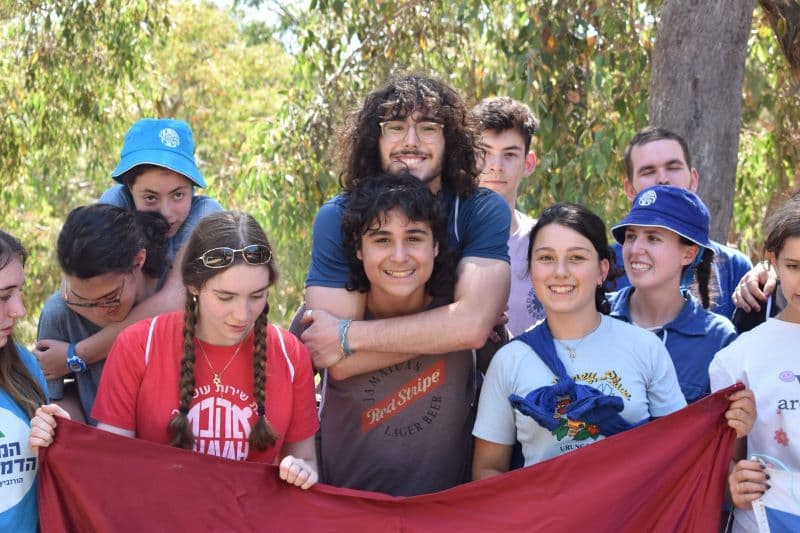
Photo: Hashy campers with a rainbow version of the youth group flag (supplied)

You might also like
  • Speedy Shatari: a leader for LGBTQ+ visibility
    Ruby Kraner-Tucci
  • ‘Purifying the creepy-crawly’ by studying Talmud at Queer Yeshiva
    TJI Pick
  • Bullying, exclusion ‘common’ for women and non-binary people in Jewish organisations
    Deborah Stone
logomark.67a07ee3
We believe in the free flow of information

Republish our articles for free, online or in print, by using our Creative Commons licence

You might also like

    chai necklace copy
    ReflectionAustralia

    Facing my mortality, the Book of Life is no metaphor

    Talia Slonim 5
    Generation change Template
    Generation ChangeInterviewAustralia

    Ash Densham: Building community through Humanistic Judaism

    Gideon Cohen
    antisemitism online
    NewsAustralia

    Proposed digital care law to offer protection against online antisemitism

    Deborah Stone

About the author

Ruby Kraner-Tucci

Ruby Kraner-Tucci

Assistant Editor

Ruby Kraner-Tucci is a journalist and TJI's assistant editor. Her writing has appeared in The Age, Australian Jewish News, Time Out and Broadsheet, among others. Ruby was awarded Multicultural NSW’s Best Report in Multicultural Media 2025 and has been named a Top 36 Under 36 Jewish Changemaker by B'nai B'rith.

More from the author

FeatureAustralia

‘True essence of being an ally’: The non-Jews choosing to work in the Jewish community

InterviewAustralia

Elliot Szafran: food that feels like a hug from Zaide

NewsAustralia

Antisemitic incidents down from peak but still triple pre-Gaza war

FeatureArts & Culture

Bringing Terezin music to life