Aa
  • Read, Watch, Listen
  • TJI Series
  • Community Action
  • Events
  • Zedi
Follow us and continue the conversation
  • LinkedIn
  • Instagram
  • FaceBook
  • X
  • YouTube
Test yourself with the TJI Quiz!

Adjust size of text

Aa

Follow us and continue the conversation

  • LinkedIn
  • Instagram
  • FaceBook
  • X
  • YouTube

Your saved articles

You haven't saved any articles

What are you looking for?

Original reporting, insightful analysis and diverse views, delivered straight to your inbox

  • LinkedIn
  • Instagram
  • FaceBook
  • X
  • YouTube
Your support fuels our mission to inform, entertain and inspire.

The Jewish Independent is bound by the Standards of Practice of the Australian Press Council. If you believe the Standards may have been breached, you may approach The Jewish Independent or make a complaint to the Australian Press Council in writing at www.presscouncil.org.au. The Council may also be contacted on 1800 025 712.

  • Our Story
  • Contact us
  • Our Team
  • Support us
  • Guidelines
  • Pitch your idea
  • Republishing us
  • Community Action
  • Our Awards
  • LinkedIn
  • Instagram
  • FaceBook
  • X
  • YouTube
Aboriginal FlagTorres Strait Islanders Flag

The Jewish Independent acknowledges Aboriginal and Torres Strait Islander peoples as the Traditional Owners and Custodians of Country throughout Australia. We pay our respects to Elders past and present, and strive to honour their rich history of storytelling in our work and mission.

© The Jewish Independent 2026All Rights Reserved
Website design and development by Your Creative, MelbourneTerms & ConditionsPrivacy Policy
HomeRead, Watch, ListenWorld
FeatureWorld

Breaking ground on a borehole in Kenya, IsraAID helps communities suffering from climate crisis

Tamar Kosky Lazarus
Print this

Published: 25 August 2023

Last updated: 5 March 2024

The Horn of Africa is facing its worst drought in 40 years. TAMAR KOSKY LAZARUS reports on international aid efforts to help.

In the remote communities of Turkana County, Kenya, people sometimes go for four days without drinking.

Richard Awalan, a community outreach worker with the Israeli humanitarian group IsraAID, says to find water, members of his family must walk miles through thorny vegetation in the boiling sun with their gerry cans to reach a dry riverbed, called a laga. They dig until pools of water begin to form at the bottom – muddy at first, and then hopefully becoming clearer. This can take hours. Once the containers are full, they can begin the hours-long walk home.

The water from the laga is at high risk of contamination from open defecation, livestock watering, and even residue from a nearby gravesite. This is the water they use for all their needs – drinking, bathing, and allowing livestock to drink.

Today, after nearly a year of searching for a location with the right geological conditions, IsraAID will begin drilling on two new boreholes in remote villages with the potential to provide safe drinking water to 8000 people like Richard  Awalan and his family. Solar-driven pumps will draw up the water; IsraAID will train local water committees to manage and maintain the system, and launch a wider campaign to enhance sanitation and hygiene using the water – as part of a long-term, sustainable, and scalable solution.
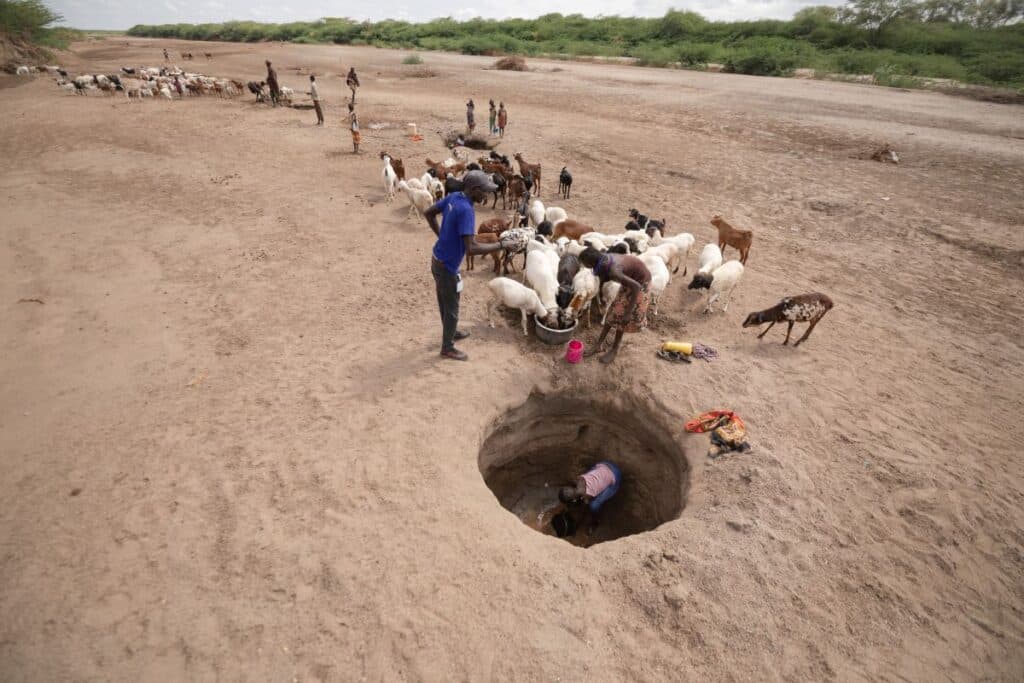
A child collects water as people and livestock queue in Turkana County, Kenya (Lameck Ododo, IsraAid)

Since 2013, IsraAID has worked in Kenya, supporting both the refugee and host communities living in and around Kakuma Refugee Camp and Kalobeyei Integrated Settlement in Turkana County. This region of Kenya houses the second-largest concentration of refugees in the country, and it continues to grow with over 1000 new arrivals each week. Refugees come from more than 10 countries, including South Sudan, Ethiopia, Burundi, and Somalia. As the Horn of Africa experiences its fifth consecutive failed rainy season, the drought has driven humanitarian needs skyward.
Due to the drought, the taps in the refugee camp are only turned on 2-3 times a week, with no reliable schedule. Children wait at home so that they can race to queue at water points when the taps are turned on. The queue can take hours and for those who live further from the source, the water pressure or allocation may dry up before they can access water.

The local, non-refugee community has even less access to services – they do not even have this intermittent access to free water. Several water kiosks exist, where water can be purchased, but many families cannot afford it. The host community also lacks access to food rations and other programs in the camp, so they must find other ways to survive.

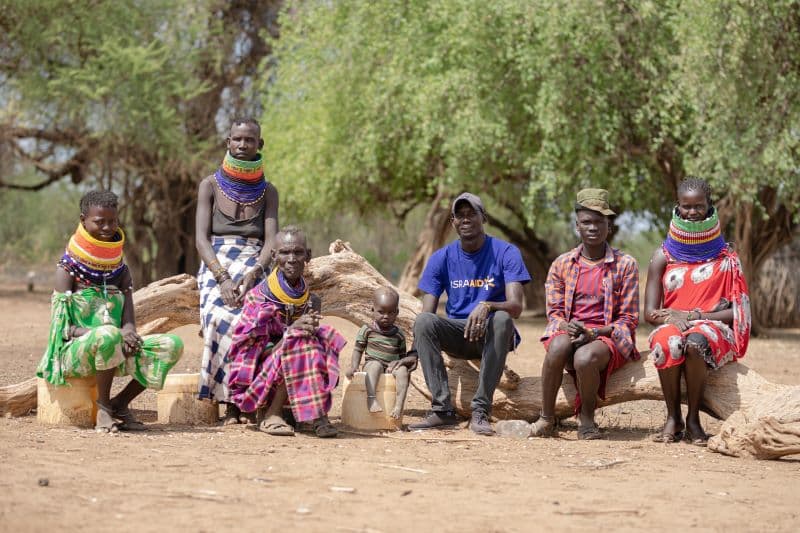
Richard Awalan (in IsraAid t-shirt) with members of his family (Lameck Ododo, IsraAid)

Richard, 25, was born and raised in the remote Lopur Village, an hour’s drive outside of Kakuma. Today, as a young father of two, he is raising his own family there while also working as a community outreach worker. Like other members of the local non-refugee community, he and his family are nomadic pastoralists, but these days, as the worst drought in 40 years ravages the Horn of Africa, their flock – which constitutes the family’s main livelihood and source of food – has dwindled.

Walking alongside Richard and his family, it was clearer than ever how much water affects daily life. The people speak of little else. Livelihoods have been decimated as livestock dies from a lack of water and vegetation. Waterborne illnesses, such as cholera, typhoid, and dysentery, spread as people turn to contaminated water sources.

Malnutrition rates have soared as vegetable gardens dry up, and dry grains and legumes – the type provided in refugee aid rations – cannot be cooked without water.

Women and children, who often take the long walk to the laga alone, are exposed to a much higher risk of gender-based violence along the way, resulting in trauma and a spike in teen pregnancies. There is a disturbing rise in child marriages as families seek dowries to survive and simply to have fewer mouths to feed at home.

This is the true price of climate change. It is being paid by those whose struggles are both the most visceral and least visible. While many of us begin to feel the sting of heatwaves and extreme weather and worry about our futures, we fail to acknowledge that many of the worst effects are already playing out in places where protracted crises have become normalised. The UN has recently received $2.4 billion dollars in pledges for the Horn of Africa, this comes nowhere near the $7 billion requested. Countries like the UK and Norway are slashing their aid commitments. The need is only growing.

These are communities of people facing the brunt of a catastrophe they did not cause, as many flee conflicts that they had no hand in. And they are committed to finding a way not only to survive but to flourish. This new borehole will not only mean safe water for thousands: It can reduce the risk of waterborne illness and malnutrition, improving health outcomes; it can give children the ability to attend school and dream of brighter futures; it can reduce the risk of violence for women and girls; it can give families, like Richard’s, the hope to rebuild their livelihoods and build stronger communities.

When I visit Kenya, I see the human cost of climate change. It is something we cannot turn away from. We owe these communities, who are building resilience in the face of it all, our attention and support. As we commence drilling on these new boreholes, we know it is only one piece of our wider commitment to this community, and that commitment is essential.

To join us, please visit www.israaid.org/donate

Top photo: A man collects water at a borehole rehabilitated by IsraAid in Kenya (Lameck Ododo, IsraAid)

You might also like
  • The forgotten Palestinians displaced in West Bank camp destruction
    Ben Lynfield
  • Focused on the urgency of war, Israel fails on climate action
    Ben Lynfield
  • A tragic bureaucratic bungle delivers a rich historical trove
    Vic Alhadeff
logomark.67a07ee3
We believe in the free flow of information

Republish our articles for free, online or in print, by using our Creative Commons licence

You might also like

    Erdogan Turkey
    AnalysisIsrael

    Turkey emerges as military threat to Israel

    Dror Doron
    Apple & rotten core Rosh hashanah
    EditorialAustralia

    Facing a new year with the knowledge life can be better

    The Jewish Independent
    Protest against settler violence in Jerusalem
    DebateAustralia

    Sanctioning settlements is a defence of Israel, not an attack

    Elisheva Madar 3

About the author

Tamar Kosky Lazarus

Tamar Kosky Lazarus

Tamar Kosky Lazarus is the Chief Development and Communications Officer at IsraAID, Israel’s leading humanitarian aid organisation.

More from the author

FeatureWorld

IsraAID comes to the Pacific for solutions to climate change