Published: 31 March 2018
Last updated: 23 January 2024
Our family was secular, but my parents were concerned about my Jewish identity so they sent me to Orthodox day schools. My connection to Judaism is complex. I grew up with a narrow traditional narrative and was convinced that it was the only one. When I returned to Israel I moved away from this and became more secular. I define myself as a cultural Jew, not religious, but deeply connected to Jewish culture and tradition.
How Jewish is your art?
I don’t define my music as Jewish music. I am Jewish and I sing in Hebrew. I have a deep attachment to the Hebrew language, even though Hebrew, in effect, is my second language. I was raised in English and I feel more creative in that language. But I am passionate about Hebrew. This led me to choose lyrics from Israeli poetry. I became very attached to poets Leah Goldberg and Rachel. I wrote music to their poems. I feel I have an ability to transmit the beauty and uniqueness of the Hebrew language through the songs that I composed and how I perform them.
How did your political awareness evolve?
I began my career at a very early age, just after the army. I was pretty clueless about politics. But my teacher, Gil Dor, who later became my musical partner, and is 17 years older than me, was much more engaged and through him my eyes were opened. From the beginning, my career took me to places around the world and journalists would ask me about Israel. At first I did not answer, but as time went on I realised that I must take a stand.
My first realisation was that there is an additional narrative to mine: the Palestinian narrative which is actually parallel to ours. And then we witnessed the Rabin assassination. I was invited to perform in the rally on that Saturday night in November 1995. When I asked the organisers who else will perform I noticed that there was a significant number of leading Israelis artists who were not there.
I realised that for some artists there is a hesitation to perform in platforms that are controversial. They are fearful of losing popularity and even their livelihood. And then Rabin was assassinated at the end of the rally. I was shocked. Was she there? Did she perform?
How did you respond?
The first thing I decided was to dedicate much of my time and energy to speaking out and working for peace, in effect lifting the torch that had fallen to the ground when Rabin was killed and running forward with it. In effect, I became an activist. I made several statements at the time and have adhered to them. I said I would not perform in the occupied territories. I was, and am still, willing to enter into dialogue with anyone, but not to entertain in a place where millions are devoid of human rights. I sit on several boards of justice and peace organisations, I speak, I write.
[gallery columns="1" size="large" ids="15630"]
I try and perform with Palestinian and Arab artists from around the world. I will mention two occurrences that exemplify my activism. In recent years I performed in alternative ceremonies on Yom Hazikaron (Memorial Day), where bereaved Israeli and Palestinian families mourn together. In addition, I refused to accept a prize from the Israeli Composers Association, protesting the fact that in the same ceremony a life-time achievement award was to be given to a musician who over the past 20 years has used his music and voice in support of extremely right wing, racist ideology, including support for Baruch Goldstein, who murdered 29 Muslims in a mosque as they were praying, and Yigal Amir, who murdered Yitzhak Rabin.
Do you pay a price for this?
Of course. There are people who reject my views. Actually, most people don’t understand my views since they are complex, not based on black and white slogans. There has been some incitement against me. But all in all, I believe that however high the price of speaking out, the price of silence is higher. Good things do not happen naturally, bad things do. Only from courage and activism will change come. I am fighting for the very soul of the country I love, Israel.
Israel is celebrating 70 years of independence. Where does this benchmark find you?
I love Israel. But I am very critical of the present Israeli government. What I am doing is my interpretation of Zionism. I believe that Zionism today needs to walk hand in hand with the pursuit of peace. Zionism solely as a source of refuge from distress has run its course. We now need to base Zionism on a new foundation: peace and justice, making Israel a light upon nations, and a source of pride for all its citizens and the entire Jewish people. We are sadly quite far from that point today, and much work needs to be done.
In your travels you have been performing around the Jewish world. Can you share some impressions?
My international career is divided between the Jewish communities and general audiences. I love to perform in front of Jewish circles. I feel a deep connection to the Jewish psyche and mentality; something binds us to each other. On the other hand, the interaction with Jewish communities is complex. Jewish communities do not relate to me simply as an artist. They see me as an extension of themselves.
They want me to represent them. I understand that and I try to choose a repertoire that is more relevant, but I am also fiercely independent and have fought for my own voice and original music, despite pressure to “do what works” or “please the audience”. I do not feel that is the role of the artist, and I have dedicated my life to art.
How would you characterise the relations between Israel and world Jewry?
The connection between world Jewry and Israel is complicated. The Jewish people gave birth to Israel. This relationship can be compared to that of a mother and child. In the beginning there was nurturing and dependence. The mother felt that the child is part of her. But the child grew up: she is now independent, rebellious, at times, even nasty to his mother. Her behaviour is often erratic and difficult to understand or justify. Both sides need to rethink and redefine their relationship.
I do not believe a parent should justify or defend a child when she is engaged in self destructive behaviour, the opposite is true. Criticism is a very deep form of caring. Nobody would accuse a theatre critic of not loving theatre; likewise, I do not see how anyone courageous and caring enough to constructively criticise Israel in the present situation, as I and so many millions do, can be accused of anything but truly loving her. Israel is in a very difficult situation today, and I think it is the responsibility of the international Jewish community to make her a country we can all be proud of, even if it means calling her out at times, and helping her get back on track.
What bothers you in the way Jews in the Diaspora view Israel?
Many Jews around the world want Israel to serve as the “iron fist” of the Jewish people, to have sharp nails, to be aggressive. I don’t want to serve this role. I want to be the heart, the soul and the brain of the Jewish people. I want people to connect to us through literature, art, and creative technology. In comes the Hebrew language. It is the wonder of our times.
The revival of Hebrew creates layers and layers of connections to our culture. Israel is the territory of Hebrew, and no language can survive without a territory (as opposed to religion which never really needed land in order to thrive). Hebrew should be the organising principle of Israel. As long as everybody functions and creates primarily in Hebrew, our Jewish identity can be preserved in a unique way, in an inclusive atmosphere (as opposed to religion, which is exclusive), with equal opportunities for all.
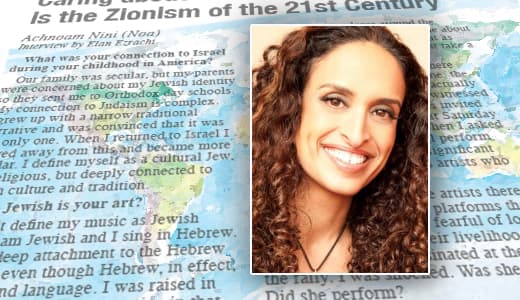
Achinoam Nini (Noa) was born in Israel in 1969 to parents of Yemenite origin. At age two she moved with her parents to the US. She was educated in Orthodox schools in New York. At age 17 she returned to Israel alone, completed her high school education and enlisted in the IDF Musical Entertainment Troop. After her military service she studied at the Rimon School of Jazz and Contemporary Music. There she met her long-time musical partner Gil Dor and launched a 28-year international musical career
Interview by Elan Ezrachi