Published: 25 April 2018
Last updated: 4 March 2024
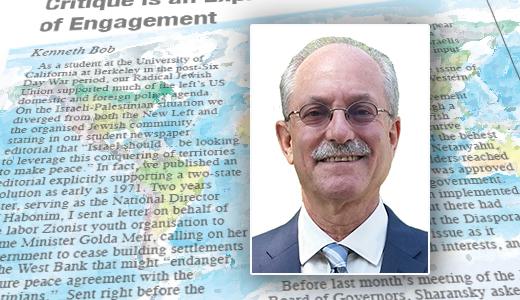
As a student at the University of California at Berkeley in the post-Six Day War period, our Radical Jewish Union supported much of the left’s US domestic and foreign policy agenda. On the Israeli-Palestinian situation we diverged from both the New Left and the organised Jewish community, stating in our student newspaper editorial that “Israel should …be looking to leverage this conquering of territories to make peace.” In fact, we published an editorial explicitly supporting a two-state solution as early as 1971.
Two years later, serving as the National Director of Habonim, I sent a letter on behalf of the Labor Zionist youth organisation to Prime Minister Golda Meir, calling on her government to cease building settlements on the West Bank that might “endanger a future peace agreement with the Palestinians.” Sent right before the Jewish holidays, a delayed response finally arrived. I was told that Prime Minister Meir could not respond to my letter due to the war that had arrived at Israel’s doorstep.
It is not new for Diaspora Jews to express criticism of Israeli policies. But when it comes to the Israeli-Palestinian conflict, mostly but not exclusively, is ‘mostly but not exclusively,’ necessary? it has long been the case that most Israelis and many Diaspora Jews maintain that it is Israelis who bear the brunt of the consequences and therefore the role of Diaspora Jews is to be politically and financially supportive of Israeli policies as a general rule. It does appear that in recent years there has been a growing awareness among some Israelis regarding the validity of Diaspora input on Israeli policy.
Over the past several years, the issue of egalitarian prayer at the Kotel (Western Wall), has been central to the conversation of Diaspora involvement in Israeli policy making. Through a painstaking process led by Jewish Agency for Israel (JAFI) Executive Chairman Natan Sharansky, at the behest of Prime Minister Benyamin Netanyahu, Israeli and Diaspora stakeholders reached an agreement on a plan that was approved by a majority of the Israeli government. The plan has sadly not been implemented due to coalition politics, but there had been broad acceptance that the Diaspora should have a say on this issue as it pertains to broader Jewish interests, and the struggle continues.
Before last month’s meeting of the JAFI Board of Governors, Sharansky asked the Jewish Public Policy Institute to prepare materials and policy guidance regarding the African asylum-seekers facing deportation per the current Israeli government policy. The fact that Sharansky viewed this as a topic for consideration by this global Jewish establishment body was significant. During the discussion, I proposed establishing a JAFI task force to develop proposals to bring to the government.
[gallery columns="1" size="large" ids="19101"]
An Israeli member of the board spoke out angrily, berating the “naïve” liberal Americans, telling us not to lecture Israelis about morality since our children don’t serve in the army and defend the country. Sharansky immediately responded, stating that while there are valid views on both sides of this argument, these same Americans, with their liberal moral values, helped get him and others released from the Soviet gulag. In the end, a resolution expressing concern about the government’s policies and establishing a task force passed overwhelmingly.
Fifty years since the military occupation of the West Bank began, there is a widening political and generational divide between Israel and the Diaspora, The situation, of course, differs from country to country and as an American, I will focus on the relationship between Israel and American Jewry, even though many of the points will apply to other countries
I speak regularly on college campuses and what I see is confirmed by recent studies. Many young, liberal, engaged Jews are consumed by the occupation, generally making the following three points:
It is a nightmare for the Palestinians living under military rule; It is morally compromising for Israelis to support and enforce it; And it is politically unsustainable if you believe Israel should be a Jewish democratic state.
As upsetting as this singular focus may be for many Israelis, it is actually good news that these young people (and not only the young) care enough to be engaged with Israel, even if in a highly critical manner. The bad news is that most young liberal Jews are detached and disinterested in Israel. Israel doesn’t speak to them and they are finding their Jewish expression in organisations and forums that studiously ignore Israel, focused instead on US domestic issues, or they simply invest in their personal and spiritual growth.
Left unaddressed, Israelis will progressively find a less engaged Diaspora community that leans to the right politically and is predominantly Orthodox. This will become politically problematic and conceptually damaging to the notion of Jewish peoplehood. Israel cannot legitimately claim to be the homeland of the Jewish people but only engage with a sub-section of Jews. The Jewish collective relates not only to a shared past, but also to a shared future– is that not the raison d’etre of Zionism and Israel?
We have to facilitate opportunities and meetings on a broad scale, so that Israelis and Diaspora Jews meet, engage and develop meaningful relationships while dealing with difficult questions. For such meetings to be fruitful, it would behoove Israelis to avoid the patronising and arrogant attitude with which they are often afflicted. Diaspora participants should embrace a modicum of humility and understanding of their standing in this engagement.
Such talking however, should lead to “doing,” which has greater potential for bringing people closer together. For example, Israeli-Palestinian co-existence efforts can provide a meeting ground for discussion between people who may disagree on political solutions but agree that people-people progress is important. Such organisations, focusing on healthcare, education, the environment and more, can provide meaningful platforms for engagement as well as produce real outcomes. Right after the 1973 Yom Kippur War cease-fire was reached, I was called to Israel for an emergency international meeting of Habonim national directors.
When Labor Party Secretary General Aryeh (Lova) Eliav sought me out, I anticipated a stern lecture in response to my ill-timed letter to Golda Meir. Instead he told me that my letter was exactly right, that there is no military solution to Israel’s conflict with the Arabs. This was a meaningful moment for me, and the relationship with the iconic Labor Zionist leader continued until his death in 2010.
Young Diaspora Jews need to meet their Lovas, their Israeli allies, today as well.