Aa
  • Read, Watch, Listen
  • TJI Series
  • Community Action
  • Events
  • Zedi
Follow us and continue the conversation
  • LinkedIn
  • Instagram
  • FaceBook
  • X
  • YouTube
Test yourself with the TJI Quiz!

Adjust size of text

Aa

Follow us and continue the conversation

  • LinkedIn
  • Instagram
  • FaceBook
  • X
  • YouTube

Your saved articles

You haven't saved any articles

What are you looking for?

Original reporting, insightful analysis and diverse views, delivered straight to your inbox

  • LinkedIn
  • Instagram
  • FaceBook
  • X
  • YouTube
Your support fuels our mission to inform, entertain and inspire.

The Jewish Independent is bound by the Standards of Practice of the Australian Press Council. If you believe the Standards may have been breached, you may approach The Jewish Independent or make a complaint to the Australian Press Council in writing at www.presscouncil.org.au. The Council may also be contacted on 1800 025 712.

  • Our Story
  • Contact us
  • Our Team
  • Support us
  • Guidelines
  • Pitch your idea
  • Republishing us
  • Community Action
  • Our Awards
  • LinkedIn
  • Instagram
  • FaceBook
  • X
  • YouTube
Aboriginal FlagTorres Strait Islanders Flag

The Jewish Independent acknowledges Aboriginal and Torres Strait Islander peoples as the Traditional Owners and Custodians of Country throughout Australia. We pay our respects to Elders past and present, and strive to honour their rich history of storytelling in our work and mission.

© The Jewish Independent 2026All Rights Reserved
Website design and development by Your Creative, MelbourneTerms & ConditionsPrivacy Policy
HomeRead, Watch, Listen
Interview

David Grossman interviews his deceased son, Uri

Limor Fayena
Print this
cover-18102016

Published: 18 October 2016

Last updated: 4 March 2024

On 10 August 2006, when Israel was at war with Hezbollah in Lebanon, David Grossman and fellow Israeli authors Amos Oz and A.B Yehoshua held a press conference at which they strongly urged the government to agree to a ceasefire that would create the basis for a negotiated solution. Grossman said, "We had a right to go to war. But things got complicated... I believe that there is more than one course of action available." Two days later, shortly before the ceasefire, Grossman’s 20-year-old son Uri, a staff sergeant in an armoured unit, was killed by an anti-tank missile during an IDF operation in southern Lebanon.

sdfsdf

To the End of the Land (2008) is a novel about the emotional strains that family members of soldiers experience when their loved ones are deployed into combat. The main character, Ora, is a woman who engages in frantic magical thinking to try to keep her son alive. Ora decides that if she goes for a long walk in Galilee with her son's father, if she is not present to hear "notifiers" tell her of his death, she will prevent it. Grossman started writing the book three years before Uri’s death, and completed it two years after. It has won critical acclaim and numerous awards, and was on President Obama’s reading list.

Born in Jerusalem, Grossman’s interest in literature was nurtured by his father, who started as a bus driver but then became a librarian. His books have been translated from Hebrew into more than 30 languages.

Grossman is an outspoken peace activist. His first novel, The Smile of the Lamb (1983), is an important examination of the West Bank occupation.

Grossman hasn’t always written on political subjects. He is also renowned for his many books for children and young adults. The Itamar series is dedicated to, and based on, Grossman’s son Uri.

ki9iklkl

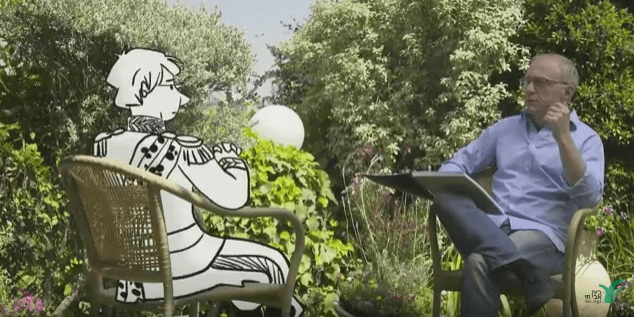
When Uri Grossman was 17, he invented the character Fieldmarshal Archibald Lomumba, a cruel and crazy dictator king. Shortly before Uri joined the army, David Grossman interviewed him in character as The Fieldmarshal. Ten years after Uri’s death, the interview notes have been turned into a short, bitter-comic film, The Fieldmarshal (2016), created by Noam Meshulam and Noam Nadav. It was released as part of the Beit Avi Chai commemorative project - “A Face. The Day. A Memorial“. In the film, David Grossman plays himself and interviews his animated character son, who takes on the personality of The Fieldmarshal. The film brings to life Uri’s clever and comic creation, but also sends a strong message about the vicious cycle of bloodshed.

The Jewish Independent asked Noam Meshulam, one of the directors, about the role of animation in this film and in films generally. He answered: “Unlike regular filming technique, animation has the ability to build a new world and a new language from scratch. The symbolic language of animation helps the viewer to digest hard content while still evoking an emotional attachment to the material.  In The Fieldmarshal we first created Uri’s character. Later on we dealt with the Fieldmarshal character and, since it was animation, it was easier to handle comic-violent scenes like decapitation. The audience experiences bloody decapitation as less shocking when it’s animated. I think that it was also easier for the family to show the content of the stories in a graphic way. Using animation enabled us to revive Uri’s material in a clean and pure way, untrammelled by the complexity of real life - this is the power of art.”

You can WATCH The Fieldmarshal here [11:02] (for English subtitles, press the CC button or select English under Settings)

This The Jewish Independent article may be republished if acknowledged thus: ‘Reprinted with permission from www.thejewishindependent.com.au ’
You might also like
  • The Altalena should be a warning, not a political weapon
    Shahar Burla
  • Turkey emerges as military threat to Israel
    Dror Doron
  • Because of my Zionist values, I’m joining an Arab party
    Yoav Segalovitz
logomark.67a07ee3
We believe in the free flow of information

Republish our articles for free, online or in print, by using our Creative Commons licence

You might also like

    Jewish-diversity copy
    Feature

    The three questions that will define the Jewish future

    Shahar Burla 1
    Web Banner – Andrew Casey Internship

    Andrew Casey Memorial Internship Program

    Paul Amato
    Israel Hamas War

    IDF: Hamas will steal fuel for tunnel ventilation systems and rockets

    TJI Wrap

About the author

Limor Fayena

Limor Fayena

Limor Fayena is a software engineer and a film lecturer. Limor holds a BFA in Film and Television. She lectures and writes about cinema and its cultural and political aspects.

More from the author

Australia

Dying, fighting, fleeing: Australians in Israel and Israelis in Australia

Opinion

The ugly message behind Israeli Jewish MKs’ refusal to sit with Arabs

Arts & Culture

Real life stories of abandoned babies and pioneering relationships

Australia

Funky Yemen Blues blasts open a window between cultures

Comments

No comments on this article yet. Be the first to add your thoughts.