Published: 12 December 2024
Last updated: 12 December 2024
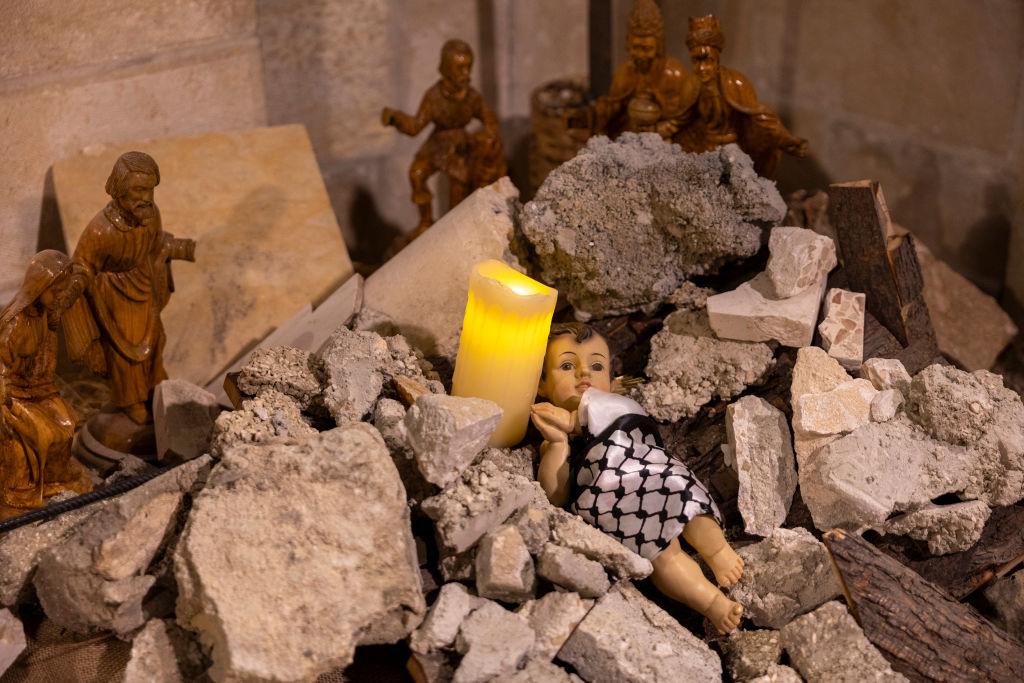
A Nativity scenein Bethlehem shows baby Jesus wrapped in a keffiyeh and placed in a rubble to show solidarity with the people of Gaza. Evangelical Lutheran Christmas Church in Bethlehem, December 2023 (Maja Hitij/Getty Images)
Published: 12 December 2024
Last updated: 12 December 2024
This story was originally published in the Forward. Click here to get the Forward's free email newsletters delivered to your inbox.
The keffiyeh — the Bedouin head scarf that has become a symbol of Palestinian resistance -— is not only the latest sartorial fad among hipster fashionistas, it is now being used to swaddle baby Jesus as well.
Kaffiyeh-clad baby Jesus is showing up in manger scenes all over the world, even in the Vatican itself.
Sometimes, those manger scenes are filled with rubble, symbolizing the mass destruction in Gaza and the gulf between the coming birthday of the Prince of Peace and the lack thereof.
You might think that this is merely a critique of Israeli actions in Gaza, or of Israel itself. You might think that this is merely an embrace of the idea that, as Kim Redigan of the Friends of Sabeel North America in Michigan put it, “God is on the side of those who are suffering. God is on the side of those who are being crushed.”
Perhaps those who nest figures of baby Jesus in the keffiyeh have noble, peaceful motives but, whether they know it or not, they are engaged in theological antisemitism —a kind of antisemitism that, like all versions, should have disappeared decades ago.
How so?
Putting Jesus in a keffiyeh erases Jesus’ Jewish identity. It has become increasingly popular to refer to Jesus as a Palestinian. The term itself is anachronistic. Jesus was born in the land of the Jews, Judea. True, the Romans would rename Judea as Syria Palaestina after the failed Bar Kokhba revolt, which led to the final destruction of Judean independence in 135 C.E. Why Palaestina? Because the Romans were invoking the memory of the ancient Philistines, the perennial enemies of the Israelites, as a way of “dissing” the Jews.
Therefore, even though Jesus of Nazareth lived and died in the land that would, a century later, be called Palestine, at the time of his life and death, it was still Judea. Jesus was a Jew.
But that idea — that Jesus was a Jew — has not always been popular among Christians. In the early years of Christianity, Marcion taught that the “good” Christian god was separate from the “bad” Jewish God. Marcionism sought to sweep any Jewish influences from Christianity. For Marcion, Jesus was not Jewish, but a purely spiritual being.
Christianity rejected Marcionism as a heretical movement. Nevertheless, it remains as a temptation. As Susannah Heschel has written, it re-surfaced in the Third Reich, when German Protestant theologians decided that Jesus was, in fact, an Aryan.
Swaddling Jesus in a keffiyeh also “resurrects” the charge that the Jews killed Jesus. How so? There is a simple, sinister syllogism at work in the symbolism of baby Jesus in a keffiyeh. The Israelis, i.e., the Jews, are killing Palestinians. Baby Jesus is dressed as a Palestinian. The ancient antisemitic slur of deicide, that the Jews killed God, re-emerges as the genocide charge — that the Jewish State has deliberately planned to destroy the Palestinian people.
The resurrection of the deicide charge has a contemporary source.
The Sabeel Ecumenical Liberation Theology Center in Jerusalem, founded by the Anglican priest and Palestinian theologian Naim Ateek, promotes a Palestinian liberation theology, which applies the theology of the liberation of the oppressed to the Palestinian issue.
As S. Ilan Troen writes in his wonderful new book, Israel/Palestine in World Religions: Whose Promised Land?, Ateek’s religious view is that of the old, presumably discredited Christian supercessionism, also known as replacement theology. Christians have replaced the Jews; Christianity has replaced Judaism.
“Ateek views the Church as the New Israel,” Troen writes, “replacing and thus erasing the role Jews had previously placed in a Covenant with the Lord.”
The kaffiyeh-clad baby Jesus is just another way to promote this theological antisemitism. It erases Jesus’s Jewish identity, and it perpetuates the myth of Jewish perfidy.
The appearance of baby Jesus in keffiyeh in the Vatican is a sad, ironic reminder of the glory of the Second Vatican Council (Vatican II), during which Pope John XXIII exonerated the Jewish people for responsibility for the death of Jesus.
For the past sixty years, Jews and Christians have worked tirelessly to redeem and repair centuries of hatred and enmity.To ignore or to set aside this historic work more than a disappointment; it is a historical tragedy.
This story was originally published on the Forward.


Rabbi Salkin is a contributing editor to Religion News Service; the co-founder and co-director of Wisdom Without Walls: an online salon for Jewish ideas, and the author of, most recently, Tikkun Ha’Am/Repairing Our People: Israel and the Crisis of Liberal Judaism.