Aa
  • Read, Watch, Listen
  • TJI Series
  • Community Action
  • Events
  • Zedi
Follow us and continue the conversation
  • LinkedIn
  • Instagram
  • FaceBook
  • X
  • YouTube
Test yourself with the TJI Quiz!

Adjust size of text

Aa

Follow us and continue the conversation

  • LinkedIn
  • Instagram
  • FaceBook
  • X
  • YouTube

Your saved articles

You haven't saved any articles

What are you looking for?

Original reporting, insightful analysis and diverse views, delivered straight to your inbox

  • LinkedIn
  • Instagram
  • FaceBook
  • X
  • YouTube
Your support fuels our mission to inform, entertain and inspire.

The Jewish Independent is bound by the Standards of Practice of the Australian Press Council. If you believe the Standards may have been breached, you may approach The Jewish Independent or make a complaint to the Australian Press Council in writing at www.presscouncil.org.au. The Council may also be contacted on 1800 025 712.

  • Our Story
  • Contact us
  • Our Team
  • Support us
  • Guidelines
  • Pitch your idea
  • Republishing us
  • Community Action
  • Our Awards
  • LinkedIn
  • Instagram
  • FaceBook
  • X
  • YouTube
Aboriginal FlagTorres Strait Islanders Flag

The Jewish Independent acknowledges Aboriginal and Torres Strait Islander peoples as the Traditional Owners and Custodians of Country throughout Australia. We pay our respects to Elders past and present, and strive to honour their rich history of storytelling in our work and mission.

© The Jewish Independent 2026All Rights Reserved
Website design and development by Your Creative, MelbourneTerms & ConditionsPrivacy Policy
HomeRead, Watch, ListenWorld
World

‘Father Teresa’ went to Ethiopia to teach for a year – and stayed for 34

Miriam Cosic
Print this

Published: 22 November 2022

Last updated: 5 March 2024

RICK HODES, medical director of the international Jewish relief group known as The Joint, is visiting Australia. He talks to MIRIAM COSIC about the Jewish hands who help communities of all backgrounds.

When Rick Hodes was a kid, growing up in a secular Jewish household in Long Island, New York, he used to read a lot. His family didn't travel much and he craved to see the world. Then he started reading about doctors working in Africa and Asia, people like the famous Albert Schweitzer and the missionary doctor Thomas Dooley, and he thought this was what he wanted to do with his life.

At college, however, he decided spontaneously to enrol in geography. After graduation, he didn't have much in the way of job prospects, so he earned a living by painting houses and hitchhiked around America. He spent a summer hiking the entire John Muir Trail in California with a friend.

"Then I hitchhiked to Alaska, got a job and thought about my life," he tells The Jewish Independent. "I decided the best thing I could do was go to medical school."

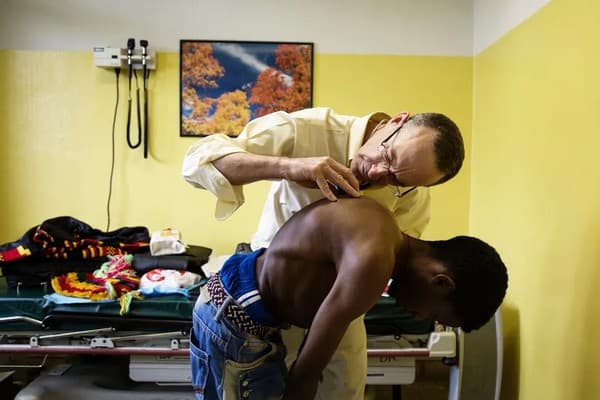
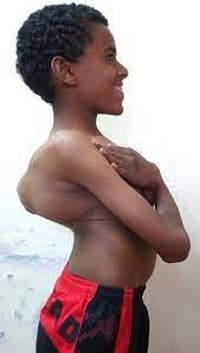
Hodes specialised in internal medicine and was soon involved in organising treatment for spinal tuberculosis: his specialty ever since. That disease deforms the spine, progressively collapsing the vertebrae until the entire rib cage becomes incapable of supporting heart and lung function, the Johns Hopkins' website explains. Few who have the condition live into adulthood.

Hodes’ work as a doctor has grown to involve much more than his specialty. He is in Australia on a three-city tour, spruiking for the Joint Distribution Committee (JDC), an international Jewish medical relief organisation that helps people, regardless of nationality or religion, worldwide.

Hodes is its medical director. "I'm speaking at synagogues. I'm speaking at schools. I'm speaking to doctors," he explains. " I'm trying to raise interest, and I'm trying to raise money."

"I contacted the organisation and said, 'I'm an American doctor, I'm Jewish. I just spent 2.5 years in Ethiopia. Can I help you?'"
“The Joint” describes itself this way: "When natural disasters or other calamities strike, we are the Jewish hands who help communities of all backgrounds and faiths rebuild. We’re on the ground when disaster hits, and we stay long after it’s over to make sure those communities get back on their feet. We also bring our expertise to slow-moving crises, like endemic poverty, food insecurity, and the plight of refugees."

Hodes has lived in Ethiopia for 35 years, where he treats Catholics and Muslims. He has volunteered for the Sisters of Mercy, Mother Teresa's famous order, for decades. And has also collaborated with a Ghanaian surgeon, Oheneba Boachie-Adjei of FOCOS Hospital in Accra, who specialises in spinal surgery. Supported by the JDC, the two of them established JDC Spinal Deformity Clinic, in Accra, in 2006, based at Mother Teresa's Mission.

Dr Hodes treating a patient in Ethiopia

Hodes' life has been extraordinary. His extroversion and exuberant conversation about his work is contagious. From the moment he began in medicine, he found himself led by coincidences that soon no longer seemed to be occurring by chance. Time spent in Israel, for example, led him deeper into Jewish studies and he is now a baal teshuva, a secular Jew who has turned to Orthodoxy. It wasn't his faith that led him to his work, however. It was vice versa, his work only strengthened his faith.

To return to the beginning, Hodes returned to medical studies in Rochester, New York. "I knew I wanted to do global health," he says. He spent a summer in Bangladesh and a winter in India as a medical student. Then, as medical resident at Johns Hopkins Hospital, he worked in Africa with Ethiopian refugees. He applied for a Fulbright fellowship, wanting to go somewhere else in Africa, but the sponsors wanted him to go back to Ethiopia.

"I went to Ethiopia in 1985 intending to spend one year teaching at the medical school," he says, "and now I've been there for 34 years.”

The serendipity continued. In 1990, while studying Hebrew in Israel, he read in The Jerusalem Post about the problems Ethiopian Jews were undergoing in the war-torn country. "So I contacted the [organisation] and said, 'I'm an American doctor, I'm Jewish. I just spent 2.5 years in Ethiopia. Can I help you?'

"They hired me for six weeks to go down to Ethiopia and be the doctor for the immigrants to Israel." The organisation was the JDC. "And after six weeks, they weren't sure what they were going to do with me. So they hired me for another six weeks. And then after 12 weeks, they decided, 'Ok, this guy is not bad'. So they kept me on."

It was also around that time that he started volunteering at Mother Teresa's mission. Despite his very public observance of the Jewish faith, Johns Hopkins University says, he is sometimes called "Father Teresa" there.

Some of his examples of the serendipity that has directed his work are astonishing. He met a woman at the Catholic mission whose eye was popping out from pressure from a brain tumour.

"I took pictures, did scans and sent them out - and nobody would touch her. And I knew that she was a ticking time bomb."

Patient with spinal tuberculosis

Soon after, Hodes was on a trip to Minneapolis, and one morning his alarm didn't go off, and he overslept. "So what do you do?" he asks rhetorically. "You throw your clothes on, you brush your teeth and you run out the door." As an observant Jew, he threw his tallit into his backpack and asked his driver to take him quickly to a synagogue after his first meeting.

"I walked in and said hello to the guy next to me," Hodes says, "and I said, 'What do you do here in Minneapolis?' And he said, 'I'm a skull-based neurosurgeon'.

"I flew this patient to him, and he got together with a cranial facial surgeon and ocular plastic surgeon and she got surgery and it saved her life. So this is a Muslim orphan raised by Catholic nuns getting free surgery ... from Dr Nussbaum and his team."

Hodes' own generosity is remarkable. He adopted two boys with tubercUlosis of the spine and added them to his health insurance so he could take them to America for surgery.

Hodes' own generosity is remarkable. He first met two boys with tuberculosis of the spine in 1990 and couldn't get them free medicine. He ended up adopting them and adding them to his health insurance so he could take them to America for surgery.

"The problem is," he says, "when you adopt an abandoned orphan who doesn't have any relatives, they become yours for life. I asked the Almighty what I should do and he told me I should help them. So I adopted them and added them to my health insurance.

"I went through medical school, never having done any orthopaedic training and never doing neurosurgery training. And now in my practice, I have maybe the largest collection of the worst spine deformities in the world".

CLICK HERE FOR DETAILS OF RICK HODES EVENTS

Photo: Vitality Society

You might also like
  • Sanctioning settlements is a defence of Israel, not an attack
    Elisheva Madar
  • Sanctions must influence, not just perform disapproval
    Adam Slonim
  • Mind the mentality: not every rejection is antisemitism
    Nomi Kaltmann
logomark.67a07ee3
We believe in the free flow of information

Republish our articles for free, online or in print, by using our Creative Commons licence

You might also like

    Erdogan Turkey
    AnalysisIsrael

    Turkey emerges as military threat to Israel

    Dror Doron
    Protest
    AnalysisIsrael

    Western ‘Palestinianism’ colonises everything – and hurts Palestinians

    Andres Spokoiny 5
    JDC Joint Nepal
    FeatureWorld

    ‘Your help is extremely needed’: Jewish aid group on the ground after Nepal flood

    Peter Kohn 1

About the author

Miriam Cosic

Miriam Cosic

Miriam Cosic is a Sydney-based journalist and a former arts and a former literary editor. She is the author of two books.

More from the author

InterviewArts & Culture

A Jewish writer’s Indigenous ‘everyboy’

FeatureArts & Culture

The house that Lehman built: a saga of family, greed and capitalism unhinged

World

Jewish museums: from treasure box to forum for dialogue

Arts & Culture

Too much Holocaust fiction – and too loose with the facts