Aa
  • Read, Watch, Listen
  • TJI Series
  • Community Action
  • Events
  • Zedi
Follow us and continue the conversation
  • LinkedIn
  • Instagram
  • FaceBook
  • X
  • YouTube
Test yourself with the TJI Quiz!

Adjust size of text

Aa

Follow us and continue the conversation

  • LinkedIn
  • Instagram
  • FaceBook
  • X
  • YouTube

Your saved articles

You haven't saved any articles

What are you looking for?

Original reporting, insightful analysis and diverse views, delivered straight to your inbox

  • LinkedIn
  • Instagram
  • FaceBook
  • X
  • YouTube
Your support fuels our mission to inform, entertain and inspire.

The Jewish Independent is bound by the Standards of Practice of the Australian Press Council. If you believe the Standards may have been breached, you may approach The Jewish Independent or make a complaint to the Australian Press Council in writing at www.presscouncil.org.au. The Council may also be contacted on 1800 025 712.

  • Our Story
  • Contact us
  • Our Team
  • Support us
  • Guidelines
  • Pitch your idea
  • Republishing us
  • Community Action
  • Our Awards
  • LinkedIn
  • Instagram
  • FaceBook
  • X
  • YouTube
Aboriginal FlagTorres Strait Islanders Flag

The Jewish Independent acknowledges Aboriginal and Torres Strait Islander peoples as the Traditional Owners and Custodians of Country throughout Australia. We pay our respects to Elders past and present, and strive to honour their rich history of storytelling in our work and mission.

© The Jewish Independent 2026All Rights Reserved
Website design and development by Your Creative, MelbourneTerms & ConditionsPrivacy Policy
HomeRead, Watch, ListenWorld
FeatureWorld

The Queen gave UK Jews a sense of security, the King has long been a friend

Colin Shindler
Print this

Published: 13 September 2022

Last updated: 5 March 2024

Though she never visited Israel, Elizabeth symbolised stability for British Jews, and Charles’ engagement with Jewish causes offers more of the same.

The death of Queen Elizabeth II has been described by many as the end of an era — a watershed in British history. The Queen's remarkable reign of 70 years — a period only exceeded in recent times by the Sun King, Louis XIV of France — encompassed the end of empire and the decline of the age of deference. Decolonisation also brought forth a multi-ethnic, multi-cultural Britain. The remarkable diversity of the new government of Liz Truss demonstrates this change. The Britain of 1952 was a very different country.

In November 1948, Prince Charles was born just a few hours after there had been an annual service of remembrance by thousands of Jewish ex-servicemen and women at Horse Guards Parade in London. A subsequent gathering at the Royal Albert Hall was held that evening to commemorate those who had fallen in the fight against Nazism — and when the birth was publicly announced, there were spontaneous cries of "Mazaltov!".

In 1948, the murder of six million Jews burned intensely in the Jewish psyche in Britain. Jewish history was not British history — even if the meeting point was reflected by the loyalty and gratitude of British Jews to the monarch and state. The allies may have won the war, but the Jews certainly lost it.

A 14-year-old Princess Elizabeth had broadcast to the children of Britain in October 1940 to remain resolute in spite of Hitler's plan to invade the British Isles. It broadly appealed to the many Jewish children, torn from their parents, who were evacuated to unfamiliar parts of the country. Princess Elizabeth's parents refused to leave London during the Blitz and the Royals visited the devastated, bombed out, East End where many Jews lived.

All this was in distinct contrast to the latent pro-Hitler sympathies of her uncle, the abdicated Edward VIII. Princess Elizabeth, in uniform, stood proudly next to Churchill on the balcony of Buckingham Palace on VE Day in May 1945.

Within weeks of her accession in 1952, the young Queen met Chief Rabbi Brodie and leaders of the Jewish community.
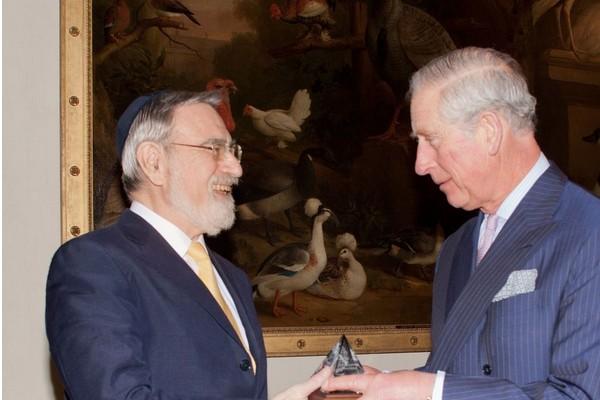

The experience of the Royal Family during World War II undoubtedly formed the bedrock of good relations that have ensued between the monarchy and the Jewish community in Britain. Within weeks of her accession in 1952, the young Queen met Chief Rabbi Brodie and leaders of the Jewish community.
The Queen became patron of the Holocaust Memorial Trust in the UK and hosted a gathering at St James's Palace on the 60th anniversary of the liberation of Auschwitz. Prince Charles attended the World Holocaust Forum at Yad Vashem in 2020 and in January of this year, he commissioned a series of portraits of survivors of the Shoah who had made their homes in Britain. A remarkable television program followed in which Charles and Camilla were shown the portraits and introduced to their subjects.

Many British Jews appreciated Queen Elizabeth because she symbolised continuity and stability in difficult times. The legacy of recent Jewish history reinforced that belief.

While the Queen was a devout member of the Church of England, Britain had become a multi-faith country during the course of her long reign. In his prayer last Shabbat to express thanks for the life of the Queen, Chief Rabbi Mirvis referred to her as “a defender of faith” — and not “a defender of the faith”. This mirrored Charles’s own views which he voiced in 1994.

The one bright spark in the dark firmament after 1945 was that the new state of Israel was courageously fighting its war of independence and pushing back the invading Arab armies. The British attitude towards the new state, however, was decidedly lukewarm and Whitehall was initially reticent to grant it recognition.

In 1948, many Jews embraced the Zionist definition that the Jews were a nation in exile and not part of the British nation. Some Jews still fill in official forms, listing their nationality as Jewish and their citizenship as British. Many left the UK to fight for the Hebrew republic. They rejected not only the anti-Zionism of the haredim, but also their tendency to laud kings and crowns in their language and outlook, imitating biblical societies of several millennia ago.

In January, Charles commissioned a series of portraits of survivors of the Shoah who lived in Britain. In a remarkable TV program, Charles and Camilla were shown the portraits and introduced to their subjects.

Ben-Gurion and his colleagues instead argued for a revolutionary change in Jewish history. Zionism looked to the American and French revolutions and to the many European independence movements of the 19th century. Ben-Gurion was a Jacobin and not a monarchist. Significantly, although Israel was part of the decolonisation struggle, unlike India, it did not join the British Commonwealth of Nations, despite it being a mandated territory and not a colony.  

Yet the Queen never visited Israel. Charles visited Israel to attend the funerals of Yitzhak Rabin and Shimon Peres — in an unofficial capacity. In 1994, Prince Philip visited the grave of his mother, Princess Alice, on the Mount of Olives — in a personal capacity. Alice was considered to be one of the Righteous of the Nations for hiding members of the Cohen family in Nazi-occupied Athens. It was only in 2018 that Prince William visited Israel officially — perhaps as a result of Brexit and the search to secure trading partners.

To be fair, this approach by the Royals was governed by the British Foreign Office in its attempt not to offend many an Arab state. The Queen presided over a state banquet for President Ezer Weizman at Buckingham Palace in 1997 and President Peres was given an honorary knighthood in 2008.

It is pertinent to note that the English monarchy barred Jews from the country between 1290 and 1656. Only the English Republic of Oliver Cromwell opened the doors to the Jews and welcomed them.

Prince Charles has pointedly not chosen another name as king and will be known as Charles III. This is a name that has not been used for 350 years by a monarch. His namesake predecessor, Charles II, the "Merry Monarch" known for his tolerance, significantly did not rescind Cromwell's permission to the Jews a few years before, to reside in England. It was the genesis of the present community.

Unlike his mother's role as Queen, Charles as Prince of Wales had the freedom to be passionate about issues that he cared deeply about such as climate change and environmentalism at a time when many thought that this was eccentric and perhaps slightly unhinged. Today politicians are forced to deal with climate change and groups of rabbis speak of the eco-synagogue.

Charles has gone out of his way to embrace ethnic minorities as part and parcel of British society. He has opposed racism and “the appalling atrocity of slavery”. Like the Board of Deputies of British Jews, he was disparaging about the Johnson government's plan to deport asylum seekers to Rwanda.

Although Israel was part of the decolonisation struggle, unlike India, it did not join the British Commonwealth.  

The Jewish Independent

Charles was close to the late Chief Rabbi, Jonathan Sacks, and was always interested in intellectual pursuit and philosophical discussion. Regarded by some as a progressive, it remains to be seen how restricted he will be as king.

Many have regarded the Queen's long reign as the yardstick by which to measure the evolution of their own journey. Fifteen British prime ministers, 14 American presidents and seven popes held office during the Queen's tenure. People under 70 have known no other monarch.

Permit me to conclude on a personal note:

I remember being called into my primary school in Stoke Newington, a working-class district in East London, as a five-year-old. Together with my classmates, I was told to sit on the cold floor of the school hall in my short trousers on a wintry February day — and informed that His Majesty King George VI had died and that Britain now had a new queen.

A year later I sat with my parents, glued to the broadcast of the coronation on our nine-inch, black and white Bush television. A few days after that I remember my mother pushing me to the front of the crowd when the Queen and Prince Philip passed by in their car on their coronation tour of East London. You never forget such episodes despite the passing years.

Perhaps the Australian prime minister, Anthony Albanese, has delivered the best quote about the queen: she exuded “a timeless decency”. Few would dissent from that accolade.

Today Britain remains a working hybrid of a constitutional monarchy and a democratic republic. Monarchy, for all its benefits, foibles and flaws, is connected to history and to the generations that went before.

Many have spoken about the selfless life of service that the Queen embodied, but perhaps the Australian prime minister, Anthony Albanese, has delivered the best quote about her: she exuded “a timeless decency”. In these troubled times, few would dissent from that accolade.

RELATED STORIES

Between a Mohel and a Sieg Heil: What Did Elizabeth Really Think of Her Jewish Subjects? (Anshel Pfeffer,  Haaretz)

Why did the British monarch never visit Israel? (Middle East Eye)

Israeli leaders mourn death of Queen Elizabeth II: Ties ‘flourished’ under her reign (Times of Israel)

King Charles has always had a special relationship with the Jewish community (Jewish Chronicle)

Photo: Prince Charles is greeted by Lord Jonathan Sacks and his successor Chief Rabbi Ephraim Mirvis before he was formally inducted as 11th Chief Rabbi of the Commonwealth, in London in 2013 (Stefan Rousseau/AP)

You might also like
  • The ICJ has ruled on genocide in Myanmar. What does it mean for Israel?
    Shahar Burla
  • Looming fear of political violence in post-election Israel
    Dror Doron
  • Building a future beyond fear: a conversation
    Deborah Stone & Orly Erez-Likhovski
logomark.67a07ee3
We believe in the free flow of information

Republish our articles for free, online or in print, by using our Creative Commons licence

You might also like

    Ric Benjamin DMZ
    OpinionIsrael

    What visiting the Korean DMZ taught me about the Israel-Palestine conflict

    Ric Benjamin
    Eisenkot Herzog
    Israel Votes 2026NewsIsrael

    Diaspora Jews urge Israel’s change bloc to form a Jewish–Arab coalition

    Sharon Offenberger 2
    Tech DNA
    AnalysisLifestyle

    We need to talk about cancer risk 

    David Adler

About the author

Colin Shindler

Colin Shindler

Colin Shindler is an emeritus professor of Israel Studies at SOAS, University of London. He is the author of several books about Israel: the latest "A Forever War: Israel, Palestine and the Struggles for Statehood" was published in 2026.

More from the author

AnalysisWorld

Russia’s campaign against Jewish targets in Europe

AnalysisWorld

New evidence points to Iranian responsibility for Diaspora antisemitic attacks

AnalysisWorld

UK’s dramatic policy change on Israel-Palestine

AnalysisWorld

Diaspora leadership must be candid about its disillusion with Netanyahu