Published: 30 January 2016
Last updated: 4 March 2024
After the ‘Six Day War’ of 1967, Israel’s triumph over the surrounding and threatening enemies of Egypt, Syria and Jordan developed into an almost mythological tale of survival against the odds. Israel‘s David conquered the Goliath of the belligerent Arab states, Jerusalem was reunited and at last, Jews were free to worship and live in the places that had been barred to them.
I recall the excited atmosphere in my classes at Vaucluse Boys High, listening incredulously to the radio news reports (before the days of blanket television coverage). I felt proud to be Jewish. We were on the winning side, no longer the victims. We strongly identified with these modern, conquering heroes – the Israeli soldiers.
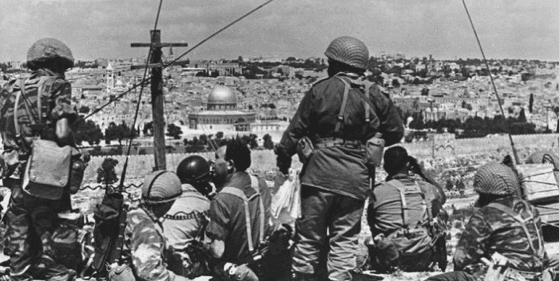
The few images I recall are of General Moshe Dayan and his tough, unshaven men at the Western Wall, of thousands of shoes and masses of equipment abandoned by the fleeing Egyptian soldiers, of burnt out enemy planes that never got off the ground and Israeli soldiers at the Suez Canal. Jerusalem was ours. Likewise the Golan Heights, Gaza, the West Bank and Sinai. The threat was gone in just Six Days! It seemed like a biblical miracle, with God on our side.
I spared little thought of the consequences of this humiliation for the losers. Why should I? What if Israel had lost the war? We knew what ‘they’ would have done to us. No, this was a victory of Good over Evil. Safe in my Australian high school, I nevertheless felt personally and on behalf of Israel, to be more secure somehow.
‘Censored Voices’, a mesmerizing and confronting film by young Israeli director Mor Loushy, reveals how narrow and superficial that view was. We know better now—or do we?
The strength of this painstakingly researched documentary is that it provides a unique and focused perspective on those heady days - the voices heard are those of Israeli soldiers recorded within days of returning from the war.
There are no onscreen interviews. In a powerful technique, we see the aged and almost hypnotized faces of the now aged soldiers forty six years later, as they hear their young, passionate, often anguished voices recalling their experiences with devastating honesty. It’s a powerful experience for them – and for us, the audience.
In 1967, a group of young kibbutzniks, led by renowned author Amos Oz and editor Avraham Shapira, recorded astonishingly intimate audiotape conversations with soldiers freshly returned from the battlefields. The Israeli Army censored the recordings, allowing only about 30% of the conversations to be published. “Censored Voices” reveals these original recordings for the first time, in all their rich complexity.
The film is less about what the soldiers did, than about what these young men felt. What went through their minds as they were thrust into the cauldron of war? What was it like to see your first corpse? To kill for the first time? What did they feel for the enemy surrendering in their thousands? Did they feel like liberators or occupiers? Was it a triumph? Or something darker? Were the images we saw in the newsreels representative of the actuality at the time?
The soldiers’ voices are guileless and eloquent, probably helped by the fact the recordings are not on film. Perhaps they felt more open and less inhibited via the audio recordings? Home safe, they can hardly believe what they have witnessed, only knowing that the experiences have changed them - and Israel too. Having seen the faces of the enemy, having seen friends die, having cleared villages of their inhabitants, they don’t subscribe to the more superficial stories that we who did not participate, grew up with.
Director Mor Loushy feels the film, “… deals with morals and consciousness. That’s a discourse that is gone now in Israel. It’s so important to hear these sincere voices, to go back to this authentic moment in 1967 and to really hear these very special conversations, because after that a lot of politics came and a lot of myths came. We have an opportunity to hear something naked before it became about politics – left, right. These men were the heart of Israel. They were the soldiers. They gave their lives to their country. They built the country. So it’s not my story, it’s their story. I think it’s very important to hear them and raise this debate in Israel. It’s not an outside criticism. It’s coming from people that gave everything to Israel. I do hope that it will not become about left or right because it’s bigger than that.”
With the voice recordings as the spine of the film, Loushy had to find visual ways of bringing those dramatic days to life. Using raw footage from newsreels and vivid archival material, she draws the audience into the experience of being on the front line and on the home front as well. Much of the footage would not have been seen at the time and some of it is confronting, as are the stories told by the participants.
The good guys/bad guys narrative that I grew up with, quickly dissolves as the soldiers describe their transformative wartime experiences. Though we all know terrible things happen in war, we don’t like to think that our side was complicit. Through the young soldiers’ experiences. I felt drawn under a grindstone of human emotions, doubts and existential questions. I no longer felt swept up by the triumph of it all, as I had back in 1967.
It’s a film that will generate debate. We can’t question their commitment, credentials or perspectives, fighting and dying as they were for the survival of their country. We are left to examine our own responses to their traumatic experiences, reflected in the gently filmed faces of the old men listening to their younger selves.
Knowing now what the future would bring, with its rolling wars, intifadas and endless road maps to peace, it is poignant to listen to the soldiers’ prescient speculations as to what their conquest of all this territory might do to the ideals of Zionism, to the integrity of the state of Israel and to its true believers, including themselves.
The complexities and moral dilemmas of the film emerge from the fact that, as Israelis, they had no choice. Attack or be attacked, kill or be killed, occupy or be occupied. But newly blooded (literally) and matured, they were under no illusions that their war would bring Peace.
When asked what he thinks when he listens to those recordings, Amos Oz reflects, “I feel we spoke the truth. A truth I stand behind to this day.”
Screening Melbourne: February 8, Sydney February 10. Tickets available here.
See trailer of Censored Voices here
This The Jewish Independent article may be republished if acknowledged thus: “This article first appeared on www.thejewishindependent.com.au and is reprinted with permission."