Aa
  • Read, Watch, Listen
  • TJI Series
  • Community Action
  • Events
  • Zedi
Follow us and continue the conversation
  • LinkedIn
  • Instagram
  • FaceBook
  • X
  • YouTube
Test yourself with the TJI Quiz!

Adjust size of text

Aa

Follow us and continue the conversation

  • LinkedIn
  • Instagram
  • FaceBook
  • X
  • YouTube

Your saved articles

You haven't saved any articles

What are you looking for?

Original reporting, insightful analysis and diverse views, delivered straight to your inbox

  • LinkedIn
  • Instagram
  • FaceBook
  • X
  • YouTube
Your support fuels our mission to inform, entertain and inspire.

The Jewish Independent is bound by the Standards of Practice of the Australian Press Council. If you believe the Standards may have been breached, you may approach The Jewish Independent or make a complaint to the Australian Press Council in writing at www.presscouncil.org.au. The Council may also be contacted on 1800 025 712.

  • Our Story
  • Contact us
  • Our Team
  • Support us
  • Guidelines
  • Pitch your idea
  • Republishing us
  • Community Action
  • Our Awards
  • LinkedIn
  • Instagram
  • FaceBook
  • X
  • YouTube
Aboriginal FlagTorres Strait Islanders Flag

The Jewish Independent acknowledges Aboriginal and Torres Strait Islander peoples as the Traditional Owners and Custodians of Country throughout Australia. We pay our respects to Elders past and present, and strive to honour their rich history of storytelling in our work and mission.

© The Jewish Independent 2026All Rights Reserved
Website design and development by Your Creative, MelbourneTerms & ConditionsPrivacy Policy
HomeRead, Watch, ListenArts & Culture
Arts & Culture

Greek-Jewish choral performance soars above Nazi darkness

Vic Alhadeff
Print this

Published: 4 November 2022

Last updated: 5 March 2024

Australian Greek and Jewish choirs joined forces in Sydney last weekend to perform The Ballad of Mauthausen song cycle in an inspirational expression of shared humanity.

It’s a magnificent outcome from history’s darkest moment – a sublime piece of music which conveys a love story across cultures within the shadow of a Nazi concentration camp. It ranks among the most stirring musical compositions ever written in the Greek language and possibly in any language. Even if one cannot understand the lyrics, the pain and the pathos are palpable.

In a deeply moving event last Sunday evening - unprecedented in this country - the Australian Hellenic Choir and Sydney Jewish Choral Society joined forces in an overflowing Clancy Auditorium at the University of NSW to perform The Ballad of Mauthausen in an inspirational cross-cultural expression of shared humanity. 

A four-part song cycle, The Ballad of Mauthausen had its origins in the remarkable love story that flowered in the Mauthausen concentration camp in Austria during World War II between a Greek prisoner, Lakovos Kambanellis, and Janina Rimkoute, a Lithuanian Jewish female prisoner.

Their love affair was set against the backdrop of the hangings, executions, brutality and humiliation they experienced and witnessed on a daily basis. 

The unlikely sanctuary for their clandestine encounters in the months which followed liberation was the top of an abandoned machine-gun tower overlooking the camp, with the base of the gun emplacement doubling as a clothes hanger and Kambanellis’s broken shoes serving as a pillow on the wooden floor.

The brainchild for this innovative and remarkable event – which was possibly a world-first – came from James Tsolakis, President of the Australian Hellenic Choir, who took the idea to Anne Spira, Chair of the Sydney Jewish Choral Society.
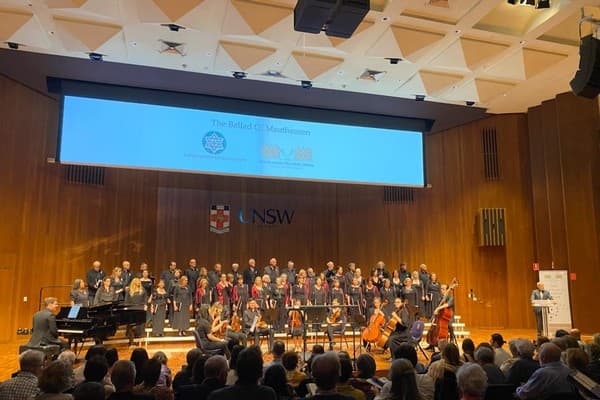
Both choirs, with Vic Alhadeff at the podium (supplied)

Spira embraced the idea and more than 700 people heard the outstanding outcome, complemented by the delivery of historical context which outlined the Holocaust as it impacted the Jews of Greece. Underscoring the historical and emotional power of the event was that it occurred two days after Oxi Day – the anniversary of the moment when Greece rejected Hitler’s demand that it surrender.

The timing of the performance was given more resonance by the fact that next week is the anniversary of Kristallnacht – The Night of Broken Glass - which marked the onset of the Holocaust on November 9, 1938.

Mauthausen was one of the first concentration camps built by Nazi Germany. Located on a hill above the working-class town of Mauthausen, about 20 kilometres east of Linz in upper Austria, it was the central hub of a sprawling complex of almost 100 sub-camps in Austria and southern Germany.

The prisoners were put to work in mines, quarries, arms and munitions factories and plants which assembled Messerschmidt fighter aircraft for the German air force. With the main camp situated near a granite quarry, the prisoners were forced to haul blocks of stone weighing up to 50 kilograms up the 186 steps of the so-called Stairs of Death. Emaciated prisoners frequently collapsed, dropping their loads and inevitably crushing those following behind.

SS guards would order prisoners to race up the Stairs of Death carrying the boulders; those who survived were then confronted with the option of either being shot or pushing the next prisoner off the cliff. Many chose to jump.

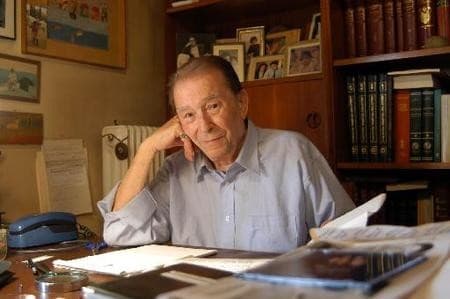
Lakovos Kambanellis
Lakovos Kambanellis

A gifted author and poet, Kambanellis expressed his memories and experiences on paper after the war was over, poignantly describing the love between Janina and himself and their conflicted emotions in meeting in such bizarre circumstances, as well as the atrocities inflicted on the prisoners.

He also conveyed the extraordinary courage and strength of Andonis, a Greek prisoner who voluntarily carried the boulder of a struggling Jewish prisoner as well as his own; when an SS officer reacted by ordering Andonis to pick up a heavier one, he selected one that was even larger than he was ordered to carry and carried it to the top of the 186 steps.

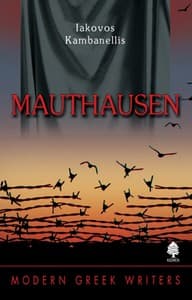
Kambanellis’s writing remained unpublished for 20 years, until global events such as the assassination of US president John Kennedy motivated him to return to his manuscript. He took it to a publisher, who immediately recognised the power and importance of the work, and the book Mauthausen was published in 1965 to overwhelming acclaim, leading to Kambanellis to be described as the Primo Levi of Greek literature.

While his book was being readied for publication, Kambanellis wrote a poem in four parts, again capturing his love for Janina against the terrible backdrop of the Holocaust. The publisher suggested the poems be put to music and that Mikis Theodorakis - best known for composing the music of Zorba the Greek and the score for the Greek political film Z – compose the score. Kambanellis agreed, as did Theodorakis. The Ballad of Mauthausen is the magnificent result.

The Jewish Independent

The world premiere was attended by then-Austrian chancellor Franz Vranitzky and conducted by Theodorakis himself. And in 1995 he conducted a concert at the site of Mauthausen to mark the 50th anniversary of its liberation. 

About 100,000 people were murdered at Mauthausen, which was liberated by the 3rd US Army in May 1945 – the last camp to be liberated by the Allies. Approximately 87 per cent of Greece’s 60,000 Jews were murdered in the Holocaust.

Vic Alhadeff was MC for The Ballad of Mauthausen performance. His family was from Rhodes Island, from where 1673 members of the Jewish community were deported to Auschwitz. All but 150 were murdered there; they included 151 members of Alhadeff’s family, as well as his paternal grandparents.

Photo: The Hellenic and Jewish choirs singing at the Clancy auditorium at UNSW last Sunday (supplied)

You might also like
  • Was the barmi a shemozzle? How Australians use Jewish words 
    Caroline Hendy & Emma Breslow
  • At home where we are: Salzberg, The Sound of Music and the value of ‘here’
    Andrew Wirth
  • When the state faltered, civil society and Diaspora Jewry stepped up
    Shahar Burla
logomark.67a07ee3
We believe in the free flow of information

Republish our articles for free, online or in print, by using our Creative Commons licence

You might also like

    why main 4th
    PodcastArts & Culture

    Why we need to find our why now: new TJI podcast

    Ittay Flescher and Courtney Winter-Peters 1
    Wake main 2nd
    FeatureArts & Culture

    New ‘spoken word’ festival in Sydney offers stories directly from creators

    Miriam Hechtman
    Copy of Website books template (2)
    FeatureArts & Culture

    The winning Jewish books by Australians in the past year

    Gideon Cohen

About the author

Vic Alhadeff

Vic Alhadeff

Vic Alhadeff OAM is former CEO of the NSW Jewish Board of Deputies and former editor of the Australian Jewish News.

More from the author

InterviewArts & Culture

‘The battle for the future of Jews will be fought in the cultural arena’

InterviewWorld

IHRA head: discrediting definition means ‘turning a blind eye’ to anti-Zionism

OpinionArts & Culture

40 years since Lanzmann’s Shoah, his central question remains: When is it too late?

OpinionAustralia

A shocking moment at Sydney Writers’ Festival