Aa
  • Read, Watch, Listen
  • TJI Series
  • Community Action
  • Events
  • Zedi
Follow us and continue the conversation
  • LinkedIn
  • Instagram
  • FaceBook
  • X
  • YouTube
Test yourself with the TJI Quiz!

Adjust size of text

Aa

Follow us and continue the conversation

  • LinkedIn
  • Instagram
  • FaceBook
  • X
  • YouTube

Your saved articles

You haven't saved any articles

What are you looking for?

Original reporting, insightful analysis and diverse views, delivered straight to your inbox

  • LinkedIn
  • Instagram
  • FaceBook
  • X
  • YouTube
Your support fuels our mission to inform, entertain and inspire.

The Jewish Independent is bound by the Standards of Practice of the Australian Press Council. If you believe the Standards may have been breached, you may approach The Jewish Independent or make a complaint to the Australian Press Council in writing at www.presscouncil.org.au. The Council may also be contacted on 1800 025 712.

  • Our Story
  • Contact us
  • Our Team
  • Support us
  • Guidelines
  • Pitch your idea
  • Republishing us
  • Community Action
  • Our Awards
  • LinkedIn
  • Instagram
  • FaceBook
  • X
  • YouTube
Aboriginal FlagTorres Strait Islanders Flag

The Jewish Independent acknowledges Aboriginal and Torres Strait Islander peoples as the Traditional Owners and Custodians of Country throughout Australia. We pay our respects to Elders past and present, and strive to honour their rich history of storytelling in our work and mission.

© The Jewish Independent 2026All Rights Reserved
Website design and development by Your Creative, MelbourneTerms & ConditionsPrivacy Policy
HomeRead, Watch, ListenArts & Culture
Arts & Culture

Hear us sing: Women musicians raise their voices against discrimination

Elana Sztokman
Print this

Published: 31 March 2023

Last updated: 5 March 2024

Marginalised in the music industry and facing religious discrimination in public spaces, Israel's female musicians are fighting to be heard.

During the democracy demonstrations, a new presence appeared on stage in Tel Aviv. Eliyana Hayut, 13, a student at a music conservatory in the Galilee, sang the Hatikva, the Israeli national anthem, before massive crowds.

Her performance was a protest against the fact that she was cancelled the previous week from singing at a public event in her local council because the organisers decided that they did not want to “offend” a Haredi man in the audience whose religious beliefs prevent him from listening to women sing.  But the organisers were prepared to  offend the young artist, as well as women everywhere.

Women and girls in Israel have been facing this kind of exclusion for years – from female soldiers to female Knesset choir members to countless male-only line-ups that take place all around Israel – despite the fact that it is against the law. But this was the first time that the silencing of women’s voices had a boomerang effect.

Not only did Hayut sing beautifully in front of hundreds of thousands of people, but people now also know her name. As a result of her cancellation, she has now become a star – and a symbol of women’s fight to be heard.

Some of the women responsible for this turnaround belong to Kadma, a group that formed in August to advance women in the music industry in Israel. Bolstered by the fighting spirit of Hayut’s mother, Avigail, who posted widely about the injustice her daughter experienced, the women of Kadma collaborated with Bonot Alternativa, which has been leading women in the street demonstrations, to support the young singer.

They decided to bring this story to the public’s attention, to make sure her voice would be heard, and to raise awareness about the gender barriers women artists face in the music industry.
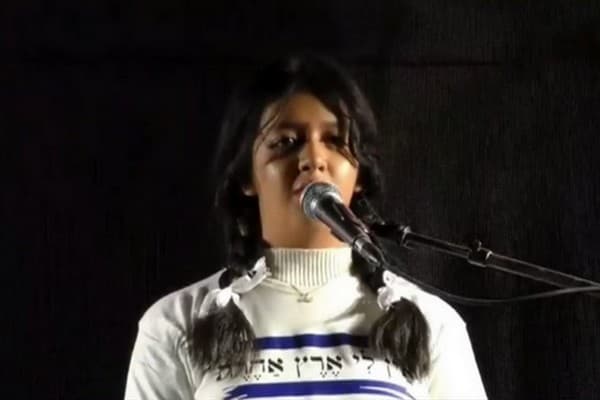
Eliyana Hayut, 13, singing Hatikvah at the Tel Aviv protest (Demokrat TV)

“We’re meeting other women like ourselves, and it is very uplifting and empowering,” says musician and songwriter Amit Amitay, 28, the founder of Kadma. The initiative was sparked two years ago when on International Women's Day she was struck by the absence of women in the musical space.

“I walked into a jam session and realised there are almost no women jamming. Women may sing, but they very rarely play their instruments in these jam sessions. And it’s such a shame, because the jam session is a great opportunity for expressions of creativity and power.”

Amitay’s first initiative was to open a women-only jam session. “That was when I realised that there was a need for women-only spaces.” Next she collaborated with a music school to open up a course to train women about how to make it in the music industry. That was when she discovered that the problem was much deeper.

Last year, she got together with some leading female artists and started Kadma, which now has 600 active members. “It’s about building a community of women musicians who can support each other and boost each other up.”

I walked into a jam session and realised there are almost no women jamming. Women may sing, but they very rarely play their instruments in these jam sessions.

Amt Amity, founder of Kadma

One of Kadma’s first activities was to hold a conference for over 100 women musicians to discuss their challenges and strengths. Panellists discussed issues such as motherhood, safe spaces, and the many jobs where women struggle to be seen and valued – not only in singing and playing, but also in areas like sound, conducting and production.

Indeed, women’s exclusion in music is hardly the domain of the religious world only. One only has to turn on the popular radio station Galgalatz to notice how few women artists are played. One study found that only 10% of the top 40 songs voted on by Galgalatz are sung by women artists – and some of those are led by a man.

This is consistent with global patterns. A 2001 study of the Annenberg Inclusion Initiative found that women only 21.6% of artists on the Billboard Hot 100 Year-End Charts over the past nine years were women. Moreover, there has been no meaningful or sustained increase in the percentage of women artists in nearly a decade. A paltry 7.1% of duets and bands on the Top 40 charts included a woman.

In Israel, the problem is persistent, and until now was barely noted. At Festival Tamar, one of the largest and oldest Sukkot music festivals in Israel, the line-up of artists has been almost all male year after year.

Kadma spokeswoman Shira Carmel

“The men who run these festivals simply do not see us,” says singer-songwriter Shira Z. Carmel, spokeswoman for Kadma. “They see the same male performers over and over. It’s boring and sexist, and cowardly.”

Organisers have claimed that there are simply not enough women artists. In response, Carmel compiled a list of more than women musicians, an index which now contains 350 musicians and is still growing.

Following the exclusion of women at the Tamar Festival, Carmel wrote an oped in Haaretz to raise awareness. “It is exciting to see that as soon as we started this organisation, I am suddenly able to say these things out loud, and people are interested in hearing.”  

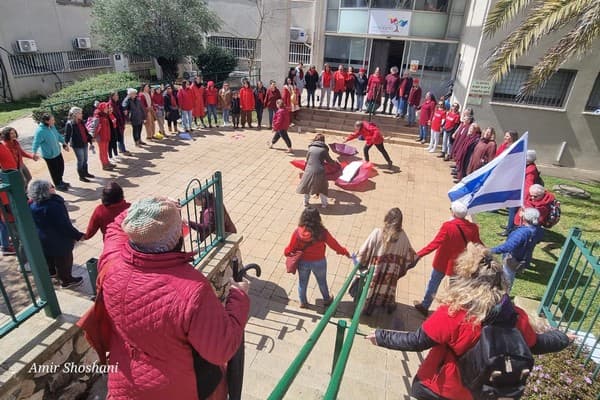
adma/bonot alternativa singing protest (Amir Shoshani)

If Hayut’s story is any indication, the issue may finally be getting some attention. At the demonstrations last week, groups of women sang, Ein li eretz acheret (I have no other land), composed by Koreen Elal, to incorporate women’s exclusion into the message of the protests. And Hayut received an apology from the Ministry of Education that ran the event where she was cancelled.

“It was amazing,” Carmel says. “We organised the singing protest in under 24 hours, and women all over responded. They sang together with Hayut’s mother in a heart-warming display of solidarity. We succeeded in getting attention for the exclusion of women in music. At least for now. It’s not over yet.”

Photo: Kadma founder Amit Amitay (Nicky Trok)

You might also like
  • ‘L’chaim for the next 1,500’: Israeli drummer celebrates Cirque Du Soleil milestone
    Gideon Cohen
  • Rachel Moshel: Creating a space for Jewish art and joy
    Gideon Cohen
  • I’m a Jewess and I’m owning the term 
    Leila Segal
logomark.67a07ee3
We believe in the free flow of information

Republish our articles for free, online or in print, by using our Creative Commons licence

You might also like

    Pearly Spurtle
    FeatureArts & Culture

    Israeli ingredients a recipe for ‘Pearly Spurtle’

    Gideon Cohen
    Article Image
    FeatureArts & Culture

    What to see at the 2026 Jewish International Film Festival

    Kathy Laster
    MJBW main
    FeatureArts & Culture

    Melbourne writers fest a place of connection both outward and inward

    Peter Kohn

About the author

Elana Sztokman

Elana Sztokman

Dr Elana Sztokman is an award-winning Jewish feminist author, anthropologist, and activist. Her latest book is 'When Rabbis Abuse: Power, Gender, and Status in the Dynamics of Sexual Abuse in Jewish Culture'.

More from the author

ReflectionIsrael

How I changed my mind about the Zionist narrative

ReflectionIsrael

The painful process of truly listening to Palestinian pain

Israel

Signs of change on the streets of Jaffa