Aa
  • Read, Watch, Listen
  • TJI Series
  • Community Action
  • Events
  • Zedi
Follow us and continue the conversation
  • LinkedIn
  • Instagram
  • FaceBook
  • X
  • YouTube
Test yourself with the TJI Quiz!

Adjust size of text

Aa

Follow us and continue the conversation

  • LinkedIn
  • Instagram
  • FaceBook
  • X
  • YouTube

Your saved articles

You haven't saved any articles

What are you looking for?

Original reporting, insightful analysis and diverse views, delivered straight to your inbox

  • LinkedIn
  • Instagram
  • FaceBook
  • X
  • YouTube
Your support fuels our mission to inform, entertain and inspire.

The Jewish Independent is bound by the Standards of Practice of the Australian Press Council. If you believe the Standards may have been breached, you may approach The Jewish Independent or make a complaint to the Australian Press Council in writing at www.presscouncil.org.au. The Council may also be contacted on 1800 025 712.

  • Our Story
  • Contact us
  • Our Team
  • Support us
  • Guidelines
  • Pitch your idea
  • Republishing us
  • Community Action
  • Our Awards
  • LinkedIn
  • Instagram
  • FaceBook
  • X
  • YouTube
Aboriginal FlagTorres Strait Islanders Flag

The Jewish Independent acknowledges Aboriginal and Torres Strait Islander peoples as the Traditional Owners and Custodians of Country throughout Australia. We pay our respects to Elders past and present, and strive to honour their rich history of storytelling in our work and mission.

© The Jewish Independent 2026All Rights Reserved
Website design and development by Your Creative, MelbourneTerms & ConditionsPrivacy Policy
HomeRead, Watch, ListenAustralia
Australia

Honouring RBG: ‘A life profoundly linked to change’

Michael Visontay
Print this

Published: 17 March 2023

Last updated: 5 March 2024

Iconic Supreme Court Judge Ruth Bader Ginsburg was celebrated in a Sydney Jewish Writers Festival session this week.

Ruth Bader Ginsburg’s rise to the highest court of the United States came despite almost every possible barrier, said Suzie Miller, author of the play RBG, Of Many, One.

"Ruth had three strikes against her: being a woman, being a mother and being Jewish. Her family grew up poor," Miller told a Sydney Jewish Writers Festival audience this week.

Heather Mitchell, the acclaimed actor who played the iconic judge in the Sydney season, added that despite the challenges the law was a natural career for Ginsburg.

 “She understood injustice from an early age; before she knew what the word meant. The law was a great fit for her understanding of injustice.”
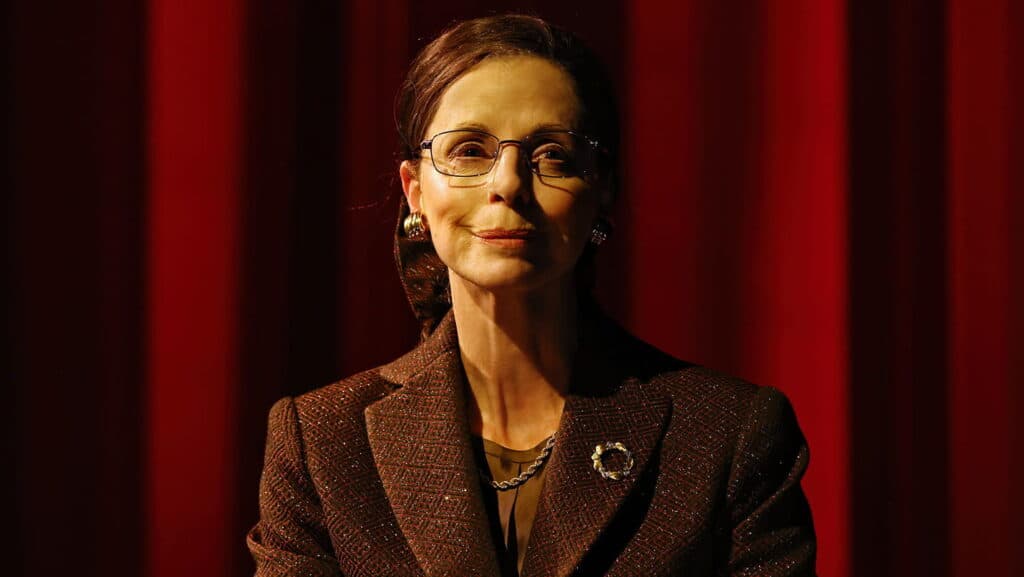
Heather Mitchell as RGB in the Sydney Theatre Company production (Courtesy STC)

After their success with the play, which sold out in Sydney last year, Miller and Mitchell held another Sydney audience enthralled on Wednesday night as they discussed the life and achievements of the woman who has come to be known simply as RBG.

In an event for the Sydney Jewish Writers Festival, Miller and Mitchell were in conversation with journalist and broadcaster Michaela Kalowski before a packed auditorium at the Emanuel School in Sydney's east.

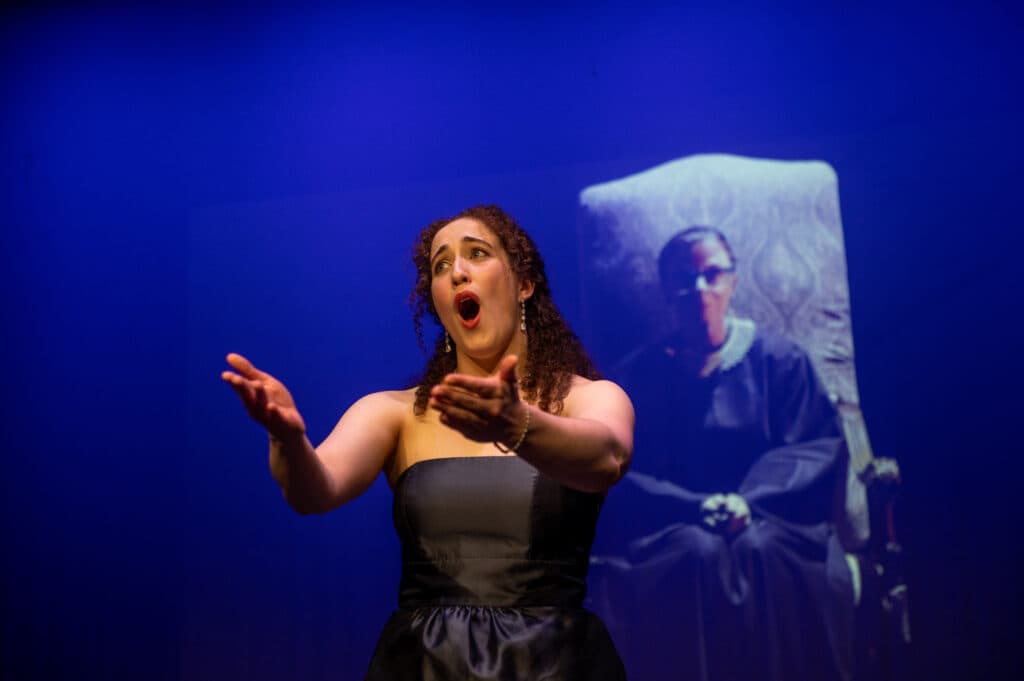
The discussion was held on what would have been Ginsburg’s 90th birthday and in honour of the anniversary, opera singer Elizabeth Cooper opened proceedings with a quartet of arias and songs that celebrated Ginsburg’s lifelong passion for opera. 

Miller and Mitchell took up where the music left off, speaking with relish and reverence about the intertwined personal and professional hallmarks of Ginsburg's life. To underscore the vibrancy of her tenacious character, Mitchell also broke into her onstage character at several moments during the evening, which drew rousing applause from the audience.

Ginsburg's career was distinguished by her advocacy for women's rights both as an attorney and on the Supreme Court. Her dissenting judgments on equal pay cases in the predominantly conservative court were taken up by president Barack Obama and adopted into legislation. But it wasn’t just equality for women that drove Ginsburg, Miller said. It was also equality for men, the opportunity to live and function in a different way with women.

Opera singer Elizabeth Cooper at the event

"When Ginger Rogers danced with Fred Astaire, she danced backwards in high heels, but people just thought it was Fred dancing," Miller said. "I think women have been dancing backwards in high heels through life. Ruth had that awareness, and that's what fuelled her."

But she was also driven by a great optimism and zest for life," Mitchell added. "She saw women as they were before they had social constructs built around them. She saw people as equals."

In that vein, "the play was written in a way to invite men to be more like [Ginsburg's husband] Marty," said Miller, referring to domestic responsibilities he fulfilled that enabled his wife to pursue her career to the fullest. "It’s not enough to believe in equal rights. You have to live it," she added.

Miller said she wrote the play with Mitchell in mind. Although they were friends and Mitchell bore a good likeness to the character, the playwright said there was another reason. "Many years ago, I saw her play an 11-year-old boy in a production of Cloud Nine, and I said 'clock that' for later, referring to the passage of time Mitchell travels as RBG, from young girl to older woman.

In reference to Ginsburg's late-career judgments, she may have been "guilty of too much hope," Miller said. "She thought that [Hilary] Clinton would win in 2016 and use her dissenting arguments." But Donald Trump beat Clinton and proceeded to "rattle the institutions of justice", Miller said. "Ginsburg's commitment to the separation of powers between the executive and the judiciary was something a lot of people didn't understand."

Her decision not to resign, while under pressure from Trump to make way for a younger, more conservative judge, was an expression of her commitment to that separation of powers, she said.

When Mitchell was asked what she drew on to bring alive that combination of optimism, tenacity and social conscience, she pointed to her research into Ginsburg's family. "Ruth had a very rich life, loving parents, especially her mother, who gave her great advice. "Never raise your voice. Be your own person find your own voice.

"The key about Ruth was the voice. For me, the process was about finding Ruth’s voice."

As she dug further, Mitchell said she found a remarkable range of similarities with her character. "I was brought up in a Jewish household, my mother died while I was doing my last exam at school, and so did Ruth's, my husband's name is Marty, and he's my rock (which drew laughter).

"We've both had cancer; I've had it twice; she had it three times. We both have two kids, and I'm American as well as Australian, and ... I played a judge once. And she looks very like my grandmother.

"I just felt such a connection with her, to be able to speak words she had said was a great privilege; every performance."

Mitchell said that getting the accents right - in addition to Ginsburg, she also played Bill Clinton, Obama and Trump - was a challenge.

"When Ruth got older, her bite changed, maybe she had some dental work done, and her voice changed from her younger days as a student at Cornell. But I had a wonderful voice coach."

At the end of a vibrant hour of conversation and some impromptu theatre, Kalowski asked both what they hoped future audiences might take away from seeing the play.

Mitchell: "To be inspired, moved, to feel that life is a wonderful journey."

Miller: "I think that she offers a template by which we can live a good life, a life profoundly linked to change."

Photos: Kathy Luu 

You might also like
  • Books: A mother’s anxiety, a Millenial’s insecurity and a sexual seachange
    Aviva Lowy
  • Scarlett, Bernie, RBG, Kushner, Zuckerberg – a huge year for U.S. Jews
    Dan Coleman
  • RBG: Death of a titan in a time of turmoil
    Dan Coleman
logomark.67a07ee3
We believe in the free flow of information

Republish our articles for free, online or in print, by using our Creative Commons licence

You might also like

    Jewish word map
    FeatureArts & Culture

    Was the barmi a shemozzle? How Australians use Jewish words 

    Caroline Hendy & Emma Breslow 1
    Royal Commission final
    Royal CommissionNewsAustralia

    Strategies for cohesion final focus of Royal Commission hearings

    Peter Kohn 1
    funding handouts
    NewsAustralia

    Who will get the money from the Cranbourne windfall?

    Gideon Cohen

About the author

Michael Visontay

More from the author

NewsAustralia

Matt Chun’s hate speech prompts change in arts funding policy

AnalysisAustralia

Mishandled antisemitism education is not just ineffective, it’s dangerous

FeatureLifestyle

Where Shtisel meets The Jetsons

ReviewIsrael

Beinart’s utopian vision ignores awkward truths