Aa
  • Read, Watch, Listen
  • TJI Series
  • Community Action
  • Events
  • Zedi
Follow us and continue the conversation
  • LinkedIn
  • Instagram
  • FaceBook
  • X
  • YouTube
Test yourself with the TJI Quiz!

Adjust size of text

Aa

Follow us and continue the conversation

  • LinkedIn
  • Instagram
  • FaceBook
  • X
  • YouTube

Your saved articles

You haven't saved any articles

What are you looking for?

Original reporting, insightful analysis and diverse views, delivered straight to your inbox

  • LinkedIn
  • Instagram
  • FaceBook
  • X
  • YouTube
Your support fuels our mission to inform, entertain and inspire.

The Jewish Independent is bound by the Standards of Practice of the Australian Press Council. If you believe the Standards may have been breached, you may approach The Jewish Independent or make a complaint to the Australian Press Council in writing at www.presscouncil.org.au. The Council may also be contacted on 1800 025 712.

  • Our Story
  • Contact us
  • Our Team
  • Support us
  • Guidelines
  • Pitch your idea
  • Republishing us
  • Community Action
  • Our Awards
  • LinkedIn
  • Instagram
  • FaceBook
  • X
  • YouTube
Aboriginal FlagTorres Strait Islanders Flag

The Jewish Independent acknowledges Aboriginal and Torres Strait Islander peoples as the Traditional Owners and Custodians of Country throughout Australia. We pay our respects to Elders past and present, and strive to honour their rich history of storytelling in our work and mission.

© The Jewish Independent 2026All Rights Reserved
Website design and development by Your Creative, MelbourneTerms & ConditionsPrivacy Policy
HomeRead, Watch, ListenAustralia
Generation ChangeInterviewAustraliaLifestyle

Jaimee Krawitz: changing the eating disorder conversation

27-year-old Krawitz is on a mission to change the language around disordered eating for individuals, caregivers and educators, using her own lived experience to inform her newly-established support non-profit, Hide N Seek.
Ruby Kraner-Tucci
Print this
Jaimee Krawitz

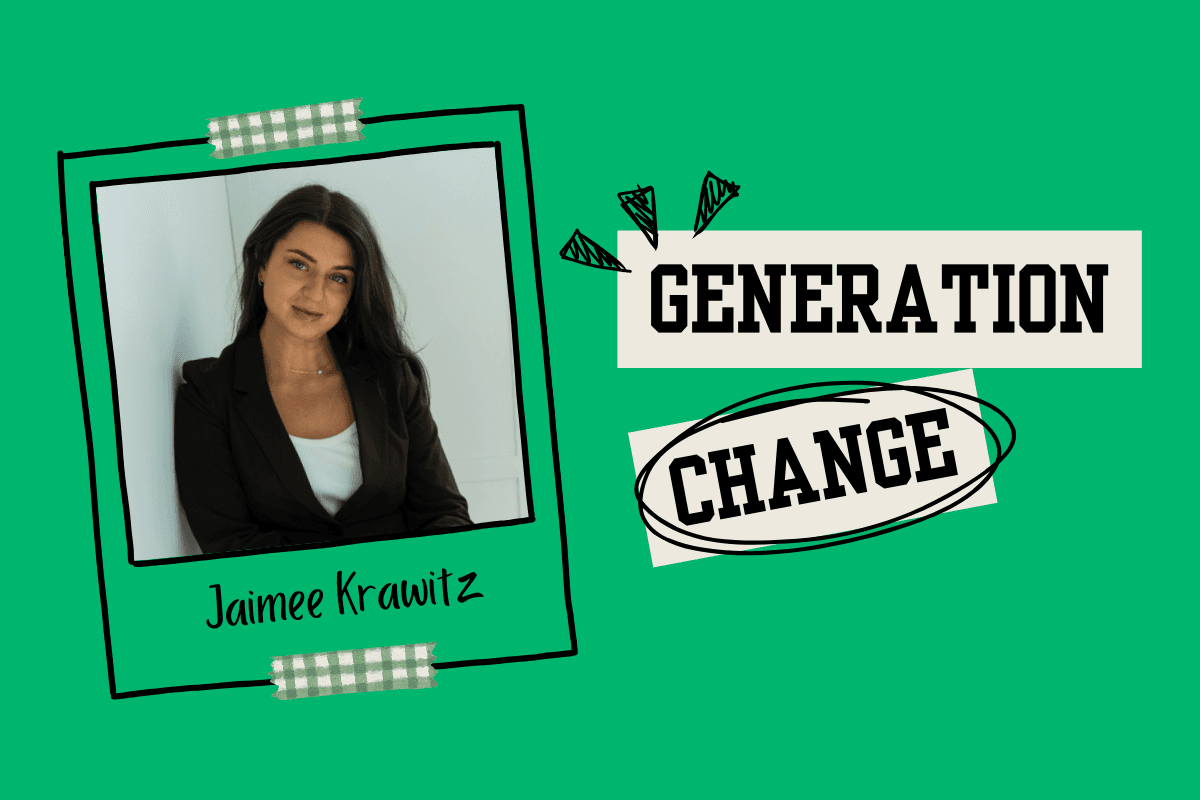
Jaimee Krawitz is the founder of eating disorder support non-profit Hide N Seek (Image: TJI).

Published: 13 March 2025

Last updated: 15 September 2025

Approximately 1.1 million Australians live with an eating disorder. Why did you decide to set up a support non-profit in this space?

It started off in 2020, when I finished my Bachelor of Counselling degree. I had been meeting with Dean Cohen, who stared Flying Fox and was a mentor to me. I wanted to start something on my own and Dean helped me think about the endeavour being meaningful.

I have a lived experience of an eating disorder, and was set on exploring that area because it's close to my heart. I want to help people who don't have the same opportunities or resources that I had. My recovery was very quick. I got in early because I had the right healthcare around me, but if I'd spoken up a little bit earlier, I would have had even more help than I did. Having the communication skills, language and awareness – both for me and my parents – to open a conversation around eating disorders at an early stage would have been a game changer.

Coincidentally, at the time I was thinking about this, it was COVID and eating disorder rates completely skyrocketed. I knew that I was in the right field at the right time.

How did you go from initial concept to launching Hide N Seek?

I didn’t want to solely target the person who was suffering from an eating disorder, I really wanted to reach the support people, the caregivers.

I started off by having a few open table conversations, which involved affected people, caregivers and practitioners, and learnt about the biggest issues in the sector. I was then asked to be part of a Hackathon with Australian Friends of Shaare Zedek, which involved people around Australia, America, Israel and Mexico discussing the concept of eating disorders and what we could do.
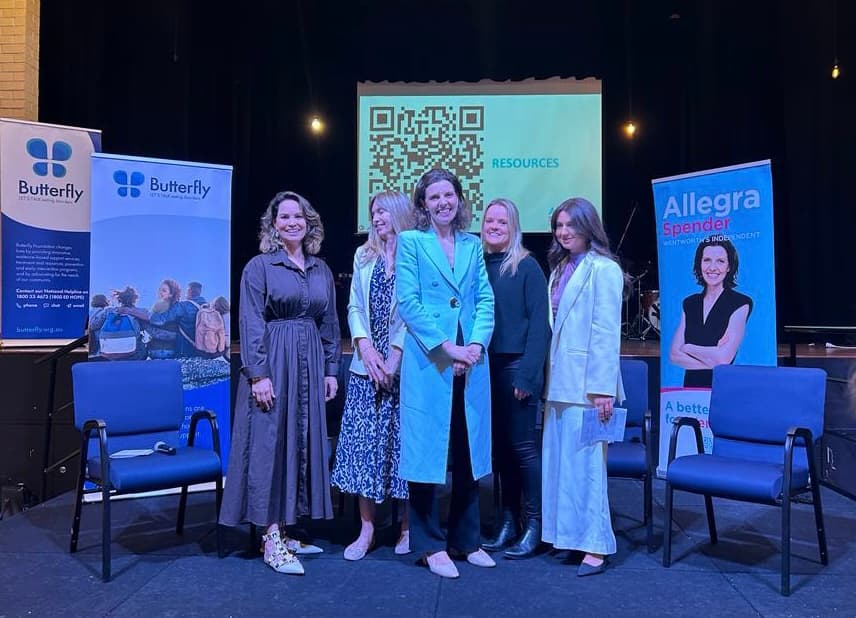
Krawitz (RHS) was invited to speak at an expert panel discussion about body image arranged by Wentworth MP Allegra Spender (middle). (Image: supplied)

Out of those experiences, I put together an educational resource book on how to support someone experiencing an eating disorder called ‘The Language of Seeking Help’, which was endorsed by doctors and professors at The Royal Children's Hospital.

Someone from the hospital said the resource was amazing and asked about my future. My dream was to build an organisation and so I brought all my mentors together – they became my board – and came up with the name, Hide N Seek. It’s evolved into the most life changing experience for me.

Tell me about the name – how did you land on it?

I was going back and forth for ages! I didn't want the name to necessarily be associated with eating disorders in a heavy and serious way. The meaning behind Hide N Seek is around hiding away from the issue and then seeking help. We are trying to take people away from suffering in silence to pushing them to seek the right help at the right time.

"I felt as though my Jewish connection especially deepened when I started Hide N Seek."

Jaimee Krawitz

Hide N Seek harnesses the power of language to change the way people speak about eating disorders. While we’re still in the early stages, we've got a board, we've got medical advisors who specialise in eating disorders, and our community is growing. When I do public speaking events, several people come up to me to share their story, how they’re struggling, and how impactful our work is.

For now, our work is mostly educational, but the dream down the line is to build a hub where we can have a multi-disciplinary clinic with different practitioners for people to have access to and avoid waitlists.

Why did you decide to focus specifically on carers of people with an eating disorder?

Parents and carers are as heavily involved in this process as the individual, because an eating disorder isn't only impacting the individual, it's impacting the whole family. It's critical for supporters to take the time to understand where their affected person is coming from. Disordered eating occurs on a significant spectrum and with a range of associated behaviours.

When I had my eating disorder, people didn’t know what to do or say. They often just wanted to intervene, because as parents and as caregivers, we only want to help and provide solutions. But it's not only about the solution, it's about how we respond along the way – how we talk about it, how we continue to check in and how we open the dialogue.

How should someone respond to a friend or family member with an eating disorder?

It’s important to let the affected person come to you when they're ready, because a lot of the time, they're not going automatically disclose their eating disorder. 

"Eating disorders can be a very long journey, so you have to be patient, and you have to learn how to open up the conversation."

Jaimee Krawitz

As a first step, begin with soft questions to open a conversation in a way that feels safe for them and helps break down those barriers. You could say ‘I’ve noticed there’s something about you that isn’t 100% right’ or ‘I’m just checking in to see if you’re okay’.

Letting them know that you are there to support them is important, for example by saying, ‘I’m here for you whenever you’re ready to speak’ or ‘we don’t have to talk now but I’m just starting the conversation for you’. Young people want to know how you’re going to respond or react to the situation as well, so keeping things calm and approachable is critical.

The biggest thing to remember is to not attack the person. Questions like ‘what’s wrong with you?’, ‘why are you acting so differently?’, ‘what’s going on?’ or ‘why are you being so difficult?’ are not going to work effectively. You also want to guide the person to reaching the right kind of help, and look out for the early warning signs so you can intervene when needed – whether that’s a different mood or social isolation for example.

Almost a third (27%) of eating disorder cases in Australia are among those aged 10-19. How big of an influence is social media on the development of eating disorders in young people?

It’s easy to blame social media and it certainly has a strong impact. This connection was shown through a 2023 US study which found that 42% of young people aged 14–25 had probable eating disorders, and 41.7% showed signs of social media addiction, highlighting a significant link between social media use and disordered eating behaviours.

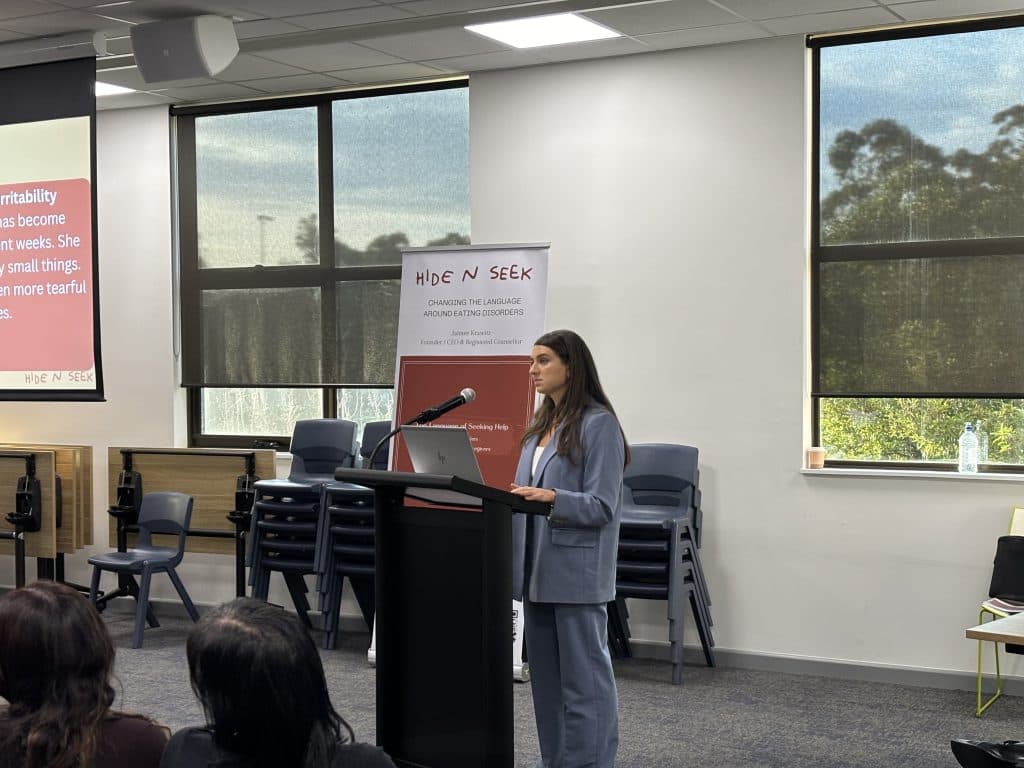
Krawitz: "When I do public speaking events, several people come up to me to share their story, how they’re struggling, and how impactful our work is". (Image: supplied)

People are easily influenced by social media, but they are also influenced by words and the way they speak to themselves. You can talk to yourself in a positive light, even when you're looking at social media. Instead of going straight to comparison, you could try seeing the person online as inspiring. It’s about that internal dialogue – social media is always going to be there but it’s about how to view it.  

If you feel comfortable, can you tell us about your journey with disordered eating?

I was 12 years old, which was very, very young. It wasn’t pleasant being in that mindset. I quickly realised that I didn’t want to live my life constantly thinking about and monitoring my food and exercise.

I got in at an early stage and things turned around very quickly for me. I've always felt very grateful for having a supportive family, friends and doctors. I sought the right help when I needed to.

What made the biggest difference to your trajectory?

I remember everyone constantly sharing their opinions about which health professional to see or clinic to attend. My parents didn’t know what to do, but they taught themselves a lot and became a fantastic guide for me.

"Everyone has their own journey, their own experiences, their own story – which means everyone can bring a different lesson into the community."

Jaimee Krawitz

Education and awareness are the core of Hide N Seek. We go into schools across south-east Melbourne and run our ambassador program, where we empower and train educators to become champions in this space – essentially eating disorder gurus. Ambassadors learn to recognise early signs of eating disorders, dispel myths and misconceptions, and facilitate effective communication about seeking help. They also lead by educating other teachers, parents and therefore students on these topics.

How does your counselling background fit with your work at Hide N Seek?

My private counselling work is separate, but Hide N Seek draws on the same skillset. As a counsellor, I’ve worked in schools, research institutes and private practice. I specialise in eating disorders, family-based therapy and couples’ therapy.

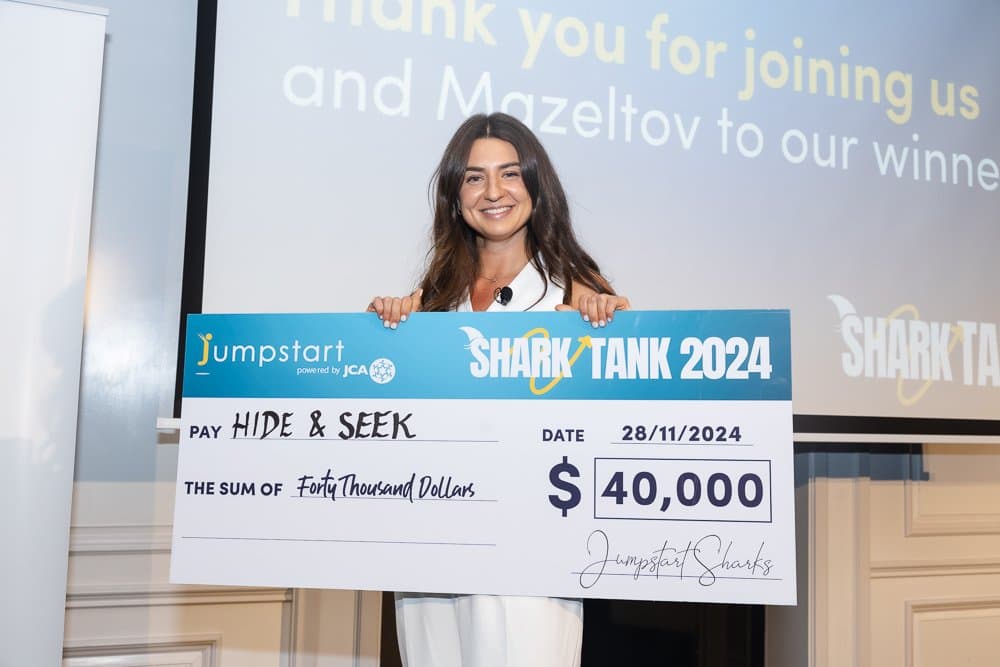
Krawitz won the 2024 Jewish Communal Appeal (JCA) Shark Tank event, and was awarded $40,000 for <em>Hide N Seek</em>. (Image: Giselle Haber/JCA)
Krawitz won the 2024 Jewish Communal Appeal (JCA) Shark Tank event, and was awarded $40,000 for Hide N Seek. (Image: Giselle Haber/JCA)

The leading interventions for eating disorders are family-based therapy and CBT, cognitive behavioural therapy. I certainly use this framework within Hide N Seek because it’s all about communication. Eating disorders can be a very long journey, so you have to be patient, and you have to learn how to open up the conversation both within the family unit and with the affected person.

How does your Jewish background intersect with your work and values?

I grew up at Mount Scopus, and I’m still very much involved in the Jewish community today. I’ve volunteered with Flying Fox and Friendship Circle, but I felt as though my Jewish connection especially deepened when I started Hide N Seek.

It all started with the Australian Jewish Funders. Their networking program really helped me meet a lot of amazing community leaders. I’ve connected with rabbis, rebbetzins and school directors who have given me opportunities to speak about and launch my organisation. I've also participated in UIA and JCA philanthropy programs, and was asked to join The Observership Program with Thread Together, all of which helped my connections and knowledge. Last year, I won JCA’s Shark Tank event and was awarded $40,000 for Hide N Seek.

What does social impact mean to you?

Making social impact is about making a mark in the community. Everyone has their own journey, their own experiences, their own story – which means everyone can bring a different lesson into the community. If we learn to listen, we can learn from one another and grow for the better.

You might also like
  • Antisemitism, homophobia and a radical response to both
    Dennis Altman
  • Facing a new year with the knowledge life can be better
    The Jewish Independent
  • Was the barmi a shemozzle? How Australians use Jewish words 
    Caroline Hendy & Emma Breslow
logomark.67a07ee3
We believe in the free flow of information

Republish our articles for free, online or in print, by using our Creative Commons licence

You might also like

    ANNIKA WELLS PRESSER
    Israel Hamas WarNewsAustralia

    No action to stop Hezbollah ally beaming antisemitic and anti-Israel content into Australia

    Michael Visontay
    vandalism car woollahra fuk israel farhat
    Australia

    Court decision fails to understand when ‘Fuk Israel’ becomes antisemitic

    Jeremie Bracka 6
    Rosh Hashanah Customs
    FeatureLifestyle

    10 little-known Rosh Hashanah customs from around the world

    Menachem Posner

About the author

Ruby Kraner-Tucci

Ruby Kraner-Tucci

Assistant Editor

Ruby Kraner-Tucci is a journalist and TJI's assistant editor. Her writing has appeared in The Age, Australian Jewish News, Time Out and Broadsheet, among others. Ruby was awarded Multicultural NSW’s Best Report in Multicultural Media 2025 and has been named a Top 36 Under 36 Jewish Changemaker by B'nai B'rith.

More from the author

FeatureAustralia

‘True essence of being an ally’: The non-Jews choosing to work in the Jewish community

InterviewAustralia

Elliot Szafran: food that feels like a hug from Zaide

NewsAustralia

Antisemitic incidents down from peak but still triple pre-Gaza war

FeatureArts & Culture

Bringing Terezin music to life 

Comments

No comments on this article yet. Be the first to add your thoughts.