Aa
  • Read, Watch, Listen
  • TJI Series
  • Community Action
  • Events
  • Zedi
Follow us and continue the conversation
  • LinkedIn
  • Instagram
  • FaceBook
  • X
  • YouTube
Test yourself with the TJI Quiz!

Adjust size of text

Aa

Follow us and continue the conversation

  • LinkedIn
  • Instagram
  • FaceBook
  • X
  • YouTube

Your saved articles

You haven't saved any articles

What are you looking for?

Original reporting, insightful analysis and diverse views, delivered straight to your inbox

  • LinkedIn
  • Instagram
  • FaceBook
  • X
  • YouTube
Your support fuels our mission to inform, entertain and inspire.

The Jewish Independent is bound by the Standards of Practice of the Australian Press Council. If you believe the Standards may have been breached, you may approach The Jewish Independent or make a complaint to the Australian Press Council in writing at www.presscouncil.org.au. The Council may also be contacted on 1800 025 712.

  • Our Story
  • Contact us
  • Our Team
  • Support us
  • Guidelines
  • Pitch your idea
  • Republishing us
  • Community Action
  • Our Awards
  • LinkedIn
  • Instagram
  • FaceBook
  • X
  • YouTube
Aboriginal FlagTorres Strait Islanders Flag

The Jewish Independent acknowledges Aboriginal and Torres Strait Islander peoples as the Traditional Owners and Custodians of Country throughout Australia. We pay our respects to Elders past and present, and strive to honour their rich history of storytelling in our work and mission.

© The Jewish Independent 2026All Rights Reserved
Website design and development by Your Creative, MelbourneTerms & ConditionsPrivacy Policy
HomeRead, Watch, ListenArts & Culture
Israel Hamas WarReflectionArts & CultureIsrael

Jonah’s unfinished story echoes louder after October 7

Contemplating an ambivalent prophet on the holiest day of the Jewish year carries a perfect message for those of us mired in the moral complexity of Jewish life after October 7.
Leah Justin
Print this
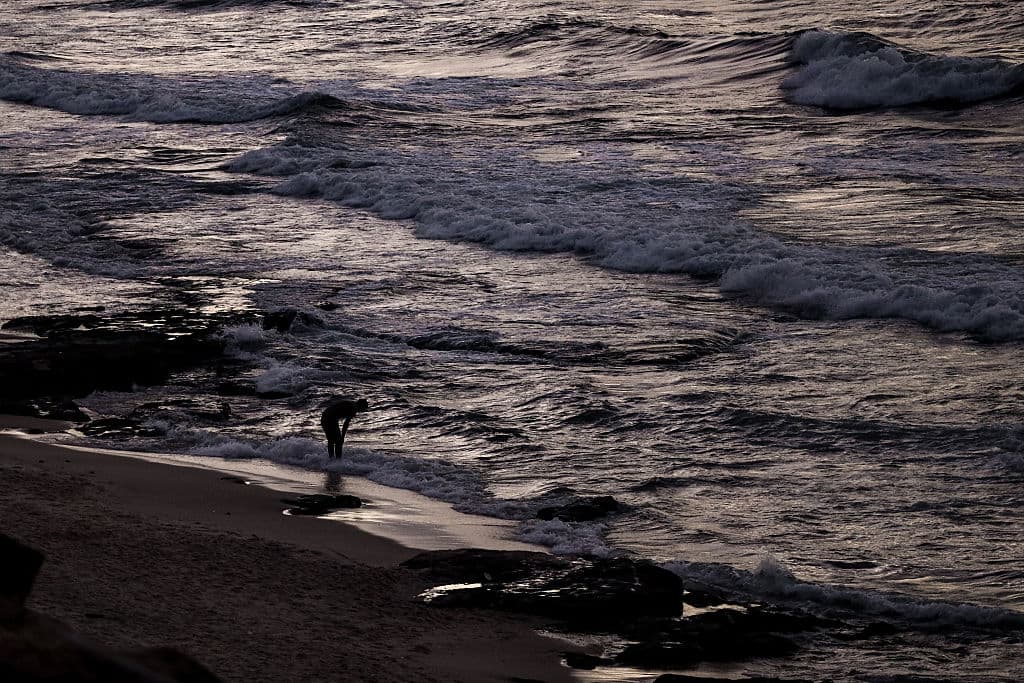
A man on the edge of the sea in the Nuseirat area of Gaza City, where people continue their daily lives despite the continuing war (Khames Alrefi/Anadolu via Getty Images)

A man on the edge of the sea in the Nuseirat area of Gaza City, where people continue their daily lives despite the continuing war (Khames Alrefi/Anadolu via Getty Images)

Published: 6 October 2025

Last updated: 6 October 2025

Every past year as we read the story of Jonah on Yom Kippur, my response has been: Really?

Why on earth is this story here and now? Not the prophet on the mountain top. Not Moses with the tablets. Not Elijah in a fiery chariot.

Instead, on the most important day of the Jewish year, we get Jonah. Jonah – who is not even a particularly enthusiastic prophet. Flawed, scared, defiant, avoidant and resentful.

But maybe that’s the point. Maybe that’s why he is perfect to read as we approach the end of Yom Kippur. He is a figure not sure what to do in a world that doesn’t make moral clarity easy.

Jonah’s most radical act is in extending recognition, in seeing the citizens of Nineveh as human

Possibly he is the most human of the prophets because he struggles with change.

When Jonah is called to Nineveh, he runs - not because he’s lazy or rebellious, but because he is afraid. Afraid that the people he’s been taught to despise might actually be redeemable. Afraid that compassion might cost him his certainty, his identity, his tribe.

Jonah’s call is that inner nudge we all feel when we see suffering and remain silent, when we know we should speak out but fear the consequences. It’s about wrestling with moral responsibility. Jonah flees from what he knows he should do.

Nineveh isn’t just some ancient city. It’s any place where we have been taught to fear, dismiss and avoid. For some today Nineveh might look like Gaza. It may be the left or the right of politics. It may be the person who posts things we don’t agree with.
To enter Nineveh is to face the humanity of the other. To break from the comfort of binary thinking and enter the complex world of empathy and justice.

Jonah boards a ship and, when he admits his running has brought a storm, is thrown overboard and eaten by the whale. But Jonah emerges, changed by introspection and goes to speak to the citizens of Nineveh, not in hate but in hope.

Jonah’s most radical act is in extending recognition, in seeing the citizens of Nineveh as human, capable of change.

Yet when Nineveh repents, Jonah is furious. He sits under a tree and sulks. He cares more for the shade of a withered tree than for a city of living souls. He wanted justice, not mercy. He wanted the world to be neat – the good rewarded, the bad punished. And don’t we all?

When we avoid moral complexity, it still finds us. The storm still comes.

For Jonah, mercy feels like betrayal, not of truth but of loyalty to his own people.

The story ends ambiguously with discomfort not clarity, as God asks him: Should I not care for Nineveh, that great city with its people and animals?

And then there is silence. We never hear Jonah’s answer. Because Jonah’s story doesn’t end on the page. It ends in us. Do we choose anger or compassion?

Since October 7 many of us have felt shattered and numbed. Violated and betrayed. The grief, trauma and fear are still real.

The images from Gaza are also heartbreaking: the devastation and deaths that we cannot bear to look at and yet cannot look away from.

It feels almost unbearable to hold both truths at once.

It’s hard to release hate, to let go of feelings of revenge, but if we don’t find a way to acknowledge others’ suffering, we too become trapped in our own fear like Jonah in the whale.

Jonah shows us that real loyalty is not blind allegiance but the courage to speak difficult truths– without exception. And to challenge in the hope of change.

Morality is not a zero-sum game. One person’s humanity doesn’t justify another’s affliction. We don’t diminish Jewish suffering by seeing the suffering of Palestinians.

It’s tempting to retreat and find comfort only among those who agree with us. Jonah’s message is a call to seek out the humanity in others even when it threatens our sense of righteousness.

As the late Lord Rabbi Jonathan Sacks reminds us: “You can run away from responsibility, but you can’t run away from the consequences of running from responsibility.”

When we avoid moral complexity, it still finds us. The storm still comes.

The bereaved David Grossman, writing the eulogy for his beloved son who died in the Lebanon War in 2006, insisted that, “Even when pain and hatred threaten to harden us, we must struggle to stay human. To feel. To see. Otherwise, we turn into Jonah. Not the prophet but the man who could no longer see anything but his own fear.”

Now I begin to understand why we read Jonah on Yom Kippur: not because we need to be scared into repentance, but because we need to be reminded that transformation is still possible.

May we all find the courage to emerge from our own stillness, our own stasis, our own whale, with the stubborn but hopeful belief that another future is possible.

Because to give up believing in a world in which our children and grandchildren’s future and Israel’s existence is assured, is simply not an option.

For if Jonah teaches us anything, it is that the story is unfinished—and it is we who must write the next chapter with courage and optimism.

This article is an edited and shortened version of a dvar Torah given at Kolenu this Yom Kippur.

You might also like
  • Jewish Futurism? We’ve been practising it for millennia 
    Renata Zimbarg
  • Diaspora leadership must be candid about its disillusion with Netanyahu
    Colin Shindler
  • Flying to vote is an act of love, not impudence
    Shahar Burla
logomark.67a07ee3
We believe in the free flow of information

Republish our articles for free, online or in print, by using our Creative Commons licence

You might also like

    Pro-Palestine Rally Outside Foreign Commonwealth Development Office
    AnalysisWorld

    UK’s dramatic policy change on Israel-Palestine

    Colin Shindler 3
    Woman with land and houses behind her
    NewsAustralia

    Australia to increase sanctions against West Bank settlements

    Deborah Stone 2
    Ms. Foundation Women of Vision Awards: Celebrating Generations of Progress & Power
    ReflectionWorld

    My memory of Gloria Steinem

    Michael Visontay

About the author

Leah Justin

Leah Justin

Leah Justin is the co founder and co-director of the Justin Art House Museum / JzaHM, which uses contemporary art to explore big ideas. She was formerly the Community Education Director at the Jewish Museum of Australia.

Comments2

  • Avatar of Ian Grinblat

    Ian Grinblat8 October at 05:21 am

    Loved this article!
    As humans, we must never cease the quest for some moral understanding, and the hope for forgiveness.
    On Yom Kippur, as we repeatedly remind God that as our creator, he formed us and he knows us intimately, we realise that his forgiveness is guaranteed provided we never abandon our quest for that elusive moral understanding.

  • Avatar of Evie Katz

    Evie Katz7 October at 06:09 am

    Greaticle Leah. I like this interpretation