Aa
  • Read, Watch, Listen
  • TJI Series
  • Community Action
  • Events
  • Zedi
Follow us and continue the conversation
  • LinkedIn
  • Instagram
  • FaceBook
  • X
  • YouTube
Test yourself with the TJI Quiz!

Adjust size of text

Aa

Follow us and continue the conversation

  • LinkedIn
  • Instagram
  • FaceBook
  • X
  • YouTube

Your saved articles

You haven't saved any articles

What are you looking for?

Original reporting, insightful analysis and diverse views, delivered straight to your inbox

  • LinkedIn
  • Instagram
  • FaceBook
  • X
  • YouTube
Your support fuels our mission to inform, entertain and inspire.

The Jewish Independent is bound by the Standards of Practice of the Australian Press Council. If you believe the Standards may have been breached, you may approach The Jewish Independent or make a complaint to the Australian Press Council in writing at www.presscouncil.org.au. The Council may also be contacted on 1800 025 712.

  • Our Story
  • Contact us
  • Our Team
  • Support us
  • Guidelines
  • Pitch your idea
  • Republishing us
  • Community Action
  • Our Awards
  • LinkedIn
  • Instagram
  • FaceBook
  • X
  • YouTube
Aboriginal FlagTorres Strait Islanders Flag

The Jewish Independent acknowledges Aboriginal and Torres Strait Islander peoples as the Traditional Owners and Custodians of Country throughout Australia. We pay our respects to Elders past and present, and strive to honour their rich history of storytelling in our work and mission.

© The Jewish Independent 2026All Rights Reserved
Website design and development by Your Creative, MelbourneTerms & ConditionsPrivacy Policy
HomeRead, Watch, Listen
Opinion

Letter from both sides of the Gaza border: things people may not know

Manar Al-Sharif
Print this

Published: 8 February 2022

Last updated: 4 March 2024

MANAR AL-SHARIF talks to two women, an Israeli and a Palestinian, living either side of the border, about their desire to become neighbours again

ADELE RAEMER, WHO lives on Kibbutz Nirim, on the border with the Gaza Strip, says she has between zero and ten seconds to reach shelter when her community receives an alert warning her of an incoming rocket attack from Gaza.

"I am still blogging because I feel compelled to act. I give interviews, tell our story, and express the humanity that my community and I share with our Arab neighbours just a few miles away, across the border. Unfortunately, I do not see this perspective represented in the media," she told The Jewish Independent.

Adele is the founder and moderator of the Facebook group "Life on the Border, things people may not know (but should)," a private group she created on Facebook in 2011 informing people from near and far of what’s happening on the ground.

Some Gazans have joined the group and contributed to the dialogue, but only in limited ways due to the risks involved, such as social harassment and being imprisoned for years due to the lack of human rights organisations in Gaza.

When Gazans feel compelled to say something, especially during times of escalation, they enter the group and inform the members of the situation in Gaza, Adele added.

During the most recent aggression, in May 2021, Mariam - from Gaza - and two other women - from the United States and Norway - participated in a dialogue in the group, with hopes of reaching out to the people and supporting them in various ways.

Mariam used her energy and courage to inform the people on the other side of the border of what was happening on her side. "I really feel sorry for both you and the people of Gaza, because I believe we are all the victims, who do not benefit from the conflict," she says.
“We do not hate you," Mariam added in her posts, insisting that children in her community are not taught to hate Israelis in their schools. "My father used to work in Israel, and he liked the Israelis very much. Sometimes, he even said that some of them are actually better than Arabs."

"The incoming [Israeli] rockets frighten our children. I tell my husband to let them watch some videos on YouTube to distract them," Mariam posted.

We do not hate Israelis, Mariam says, and insists that children in her community are not taught to hate Israelis in their schools.

Adele uses the same strategy with her grandchildren: "My daughter puts movies on TV so the children don't pay attention to what's going on around them." 

Raemer, who was born in the US, moved to Israel just weeks after the Yom Kippur War (1973) ended, and was immediately drafted into the Israel Defence Forces. When she first arrived at the Gaza frontier, she saw a nominal border.

But at that time, the residents could cross the boundary freely, and dozens of people from the other side would cross over as well. However, since Israel withdrew all of its settlers and soldiers from the Gaza Strip in 2005, the border has become a warzone, and Israelis can no longer have any in-person contact with their Gazan neighbours.

Israelis and Gazans can only connect virtually (through Facebook, Zoom, etc.) as a result of the blockade, imposed by Israel and Egypt after Hamas took control of Gaza in 2007.

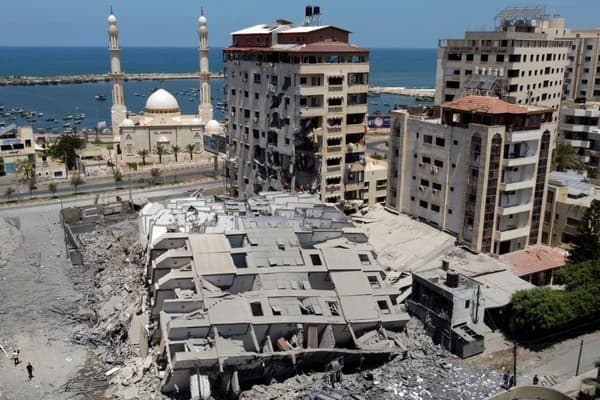
A building flattened by Israeli bombs during the May 2021 conflict

Adele is a mother and grandmother who lives and raises her family on the border. She is recently retired, after 38 years of teaching English in schools. She raised her four children in her kibbutz and now has eight grandchildren. 

The community is idyllic at times, but during military escalations, life on the border turns extremely volatile. One of Adele's daughters, with three children of her own, lives in the same kibbutz as she does: in the range of mortars, rockets, infiltration attempts, and incendiary balloons that set fire to their fields and explode overhead.

Another daughter, also with three children, lives not far away in another town, still within rocket range. Her sons live in Tel Aviv, which was also pounded by rockets during the conflict in May last year.

Her second husband, a British immigrant, suffered from bipolar disorder and committed suicide in 2008, a month and a half before the first Gaza War, known as Operation Cast Lead. This was Adele’s first real experience with war. 

When fighting broke out, so soon after losing her husband, she lacked the emotional strength to remain in a warzone without a safe place to take shelter. Her youngest son, who was in the 12th grade at the time, went to a kibbutz in the country's centre -out of rocket range-, that was hosting people from their community, and where the majority of the kibbutz children went.

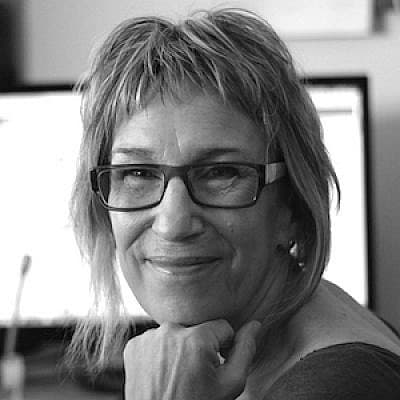
Adele Raemer
Adele Raemer

Adele couldn't accompany him because she had two dogs, and the kibbutz was not equipped to host pets; so she fled to a friend's house in Yaffo (just south of Tel Aviv) where she stayed for the majority of the fighting.

They didn't have safe rooms at the time, she explained. Each family had to figure out where the "safest" place in their house was. Often, it was little more than a hallway without any external walls or windows.

During rocket alerts, everyone in the house would have to run to that hallway, crouch down, and pray that the rockets didn't score a direct hit - in which case, nothing would protect them. 

"The majority of people on both sides are not extremists. All Israeli citizens are expected to do military service (or some sort of national service) before they go to college. I served in the army, as did my sons and daughters, and, of course, my husband,” says Adele.

I hope the Palestinians will get the opportunity to build their own state, next to ours, so we can finally live in peace, as good neighbours.

“We’re a people's army. We do what we must because we all deserve to live in safety. My granddaughters deserve to be able to play in the grass without being traumatised by incoming rockets", she stresses. 

Adele believes Israelis and Gazans could be good neighbours. She remembers a time when cooperation between them was commonplace. For example, in the early 1990s teachers from a school in Gaza came to her teachers’ office to formulate a joint educational program.

And there were plans for a maternity hospital just a few kilometres up the road, near Kissufim Crossing into Gaza, that was supposed to accommodate women from both sides of the border.

She used to drive to the beach in Gaza and go to shops in the Gazan markets, where she would buy furniture and clothing. 

Those memories give her hope that one day the situation can be turned around, that a sense of normalcy can return. Like most of the neighbouring communities around the world, there can be cross-border collaborations, rather than cross-border skirmishes and war. 

Through all of this, Adele’s ray of hope has been the knowledge that there are people on the other side of the border who want the same things that she does: to put food on their tables, clothe their children, and keep their families healthy and safe.

"The Jews are finally home in their ancestral land, no longer at the mercy of other cultures or countries to keep us safe. We saw how badly relying on others had turned out for us Jews throughout the ages - the Holocaust happened a mere 70 years ago, after all", she remembers.

She concludes: "no one wanted us then. Our Zionism has built an amazingly beautiful, wonderful country. I hope the Palestinians will get the opportunity to build their own state, next to ours, so that we can finally live in peace, as good neighbours. Preferably sooner rather than later." 

Photo: Shvil La-shalom, path to peace, Visitors Centre, in Netiv Haasara (Courtesy)

You might also like
  • Diaspora leadership must be candid about its disillusion with Netanyahu
    Colin Shindler
  • Flying to vote is an act of love, not impudence
    Shahar Burla
  • Palestinians disillusioned with Hamas and armed struggle: new survey
    Shahar Burla
logomark.67a07ee3
We believe in the free flow of information

Republish our articles for free, online or in print, by using our Creative Commons licence

You might also like

    Feature

    While still holding off the ground invasion, Israel praises Qatar over hostage talks

    TJI Wrap
    Copy of Politica Podcast Social Tiles (600 x 400 px)
    Israel Iran WarPodcastIsrael

    Politica – Israeli Politics Explained

    The Jewish Independent 1
    tame kostakidis west
    AnalysisAustralia

    How not to apologise

    Zac Klugman

About the author

Manar Al-Sharif

Manar Al-Sharif

Manar Alsharif is a Palestinian-Syrian journalist and activist who grew up in Syria. After the outbreak of the Syrian civil war, she and her family were forced to flee to Egypt before later moving to Gaza. Her journalism and activism in Gaza led to her arrest by Hamas authorities, where she spent three months in jail, including a period in solitary confinement, and endured a two-week hunger strike. She remains committed to amplifying marginalized voices and exposing the realities of repression. 

More from the author

InterviewWorld

‘Hijacking, anarchic, extreme’: How some Gazans view international pro-Palestine protesters

Mohammed’s battle for a better future for the people of Gaza