Published: 13 February 2018
Last updated: 4 March 2024
The so-called 'Marber grid', a special layout for Penguin book covers, is considered one of the most important contributions to British graphic design. It was, however, the invention of Holocaust survivor Romek Marber, a Jew from Central Poland, who was barely out of his teens when he immigrated to Britain in 1946.
A German Jewish 'enemy alien', initially interned on the Isle of Man when war broke out, spearheaded the modern concept of corporate identity. The talents of Frederick Henri Kay Henrion, formerly Heinrich Fritz Kohn, were soon put to use creating striking Allied propaganda posters.
On display is the original artwork for Four Hands (1944), a poster commissioned by the US Office of War Information, which shows four hands ripping a swastika apart: a visual display of Allied triumph over Nazi Germany.
Henrion's design consultancy would produce some of the most memorable logos in post-war British industry: trademarks for sugar company Tate & Lyle, fashion retail company C&A, and the National Theatre are instantly recognisable, even today.
Misha Black, a Jew from Baku, then part of the Russian Empire, played an integral part in refashioning the aesthetic of London's transport system. It was Black who called on fellow Jewish émigré Jacqueline Groag, born Hilde Blumberger, to redesign the fabric used on train and bus services.
Hans Unger, a German Jew who had lost several toes to frostbite when he crossed the Pyrenees escaping the Nazis, was just one of the artists Black commissioned to design murals for the Victoria Line Tube stations.
[gallery columns="2" size="medium" ids="17093,17095"]
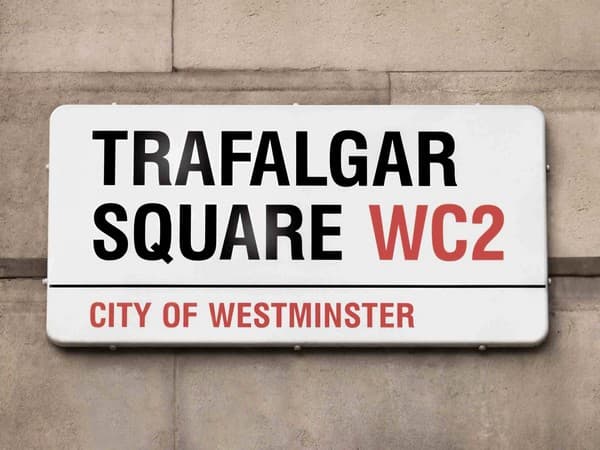
It was Black himself, however, who dreamt up London's iconic street plaques in the 1960s.
These Jewish refugees of Europe, exposed to movements like Surrealism and Modernism on the continent, radically changed the face of British design. As Marber himself put it at a Krakow retrospective of his work in 2015:
“What I made then was considered very fashionable. The English were not accustomed to this kind of art, they still had a pre-war approach. In fact, in this case, ‘pre-war’ means from the end of the 19th century.”
The Bauhaus philosophy of simplicity of concept and reduction to essentials can be spied in Hans Schleger's pre-war reinvention of the Transport for London roundel, with its classic 'bull’s-eye' reduced to a plain white bar and circle, against a red background.
Groag's distinctive red and blue, or green, orange and black grid moquettes for London Transport, were inspired by Austrian architect Josef Hoffmann, under whom Groag had studied at Vienna's prestigious Wiener Werkstätte.
"Immigration and migration and settlement is at the heart of what the [Jewish] museum does", Head of Exhibitions Joanne Rosenthal told +6IJ. "Obviously the context in which the exhibition takes place is not lost on us, and there are lots of obvious echoes [between that time and now]: the fight against the far-right and the re-emergence of fascism today has a strong kind of current running through the exhibition".
As a toxic mix of renewed nationalism and anti-immigration fervour has spread across Europe, exhibitions which broach these questions can create a helpful dialogue about these issues.
[gallery columns="1" size="medium" ids="17096"]
As for the exhibition's visitors, the majority of whom do not identify as Jews, "If there are any recurring messages, it's: 'I had no idea these individuals were Jewish, I had no idea that this work was produced by immigrants to Britain.' There are very clear narratives that come out that people seem tend to pick up on, the message of the exhibition and the influence of these individuals", notes Rosenthal.
In the aftermath of Brexit, this can surely only be a good thing.
Home Office figures showed a 30 percent increase of hate crimes between April 2016 and March 2017. In its latest Anti-Semitic Incidents Report, published by Jewish charity Community Security Trust (CST), 1,382 anti-Semitic incidents were reported nationwide, the highest total ever recorded for a calendar year.
For Mark Gardner, Director of Communications at CST, it is “hard to imagine that this overall climate will do anything other than help fuel anti-Semitism, especially where Jews and Zionists are blamed or hated as somehow being part of the establishment, much as we have seen in France in recent years".
This highlights the importance of the current Jewish Museum project. Too learn that some of the most striking pieces of 20th century British design were the work of individuals whose mother tongue was more likely Yiddish, than English, is a reminder of the extraordinary contributions made by refugees to their adopted country.
"Exhibitions with contemporary resonance offer a refreshing perspective to sensational news headlines. If nothing else, then, casting British history through the curator's lens can prove a stimulating alternative to the vitriol of contemporary politics".
Designs on Britain is at the London Jewish Museum until April 15
SEE DETAILS OF THE EXHIBITION
Main photo: London Transport sign, Hans Schleger
Four Hands poster, 1944, by FHK Henrion (FHK Henrion Archive, University of Brighton Design Archives, by courtesy of the Henrion estate)
Photo: of boxes: FHK Henrion Archive, University of Brighton Design Archives. The Tate & Lyle stencil mark is the property of Tate & Lyle PLC