Aa
  • Read, Watch, Listen
  • TJI Series
  • Community Action
  • Events
  • Zedi
Follow us and continue the conversation
  • LinkedIn
  • Instagram
  • FaceBook
  • X
  • YouTube
Test yourself with the TJI Quiz!

Adjust size of text

Aa

Follow us and continue the conversation

  • LinkedIn
  • Instagram
  • FaceBook
  • X
  • YouTube

Your saved articles

You haven't saved any articles

What are you looking for?

Original reporting, insightful analysis and diverse views, delivered straight to your inbox

  • LinkedIn
  • Instagram
  • FaceBook
  • X
  • YouTube
Your support fuels our mission to inform, entertain and inspire.

The Jewish Independent is bound by the Standards of Practice of the Australian Press Council. If you believe the Standards may have been breached, you may approach The Jewish Independent or make a complaint to the Australian Press Council in writing at www.presscouncil.org.au. The Council may also be contacted on 1800 025 712.

  • Our Story
  • Contact us
  • Our Team
  • Support us
  • Guidelines
  • Pitch your idea
  • Republishing us
  • Community Action
  • Our Awards
  • LinkedIn
  • Instagram
  • FaceBook
  • X
  • YouTube
Aboriginal FlagTorres Strait Islanders Flag

The Jewish Independent acknowledges Aboriginal and Torres Strait Islander peoples as the Traditional Owners and Custodians of Country throughout Australia. We pay our respects to Elders past and present, and strive to honour their rich history of storytelling in our work and mission.

© The Jewish Independent 2026All Rights Reserved
Website design and development by Your Creative, MelbourneTerms & ConditionsPrivacy Policy
HomeRead, Watch, ListenAustralia
FeatureAustraliaLifestyle

Golf club closure marks the end of an era in antisemitism

Cranbourne Gold Club was established when Jews were largely excluded from other clubs. This weekend it will close its gates opening up funds for community projects.
Ashley Browne
Print this
Cranbourne Golf Club

Cranbourne Golf Club (Maccabi Australia)

Published: 23 February 2026

Last updated: 24 February 2026

At some stage late on Saturday afternoon, the last putt will be sunk, handshakes will be exchanged, and doubtless, tears will be shed as the Cranbourne Golf Club ceases operations.

Cranbourne was a creation of its time, but its closure after nearly 72 years of operation, while sad for Melbourne’s Jewish golfers, is also a welcome sign of the times.

In the late 1940s, golf was as WASP-ish a pursuit as there was, and Melbourne was no different to other major cities. Jews were largely excluded from membership at private clubs, in this case, the world-acclaimed sand belt courses (known for their unique, natural, and sandy, loam-based soil) in the city’s southeastern suburbs such as Royal Melbourne, Kingston Heath, Victoria and Commonwealth.

It was often made clear to the handful of Jews who were accepted that they were the exception rather than the rule and not to expect too many of their brethren to join them.

In 1950, Syd Kaufman was a member of Huntingdale Golf Club, one of about 30 Jewish members, and it was made clear that there would be no more Jews admitted.

As explained in former Cranbourne president Les Kausman in his excellent 2004 history of the club. What’s Golf?, Kaufman wanted to be welcomed at a club, not merely tolerated, and so began the process of creating a golf club for the Melbourne Jewish community, just as Sydney’s Jewish golfers had with the opening of the Monash Golf Club in 1950.

In 2026, it is estimated that there only one golf club in Melbourne where, as one longtime Jewish golf identity observed, “You won’t be admitted if your name ends in ‘berg’ or ‘stein’.”

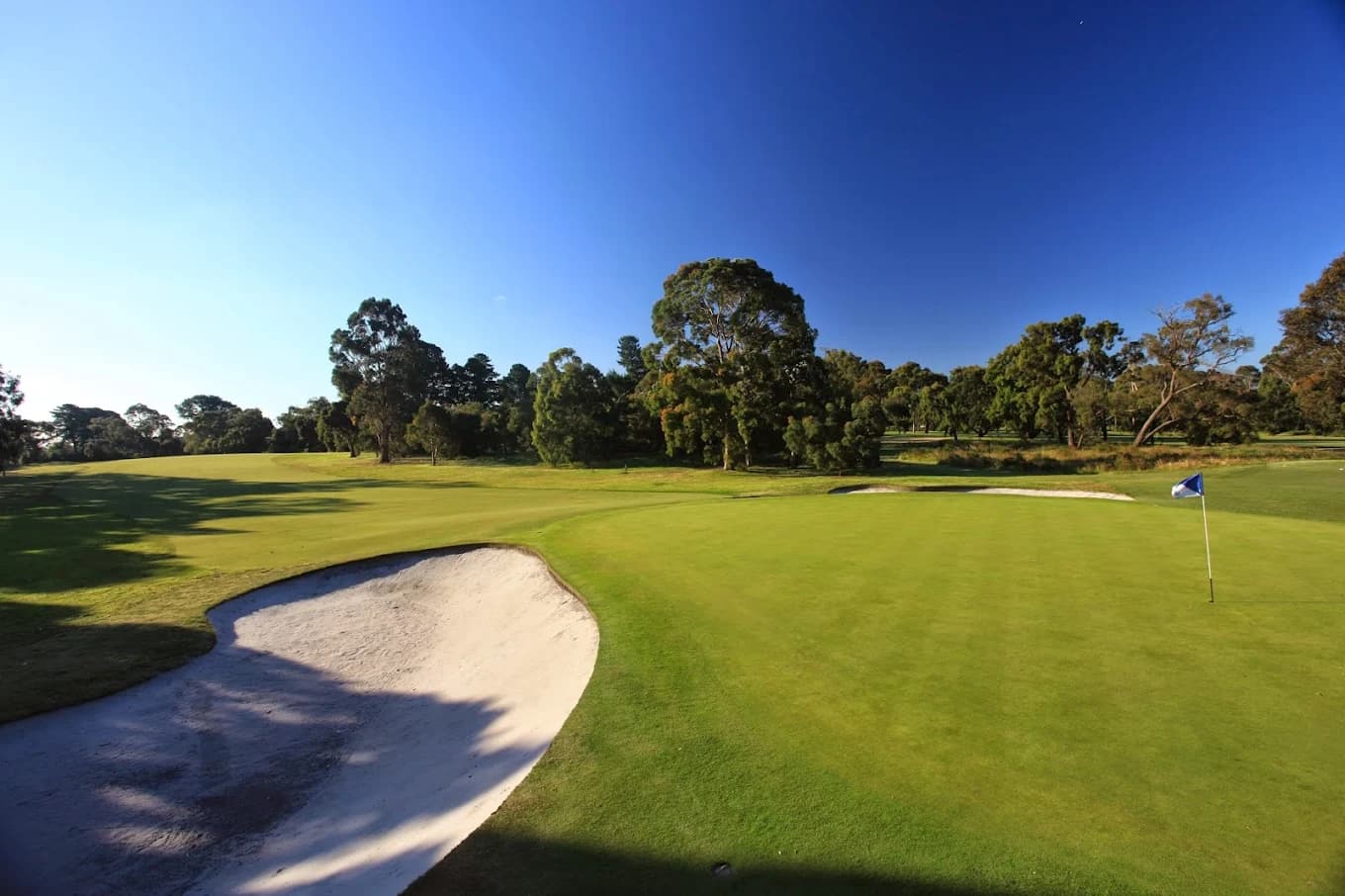
After some time, Kaufman and his committee of businessmen zeroed in on 350 acres (141 hectares) of farmland, known as Trevique, at Cranbourne, a small town southeast of Melbourne, about 40km away from St Kilda and Caulfield, where the Jewish community was developing post World War II.

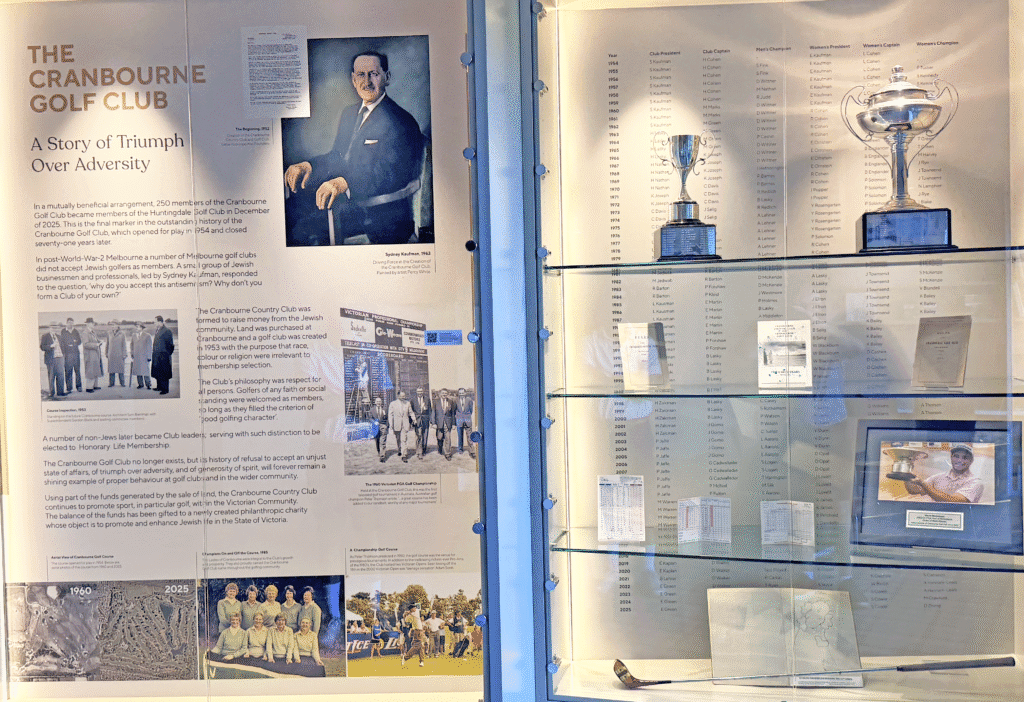
Over the next couple of years, 249 foundation members each donated 250 pounds (the equivalent of about $9000 today) to buy the land and build a golf course. And on May 9, 1954, Kaufman played the first shot off the tee, with a marquee behind him serving as the first clubhouse.

A golf course for the Jewish community was a source of intrigue in Melbourne, especially in 1960 when it hosted the first tournament to be televised. When the Jewish nature of the course received coverage in the press, club member Jessel Rothfield, wrote in a letter in The Age explaining how Jews had long been blackballed from the leading clubs.

The reason why Cranbourne was so necessary was inadvertently explained by F.A.F, who wrote to the paper in response to Rothfield, “Without a country for 1000 years, Jews have never become assimilated with the nations which harbored them – probably to the disadvantage of both races – but remain separate nuclei with their first loyalty to Jewry. Such an attitude in a golf club would be particularly undesirable.”

Cranbourne Golf Club celebrates its history (supplied)

The first thing that was made clear when Cranbourne opened was that everybody, irrespective of race, religion or creed, was free to join. But vigorous discussion took place internally about what sort of Jewish club it would be. Clubhouse open on Saturday? Yes. On major Jewish holidays? No. Pork and shellfish on the clubhouse menu? No. A mezuzah on the front door? No. A bit of Yiddish on the fairways? Naturally.

Cranbourne came to be seen as a prized Melbourne Jewish institution and one of its great success stories. Members took great pride in its regular ranking as one of the top 100 courses in Australia, earning praise from the likes of five-time British Open champion, Peter Thomson. Many top golfers, headlined by future US Masters champion Adam Scott played there at the time-honoured Victorian Open on a few occasions. For a few years, the club’s annual pro-am was one of the more lucrative in Australia.

So, if Cranbourne was a golfing nirvana for Melbourne Jews for so long, then why will the bulldozers soon be massing outside its gates?

"It’s like saying goodbye to a parent for the last time"

Former Club President Barry Lehrer

Cranbourne’s slow decline started in the 1990s. The success of Australian stars such as Greg Norman and Ian Baker-Finch on the global stage led to a surge in the sport’s popularity and golf course construction subsequently boomed. Several new courses sprung up around Melbourne and especially the Mornington Peninsula. They were brilliantly designed and they immediately vaulted to the top of the Australian golf course rankings, taking the place of the likes of Cranbourne.

Like Cranbourne, they opened their doors to all-comers and Jewish golfers jumped at the opportunity to play these courses on a regular basis. At the same time, younger and more progressive leaders emerged at Melbourne’s established golf clubs, and they finally opened their doors to their Jewish colleagues, friends and family members, mainly for genuine reasons although the whiff of anti-discrimination legislation was in the air at that time.

In 2026, it is estimated that there only one golf club in Melbourne where, as one longtime Jewish golf identity observed, “You won’t be admitted if your name ends in ‘berg’ or ‘stein’.”
For the past 25 years, Cranbourne faced real competition for the hearts, minds and dollars of Melbourne’s serious Jewish golfers and its location also started to be a factor. Once surrounded by paddocks and farmland, Cranbourne was eventually swallowed up by Melbourne’s urban sprawl, surrounded by housing estates and industrial parks. Early starters on the weekend might get there in 30 minutes from Caulfield, but the drive home could take an hour. Midweek golfers usually faced a 60-minute drive each way.

For most of this century, Jews comprised about 40 per cent of the 900 Cranbourne members across the various categories. The long-term forecasts for growth were not encouraging. Jews were increasingly making the choice to join clubs they could get to in half the time, or if they were going to drive for an hour, it was to the plainly superior courses on the coast.

And then the money came into it.

In practice, Cranbourne Golf Club was the sole tenant of the Cranbourne Country Club, the body that purchased the land and built the course in the early 1950s and the clause in the deed of trust governing the country club was that if the land was ever sold, then the proceeds from the sale would be disbursed back to the Jewish community, primarily for sporting, cultural and educational endeavours.

The value of the land skyrocketed over time and about six years ago, the country club was hit with a land tax bill for $1.6 million. After some negotiation, that bill was waived but it had become abundantly clear that such a valuable community asset supporting a diminishing number of Jewish golfers was no longer viable.

At the same time, the famous Huntingdale Golf Club was struggling. It was home to the prestigious Australian Masters for more than 30 years but had dropped out of the top 100 rankings and required a major injection of funds to bring it back to the standards of the other sand belt courses.

Huntingdale needed a partner and conversations with Cranbourne heated up. In June 2022, a deal was reached. Cranbourne would be put up for sale and $10 million would be tipped into Huntingdale’s redevelopment immediately. Eventually, Cranbourne would close, its members would be invited to join Huntingdale and on paper, it was a good match given its more recent reputation as a club especially friendly to Jews.

Not every Cranbourne member was thrilled with the outcome. A few old timers were aghast at the thought of the community giving up its own golf club given the hard yards that led to its establishment, but most understood the deal represented progress and was too good to refuse.

The land was sold in 2024 to property developer Fraser Brown, a 1995 Carlton AFL premiership player for $190 million and some of the proceeds were used to subsidise the joining fees and first few years of membership for Cranbourne members at Huntingdale or the club of their choice.

Nearly all the Jewish members have opted to join Huntingdale and are already enjoying a course that is as close to 15 minutes from where they live.

The big conversations are now taking place around the $150 million remaining from the sale of the property. The Cranbourne Foundation was formed last year, with leading commercial lawyer Stephen Sharp as the chair and former Melbourne Holocaust Museum Jayne Josem chief executive Jayne Josem as the CEO. The foundation has been tight-lipped to date, saying on its website that, “We exist to advance and strengthen participation in and continuity of Jewish life in Victoria. We do this by supporting eligible organisations and funding programs according to our current priorities and criteria.”

It will be managed as a future fund, but it is believed two projects it will consider supporting initially are Elsternwick’s Jewish Arts Quarter that will encompass the Kadimah and Holocaust Museum and a proposed relocated Jewish Museum of Australia; and the Caulfield Racecourse project that will be the new home for Mount Scopus College as well as Maccabi sports clubs and other Jewish organisations.

But that can wait. Huntingdale has reportedly welcomed its new members with open arms and has created space in and around the clubhouse to celebrate their former club’s history but on Saturday, Cranbourne will be bursting at the seams for the final day’s play.

Former club president Barry Lehrer said, “In my 35 odd years there, I've played over 2500 rounds at Cranbourne and the drive there and back in that time works out to about 250,000 kilometres.”

And it will be emotional for Lehrer, whose family spans four generations at Cranbourne, as he makes the drive and tees it up for the last time.

“I'm going to be crying as I drive out the gate,” he said. “It’s like saying goodbye to a parent for the last time, especially when you've been there for so long and it's meant so much.”

You might also like
  • Antisemitism, homophobia and a radical response to both
    Dennis Altman
  • Confronting Richard Flanagan and the myth of the Israel lobby
    Mary Garden
  • Court decision fails to understand when ‘Fuk Israel’ becomes antisemitic
    Jeremie Bracka
logomark.67a07ee3
We believe in the free flow of information

Republish our articles for free, online or in print, by using our Creative Commons licence

You might also like

    Generation Change: Rachel Moshel
    Generation ChangeInterviewArts & Culture

    Rachel Moshel: Creating a space for Jewish art and joy

    Gideon Cohen
    Royal Commission final
    Royal CommissionNewsAustralia

    Strategies for cohesion final focus of Royal Commission hearings

    Peter Kohn 1
    Futurism
    OpinionLifestyle

    Jewish Futurism? We’ve been practising it for millennia 

    Renata Zimbarg 1

About the author

Ashley Browne

Ashley Browne

Ashley Browne has been writing about Australian sport for the last 30 years and is currently a senior writer for Crocmedia. He was the co-editor in 2018 of People of the Boot, The Triumphs and Tragedy of Jews and Sport in Australia.

More from the author

FeatureAustralia

Todd Greenberg returns to his first love to run Australian cricket

Australia

AFL star’s post on Gaza could lead to suspension of Jewish-Muslim match

Australia

Harry’s stunning AFL debut: ‘I couldn’t imagine anything better than this’

Comments

No comments on this article yet. Be the first to add your thoughts.