Aa
  • Read, Watch, Listen
  • TJI Series
  • Community Action
  • Events
  • Zedi
Follow us and continue the conversation
  • LinkedIn
  • Instagram
  • FaceBook
  • X
  • YouTube
Test yourself with the TJI Quiz!

Adjust size of text

Aa

Follow us and continue the conversation

  • LinkedIn
  • Instagram
  • FaceBook
  • X
  • YouTube

Your saved articles

You haven't saved any articles

What are you looking for?

Original reporting, insightful analysis and diverse views, delivered straight to your inbox

  • LinkedIn
  • Instagram
  • FaceBook
  • X
  • YouTube
Your support fuels our mission to inform, entertain and inspire.

The Jewish Independent is bound by the Standards of Practice of the Australian Press Council. If you believe the Standards may have been breached, you may approach The Jewish Independent or make a complaint to the Australian Press Council in writing at www.presscouncil.org.au. The Council may also be contacted on 1800 025 712.

  • Our Story
  • Contact us
  • Our Team
  • Support us
  • Guidelines
  • Pitch your idea
  • Republishing us
  • Community Action
  • Our Awards
  • LinkedIn
  • Instagram
  • FaceBook
  • X
  • YouTube
Aboriginal FlagTorres Strait Islanders Flag

The Jewish Independent acknowledges Aboriginal and Torres Strait Islander peoples as the Traditional Owners and Custodians of Country throughout Australia. We pay our respects to Elders past and present, and strive to honour their rich history of storytelling in our work and mission.

© The Jewish Independent 2026All Rights Reserved
Website design and development by Your Creative, MelbourneTerms & ConditionsPrivacy Policy
HomeRead, Watch, ListenAustralia
Australia

Muhi’s story: a helping hand for Palestinian kids needing medical intervention

Michael Visontay
Print this
muhi2

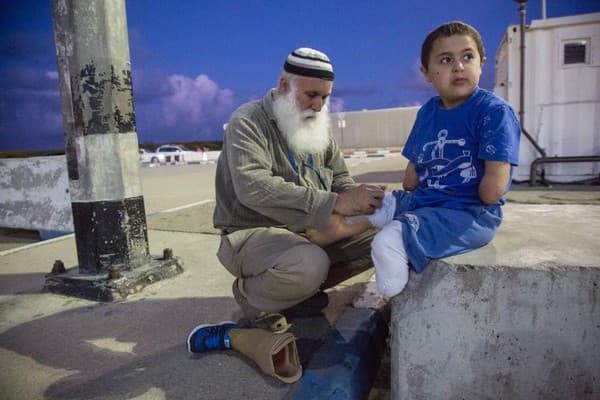
Muhi with his grandfather

Published: 20 November 2017

Last updated: 4 March 2024

Muhi (Muhammad) is a young Palestinian boy who has had all his limbs amputated due to an auto-immune disease and can only get the treatment he needs at an Israeli hospital. Muhi lives in the hospital with his grandfather, Abu Naim, and as the documentary about his plight opens, he is unable to leave the hospital.

The Israelis will not give him, nor his grandfather, a permit, and the only person who can help them is an Israeli volunteer, Buma, who has dedicated his life to helping Palestinians after his son was killed while fighting for the IDF. This heartrending story, screened at JIFF over the weekend, captures the myriad of complexities that affect ordinary Palestinians and Israelis as their leaders fire off verbal and military salvos at each other.

The screening of Muhi - Generally Temporary, was presented by Project Rozana, an Australian Initiative that seeks to "build bridges to better understanding between Israel and her neighbours" through training of Palestinian health professionals, transporting Palestinian patients and treating critically ill Palestinian children in Israeli hospitals when they can't get the appropriate treatment in Palestinian hospitals.

In a discussion after the film's screening in Sydney on Sunday, Sydney doctor and prominent Muslim community leader, Dr Jamal Riffi, who is on the board of Project Rozana, talked about the logistical, cultural and political issues - including tensions between Fatah (which collects taxes at the Erez border crossing) and Hamas that affect the eligibility of certain children to receive assistance. This is compounded by the fact that, for example, Muhi's mother is several times denied permission to come visit him.

In the film, Abu Naim is told at one point that it will be hard for Muhi to return to his home because Hamas thinks that he has been in Israel too long, and he will be an object of suspicion. By the end of the film, he has received permission to leave the hospital, and he embarks on his first days in an Israeli school, hoping to experience some of the aspects of life other children take for granted.

Dr Riffi also discussed his recent trip to Israel, where he met Muhi and his grandfather, and explained the difficulties for Abu Naim to continue to earn sufficient money to help his grandson while Muhi's parents fulfil their obligations taking care of their other children in Gaza.

He concluded his comments by talking about the goodwill that on the ground exists between Israelis and Palestinians and how much collaboration takes place at a grassroots level.


.


You might also like
  • On despair: A reflection after watching ‘Cancelled’
    Deborah Stone
  • What to see at the 2026 Jewish International Film Festival
    Kathy Laster
  • Sanctioning settlements is a defence of Israel, not an attack
    Elisheva Madar
logomark.67a07ee3
We believe in the free flow of information

Republish our articles for free, online or in print, by using our Creative Commons licence

You might also like

    Penny Wong
    DebateAustralia

    Sanctions must influence, not just perform disapproval

    Adam Slonim
    Generation change Template
    Generation ChangeInterviewAustralia

    Ash Densham: Building community through Humanistic Judaism

    Gideon Cohen
    neo-nazis white supremacists corowaTEST
    Royal CommissionOpinionAustralia

    Antisemitism, homophobia and a radical response to both

    Dennis Altman

About the author

Michael Visontay

More from the author

NewsAustralia

Matt Chun’s hate speech prompts change in arts funding policy

AnalysisAustralia

Mishandled antisemitism education is not just ineffective, it’s dangerous

FeatureLifestyle

Where Shtisel meets The Jetsons

ReviewIsrael

Beinart’s utopian vision ignores awkward truths