Aa
  • Read, Watch, Listen
  • TJI Series
  • Community Action
  • Events
  • Zedi
Follow us and continue the conversation
  • LinkedIn
  • Instagram
  • FaceBook
  • X
  • YouTube
Test yourself with the TJI Quiz!

Adjust size of text

Aa

Follow us and continue the conversation

  • LinkedIn
  • Instagram
  • FaceBook
  • X
  • YouTube

Your saved articles

You haven't saved any articles

What are you looking for?

Original reporting, insightful analysis and diverse views, delivered straight to your inbox

  • LinkedIn
  • Instagram
  • FaceBook
  • X
  • YouTube
Your support fuels our mission to inform, entertain and inspire.

The Jewish Independent is bound by the Standards of Practice of the Australian Press Council. If you believe the Standards may have been breached, you may approach The Jewish Independent or make a complaint to the Australian Press Council in writing at www.presscouncil.org.au. The Council may also be contacted on 1800 025 712.

  • Our Story
  • Contact us
  • Our Team
  • Support us
  • Guidelines
  • Pitch your idea
  • Republishing us
  • Community Action
  • Our Awards
  • LinkedIn
  • Instagram
  • FaceBook
  • X
  • YouTube
Aboriginal FlagTorres Strait Islanders Flag

The Jewish Independent acknowledges Aboriginal and Torres Strait Islander peoples as the Traditional Owners and Custodians of Country throughout Australia. We pay our respects to Elders past and present, and strive to honour their rich history of storytelling in our work and mission.

© The Jewish Independent 2026All Rights Reserved
Website design and development by Your Creative, MelbourneTerms & ConditionsPrivacy Policy
HomeRead, Watch, ListenIsrael
PeacebuildingReflectionIsrael

My experience of need made me even more committed to health diplomacy

Receiving the help of a Palestinian nurse trained alongside Israelis brought home the value of my work for health across the divide at Rozana.
Mohammad Asideh
Print this
Shireen and Mohammad copy

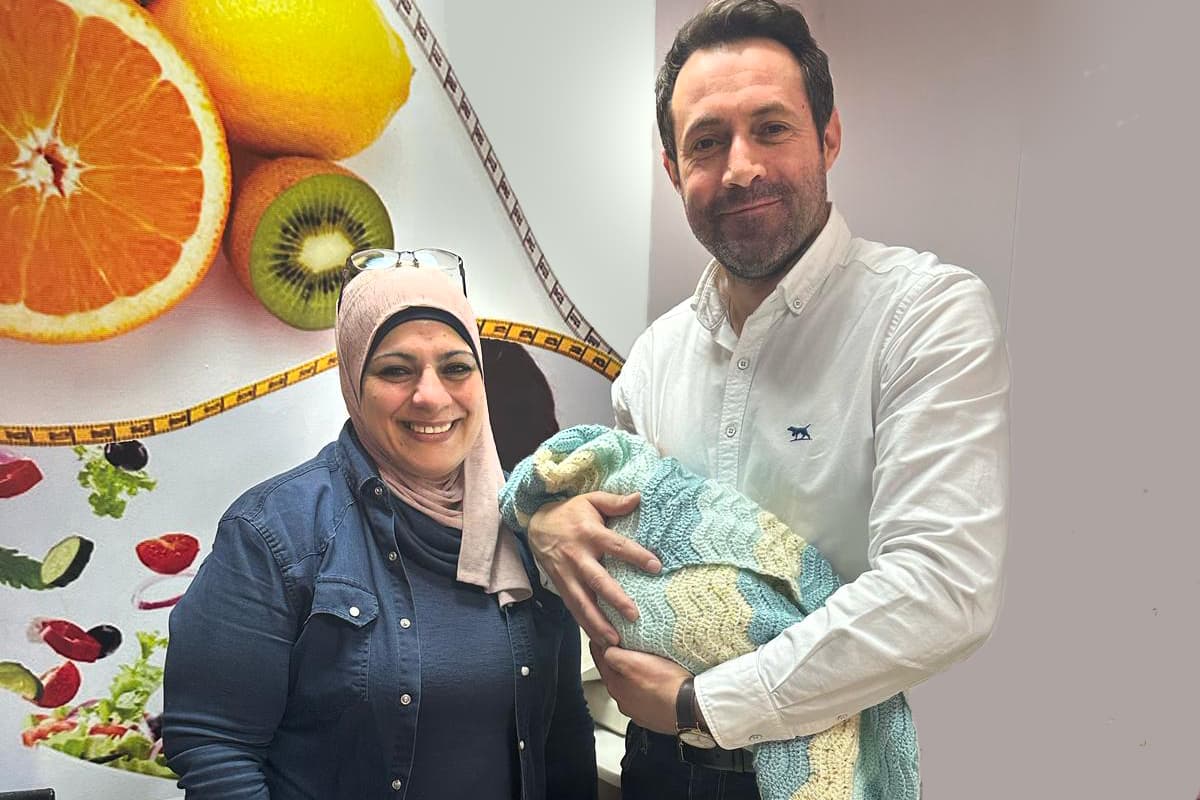
Lactation consultant Shereen Zahran with Mohammad Asideh and newborn Emil (supplied)

Published: 14 April 2025

Last updated: 9 May 2025

Five years ago, my wife and I were blessed with our first child, Laila. Like many new parents, we were overwhelmed with joy but also completely unprepared for what lay ahead. For almost four months, we barely slept two hours straight, day or night. We thought our daughter was getting the food she needed through breastfeeding, but she wasn’t. And we had no idea. 

With no family in Ramallah (they were all in Nablus or Hebron) and COVID-19 restrictions preventing travel, we were alone. Even worse, we didn’t even know we needed help. Desperate, we rushed our daughter from one hospital to another. My wife, still recovering from surgery, endured painful nights in hospital beds while I felt completely lost. 

The problem wasn’t a medical condition, it was that our daughter wasn’t getting the right nutrition to thrive. 

That experience stayed with us. Years later, when I became the director of Rozana in Palestine, I often reflected on that difficult period. If you are a parent you’d know, you eventually forget how exhausting those early months are. 

The assumption that extended families in a community like ours provide all the necessary support is simply false

Last week, we welcomed our second baby, Emil. But this time, things were different. Before we left the hospital, a nurse at Istishari, a major Palestinian hospital and a Rozana partner, asked us if we needed support after discharge. We said yes and the nurse immediately referred us to a Lactation Consultant who could guide us through feeding, sleeping schedule, and newborn care. 

Just a day after leaving the hospital, we met with Shereen Zahran, who generously spent two hours walking us through each step. 
It was only then that I learned Shereen had been trained through Rozana’s Nursing Hub project, receiving advanced training alongside hundreds of Palestinian and Israeli health professionals. Seeing firsthand the impact of Rozana’s work was a powerful moment, one that made me even more committed to our mission. 

For years, my wife and I wondered why such essential services were missing. Why were new mothers left to struggle alone, battling exhaustion, guilt, and even postpartum depression? We still remember the devastating case of the mother in Tulkarem who, three years ago, took her baby’s life because she was overwhelmed, isolated, and had no one to turn to. 

The assumption that extended families in a community like ours provide all the necessary support is simply false. The reality is that countless women and families need scientific, professional guidance, yet these services remain scarce. 

Palestine faces many pressing challenges, and to some, this issue may not seem like a priority. But to me, this is precisely the problem. Our lives are shaped by policies and the systems we build, and if we don’t address each aspect of life including health, education, transport, and the environment, we will never create the future we want. 

Rozana is changing that.  We are working to improve healthcare services, strengthening cross-border professional networks, and ensuring that no parent has to navigate these challenges alone. If my own journey has shown me anything, it’s that the work we do matters, not just for policy, but for people. 

You might also like
  • ‘Israel is systemically eliminating Palestinian collective life’:  B’Tselem
    Deborah Stone
  • Antisemitism, homophobia and a radical response to both
    Dennis Altman
  • Tame apologises – but with little grace
    Deborah Stone
logomark.67a07ee3
We believe in the free flow of information

Republish our articles for free, online or in print, by using our Creative Commons licence

You might also like

    Arab Israeli Palestinian election vote
    Israel Votes 2026FeatureIsrael

    Fear of Netanyahu victory may drive big surge in Palestinian voter turnout

    Ben Lynfield
    Erdogan Turkey
    AnalysisIsrael

    Turkey emerges as military threat to Israel

    Dror Doron
    ISRAEL-LGBTQ-PRIDE-PARADE-PALESTINIAN-CONFLICT-HOSTAGES
    NewsIsrael

    LGBT asylum seekers caught between Palestinian violence and Israeli bureaucracy

    Jarod Rhine-Davis

Comments

No comments on this article yet. Be the first to add your thoughts.

About the author

Mohammad Asideh

Mohammad Asideh

Mohammad Asideh is Director of Advocacy at Rozana, a health diplomacy organisation promoting access to quality healthcare through joint initiatives in Israel and Palestine.