Aa
  • Read, Watch, Listen
  • TJI Series
  • Community Action
  • Events
  • Zedi
Follow us and continue the conversation
  • LinkedIn
  • Instagram
  • FaceBook
  • X
  • YouTube
Test yourself with the TJI Quiz!

Adjust size of text

Aa

Follow us and continue the conversation

  • LinkedIn
  • Instagram
  • FaceBook
  • X
  • YouTube

Your saved articles

You haven't saved any articles

What are you looking for?

Original reporting, insightful analysis and diverse views, delivered straight to your inbox

  • LinkedIn
  • Instagram
  • FaceBook
  • X
  • YouTube
Your support fuels our mission to inform, entertain and inspire.

The Jewish Independent is bound by the Standards of Practice of the Australian Press Council. If you believe the Standards may have been breached, you may approach The Jewish Independent or make a complaint to the Australian Press Council in writing at www.presscouncil.org.au. The Council may also be contacted on 1800 025 712.

  • Our Story
  • Contact us
  • Our Team
  • Support us
  • Guidelines
  • Pitch your idea
  • Republishing us
  • Community Action
  • Our Awards
  • LinkedIn
  • Instagram
  • FaceBook
  • X
  • YouTube
Aboriginal FlagTorres Strait Islanders Flag

The Jewish Independent acknowledges Aboriginal and Torres Strait Islander peoples as the Traditional Owners and Custodians of Country throughout Australia. We pay our respects to Elders past and present, and strive to honour their rich history of storytelling in our work and mission.

© The Jewish Independent 2026All Rights Reserved
Website design and development by Your Creative, MelbourneTerms & ConditionsPrivacy Policy
HomeRead, Watch, ListenWorld
AnalysisWorld

New Saudi-Pakistan-Turkey alliance driven by failure of US to subdue Iran

The 'Mecca Pact' grew out Saudi insecurity over its oil reserves but Turkey may also use it to try to sideline Israeli influence in the Middle East
Dror Doron
Print this
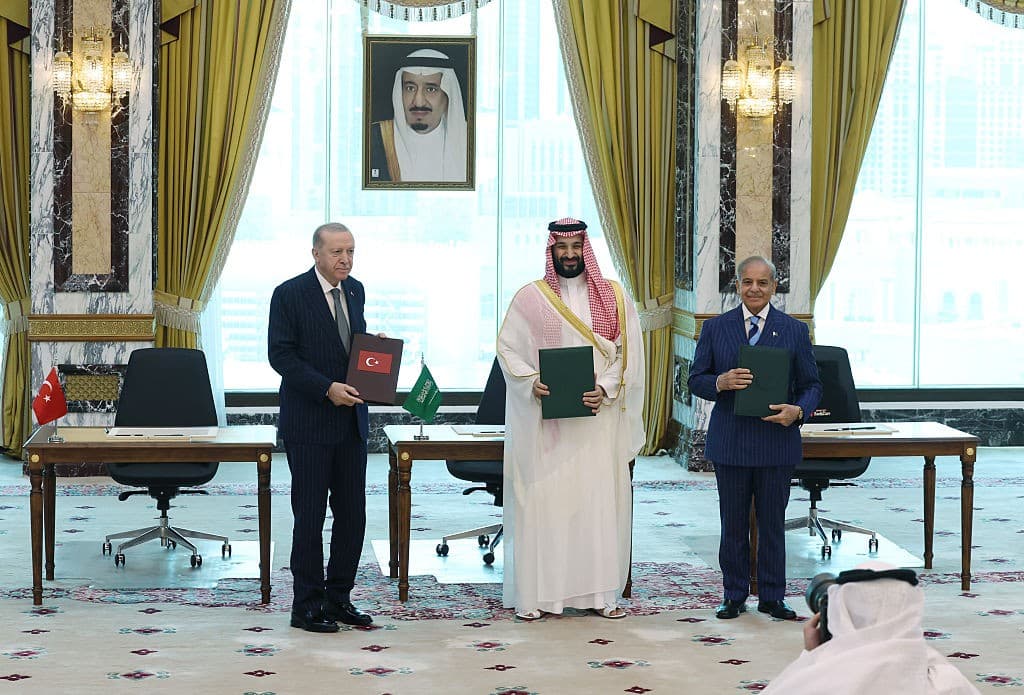
Turkiye, Saudi Arabia and Pakistan sign trilateral defense pact

Turkish President Recep Tayyip Erdogan (L), Saudi Crown Prince Mohammed bin Salman (C), and Pakistani Prime Minister Shehbaz Sharif (R) sign a trilateral defence agreement in Mecca on August 7 (Turkish Presidency/via Getty)

Published: 13 August 2026

Last updated: 13 August 2026

The new alliance between Saudi Arabia, Pakistan and Turkey is designed to counter Iran’s apparent resilience to the US-Israel military attack. But it may also try to sideline Israel.

As the war against Iran entered an unstable status quo and the Gulf states try to find a way to export their energy products while passing through the Strait of Hormuz, one conclusion is becoming clear – Iran is here to stay, and its neighbours need to come up with new means to constrain its malign regional influence.

The American-Israeli military campaign against Tehran failed to topple the regime or impose any limitations on its nuclear and missile capabilities. Even worse, the war exposed the limitations of the US military in deterring Iran and protecting the Gulf states from Iranian missile and UAV attacks.

This is the context in which the announcement of the Saudi-Pakistani-Turkish trilateral defence agreement, dubbed the “Mecca Pact”, should be seen. The high-profile public declaration reflects, more than anything else, Saudi Arabia’s desperate need to come up with a strategic mechanism that will protect the kingdom, and its highly vulnerable oil production industry, from being hit by Iran and its proxies operating from Iraq and Yemen.

It should be remembered that the Saudis already signed, in September last year, a bilateral strategic defence agreement with Pakistan, but its deterrent effect on Iran has obviously been nonexistent. Even though in April Pakistan deployed 16 fighter jets, air defence systems, and approximately 8,000 troops, Tehran seems to be giving little importance to this military presence in its calculations.

Faced with the ongoing Iranian threats and the relentless attacks by the Houthis and Iraqi Shiite militias on its oil facilities, and taking into consideration the overt American preference not to reengage militarily with Iran, the Saudis felt compelled to widen their strategic military cooperation with another regional force, in the hope that such a move would create the necessary deterrence balance with Iran.
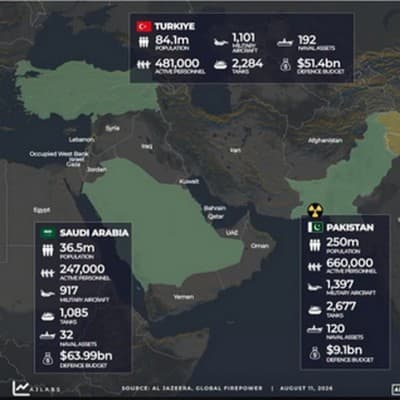

Turkey, with its massive army, shared border with Iran, and President Erdoğan’s aspiration to become a leading regional force, was the natural candidate to be added to the existing Pakistani agreement. Now, the new strategic alliance creates an impressive new reality: Iran is surrounded from the east by Pakistan, from the north by Turkey, and from the west by Saudi Arabia. Together with Pakistan’s nuclear capabilities, Turkey’s massive military forces, and Saudi Arabia’s enormous financial resources, Tehran will be pressured into recalculating its strategy.

Map showing the ‘engulfment’ of Iran (Al Jazeera)

Unfortunately for the Saudis, it appears that the decision-makers in Tehran are not impressed by the new alliance and are willing to put it to the test. Forty-eight hours after the celebratory photo-op in Mecca, the Houthis launched an attack on a Saudi oil refinery in the southern city of Jizan, and another 48 hours later, a Saudi ship was attacked in the Strait of Bab al-Mandab in the Red Sea. The lack of any response by either Pakistan or Turkey sheds a disturbing light on their commitment to come to Saudi Arabia’s defence, as articulated in the recently signed pact.

The Saudi strategic distress and the need to find other ways to prevent Iran from using the vulnerability of its energy infrastructure as a bargaining chip in Tehran’s negotiations with the US have therefore remained far from resolved.

From Israel’s point of view, the Saudi search for other means to deter Iran, and its disillusionment with the US ability to protect it, are far from good news. Israel’s close alliance with the US was a critical element in the Saudis’ willingness to engage diplomatically with Jerusalem. The diminishing reliability of Washington, and even the perception of American weakness, will have a negative effect on Riyadh’s readiness to engage with Israel.

Turkey's role is more troubling

A more troubling aspect of the “Mecca Pact” is Turkey’s role in this alliance. A vocal critic of Israel with close ties to the Muslim Brotherhood and Hamas, Turkey was a fierce opponent of Riyadh until recent years. The Saudi declaration of the Muslim Brotherhood as a terrorist organisation in 2014, and the assassination of Saudi opposition figure Jamal Khashoggi at the Saudi consulate in Istanbul in 2018, created deep tensions between Ankara and Riyadh.

Now, with Turkey gaining a position as a strategic ally of Saudi Arabia, Ankara and its outspoken anti-Israeli policy could enjoy even greater regional influence. This will most probably be used by Erdoğan to promote his agenda of sidelining Israel and excluding it from regional diplomatic initiatives.

Some Israeli politicians and media outlets have even gone as far as warning of a future coordinated military threat from the new alliance. These warnings, which point to the worst-case scenario, should be taken with a pinch of salt, as they are most likely motivated by political considerations ahead of the upcoming elections in Israel.

It should be noted that, formally, Israel has refrained from responding to the declaration of the Mecca Pact. This cautious formal approach seems to reflect the understanding in Jerusalem that, in the Middle East, the establishment of high-profile alliances is often a declarative move, and their real strategic significance should be tested over the longer term. The fact that both Turkey and Pakistan did not respond to the attacks that hit Saudi Arabia since declaring their alliance suggests that this could also be the case with the Mecca Pact.

You might also like
  • Turkey emerges as military threat to Israel
    Dror Doron
  • Hate preachers, polarised debate, counter-terrorism
    Peter Kohn
  • Netanyahu rejects Trump’s Gaza plan, testing US influence in the region
    Shahar Burla
logomark.67a07ee3
We believe in the free flow of information

Republish our articles for free, online or in print, by using our Creative Commons licence

You might also like

    Apple & rotten core Rosh hashanah
    EditorialAustralia

    Facing a new year with the knowledge life can be better

    The Jewish Independent
    Pro-Palestine Rally Outside Foreign Commonwealth Development Office
    AnalysisWorld

    UK’s dramatic policy change on Israel-Palestine

    Colin Shindler 3
    Protest
    AnalysisIsrael

    Western ‘Palestinianism’ colonises everything – and hurts Palestinians

    Andres Spokoiny 5

Comments

No comments on this article yet. Be the first to add your thoughts.

About the author

Dror Doron

Dror Doron

Dror Doron is a senior political analyst specialising in the Middle East, and is a senior adviser at United Against Nuclear Iran (UANI) focusing on Hezbollah and Lebanon.

More from the author

AnalysisIsrael

Turkey emerges as military threat to Israel

AnalysisIsrael

Trump’s Hamas disarmament deal a mirage that’s quickly faded

AnalysisIsrael

Syria reimagined: From military threat to geostrategic competitor