Aa
  • Read, Watch, Listen
  • TJI Series
  • Community Action
  • Events
  • Zedi
Follow us and continue the conversation
  • LinkedIn
  • Instagram
  • FaceBook
  • X
  • YouTube
Test yourself with the TJI Quiz!

Adjust size of text

Aa

Follow us and continue the conversation

  • LinkedIn
  • Instagram
  • FaceBook
  • X
  • YouTube

Your saved articles

You haven't saved any articles

What are you looking for?

Original reporting, insightful analysis and diverse views, delivered straight to your inbox

  • LinkedIn
  • Instagram
  • FaceBook
  • X
  • YouTube
Your support fuels our mission to inform, entertain and inspire.

The Jewish Independent is bound by the Standards of Practice of the Australian Press Council. If you believe the Standards may have been breached, you may approach The Jewish Independent or make a complaint to the Australian Press Council in writing at www.presscouncil.org.au. The Council may also be contacted on 1800 025 712.

  • Our Story
  • Contact us
  • Our Team
  • Support us
  • Guidelines
  • Pitch your idea
  • Republishing us
  • Community Action
  • Our Awards
  • LinkedIn
  • Instagram
  • FaceBook
  • X
  • YouTube
Aboriginal FlagTorres Strait Islanders Flag

The Jewish Independent acknowledges Aboriginal and Torres Strait Islander peoples as the Traditional Owners and Custodians of Country throughout Australia. We pay our respects to Elders past and present, and strive to honour their rich history of storytelling in our work and mission.

© The Jewish Independent 2026All Rights Reserved
Website design and development by Your Creative, MelbourneTerms & ConditionsPrivacy Policy
HomeRead, Watch, ListenIsrael
AnalysisIsraelWorld

Syria reimagined: From military threat to geostrategic competitor

France, the US and Türkiye have an interest in reshaping Syria's geopolitical landscape, potentially sidelining Israel's planned economic corridor in favour of a new transcontinental trade route
Dror Doron
Print this
Macron Syria Ahmad al-Sharaa

Syrian President Ahmed al-Sharaa (right) welcomes French President Emmanuel Macron (left) during an official welcome ceremony at the People’s Palace in Damascus, Syria, on July 7, 2026 (Rami Alsayed/NurPhoto via Getty Images)

Published: 16 July 2026

Last updated: 16 July 2026

Recent days have marked a significant advancement in the efforts to rebuild Syria after a devastating 15-year civil war.

In a notable development, French President Emmanuel Macron made a formal visit to Damascus – the first such visit in 18 years – becoming the first Western leader to do so since the collapse of the Assad regime in late 2024. During this visit, the French Foreign Minister and his Syrian counterpart signed a framework agreement aimed at bolstering political, economic, and institutional ties across various sectors.

Immediately following this historic meeting, Syrian President Ahmad al-Sharaa received an invitation from President Trump to attend the NATO summit in Türkiye, a nation that now acts as the international backer of Syria's new regime. In Ankara, Trump informed al-Sharaa of his intention to remove Syria from the US list of state sponsors of terrorism. Within a week, the first Syrian-American Business Forum convened in Damascus, with the participation of Jacob McGee, the US Deputy Assistant Secretary of State.

Implications for Israel

From Israel's perspective, these high-level political meetings, along with the subsequent legal and economic initiatives, signify a critical shift like the challenge posed by Syria. For decades, under Assad's brutal regime, which had maintained close ties with Iran, Damascus was viewed as a significant security and military adversary – directly threatening Israel and enabling the significant arms buildup of Hezbollah, Iran’s primary regional proxy in Lebanon.

However, the regime's unexpected collapse, following a swift ground assault by al-Sharaa’s Islamist opposition forces two years ago, transformed this threat into a new Israeli concern: the emergence of a radical Islamist adversary operating under the influence of the anti-Israel Turkish government.
While these concerns still occupy the Israeli security establishment, recent events, particularly over the past weeks, suggest that Syria is on the verge of becoming a different kind of challenge for Israel: one of a geostrategic nature rather than a military one.

Following the 2020 Abraham Accords, Israel embarked on a massive strategic initiative: the India-Middle East-Europe Economic Corridor (IMEC). This ambitious project aims to create a multinational supply chain network connecting South Asia, the Middle East, and Europe by linking India's ports with the UAE, Saudi Arabia, Jordan, Israel, and beyond.

Israel views this initiative as a mega-strategic opportunity, one that would reinforce its position as a vital bridge between East and West, enhance regional stability, and generate substantial revenues. Unfortunately, implementation of this project has stalled, as Israel's military campaign in Gaza in recent years has made it politically risky for Arab countries to launch mutual projects – particularly Saudi Arabia – which refused to join the “Abraham Accords”, or engage in any public way with Israel, due to its current situation of a pariah state.

The Turkish alternative

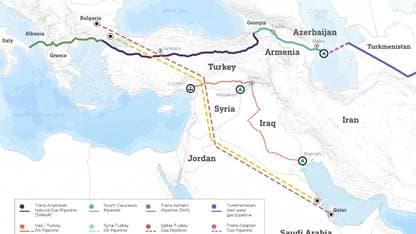
Türkiye has launched a competing initiative aimed at developing a ground route from the Gulf to Europe. This Turkish plan, part of Ankara’s strategic vision to strengthen its connections and influence in the Arab world, notably bypasses Israel, presenting the ports of Syria and Southern Türkiye as gateways to the Mediterranean.

Proposed ground route

In April, Turkish Transport and Infrastructure Minister Abdulkadir Uraloğlu announced an agreement among Türkiye, Syria, and Jordan to modernise their rail networks. This initiative aims to connect Türkiye’s rail system with those of Syria and Jordan, eventually linking to Saudi Arabia’s railway network and creating a north-south trade route between Europe, the Levant, and the Gulf.

Following Iran's utilisation of the Strait of Hormuz as a choke point in recent months, the necessity for such a route has become increasingly critical for the secure export of energy products from the Gulf. Under these circumstances, Türkiye has actively promoted an alternative to Israel's IMEC initiative, which must be understood in light of the recent diplomatic developments in Syria.

French and US interests

During Macron’s visit to Damascus, President al-Sharaa called upon France to join efforts in transforming Syria into a transportation hub, asserting that, “the importance of Syrian geography has once again become clear. Syria has regained its vital role as an indispensable link in global transport corridors, and we want France to be our primary partner on this path.” One of the most significant outcomes was a strategic partnership between Syria's General Authority for Land and Sea Ports and Customs and French shipping giant CMA CGM, covering maritime and air transport as well as logistics.

This agreement, along with Trump's move to remove Syria from the list of state sponsors of terrorism, has led the Syrian Central Bank Governor to declare that recent developments will pave the way for Syria's reintegration into the global economy. Presently, it appears that the momentum is shifting towards the establishment of an Arab-Turkish strategic land corridor, leaving Israel on the sidelines as the geostrategic initiatives it hoped to promote materialise without its involvement.

You might also like
  • Turkey emerges as military threat to Israel
    Dror Doron
  • Trump’s Hamas disarmament deal a mirage that’s quickly faded
    Dror Doron
  • Saudi nuclear deal fiasco: what was Trump thinking?
    Michal Yaari
logomark.67a07ee3
We believe in the free flow of information

Republish our articles for free, online or in print, by using our Creative Commons licence

You might also like

    Apple & rotten core Rosh hashanah
    EditorialAustralia

    Facing a new year with the knowledge life can be better

    The Jewish Independent
    Woman with land and houses behind her
    NewsAustralia

    Australia to increase sanctions against West Bank settlements

    Deborah Stone 2
    Pro-Palestine Rally Outside Foreign Commonwealth Development Office
    AnalysisWorld

    UK’s dramatic policy change on Israel-Palestine

    Colin Shindler 3

About the author

Dror Doron

Dror Doron

Dror Doron is a senior political analyst specialising in the Middle East, and is a senior adviser at United Against Nuclear Iran (UANI) focusing on Hezbollah and Lebanon.

More from the author

AnalysisIsrael

Turkey emerges as military threat to Israel

AnalysisWorld

New Saudi-Pakistan-Turkey alliance driven by failure of US to subdue Iran

AnalysisIsrael

Trump’s Hamas disarmament deal a mirage that’s quickly faded

Comments

No comments on this article yet. Be the first to add your thoughts.