Aa
  • Read, Watch, Listen
  • TJI Series
  • Community Action
  • Events
  • Zedi
Follow us and continue the conversation
  • LinkedIn
  • Instagram
  • FaceBook
  • X
  • YouTube
Test yourself with the TJI Quiz!

Adjust size of text

Aa

Follow us and continue the conversation

  • LinkedIn
  • Instagram
  • FaceBook
  • X
  • YouTube

Your saved articles

You haven't saved any articles

What are you looking for?

Original reporting, insightful analysis and diverse views, delivered straight to your inbox

  • LinkedIn
  • Instagram
  • FaceBook
  • X
  • YouTube
Your support fuels our mission to inform, entertain and inspire.

The Jewish Independent is bound by the Standards of Practice of the Australian Press Council. If you believe the Standards may have been breached, you may approach The Jewish Independent or make a complaint to the Australian Press Council in writing at www.presscouncil.org.au. The Council may also be contacted on 1800 025 712.

  • Our Story
  • Contact us
  • Our Team
  • Support us
  • Guidelines
  • Pitch your idea
  • Republishing us
  • Community Action
  • Our Awards
  • LinkedIn
  • Instagram
  • FaceBook
  • X
  • YouTube
Aboriginal FlagTorres Strait Islanders Flag

The Jewish Independent acknowledges Aboriginal and Torres Strait Islander peoples as the Traditional Owners and Custodians of Country throughout Australia. We pay our respects to Elders past and present, and strive to honour their rich history of storytelling in our work and mission.

© The Jewish Independent 2026All Rights Reserved
Website design and development by Your Creative, MelbourneTerms & ConditionsPrivacy Policy
HomeRead, Watch, ListenArts & Culture
DebateArts & Culture

Not seeing Oy to Oy: The generational divide over Holocaust humour

Larry David recently published a satirical article in the New York Times entitled “My Dinner with Adolf”. One generation found it hilarious, the other thought it offensive.
Jeanette Lewis & Isabelle Oderberg
Print this
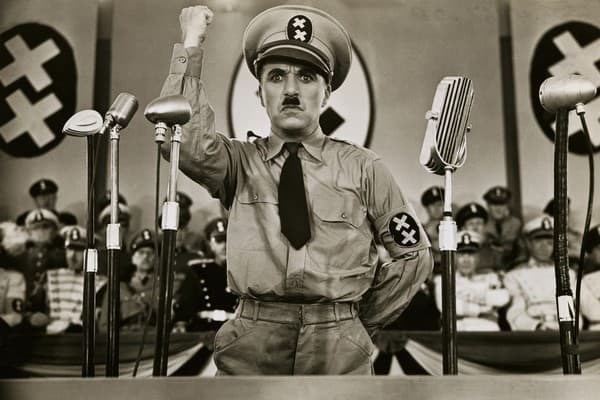
Charlie Chaplin in The Great Dictator

Charlie Chaplin in The Great Dictator

Published: 8 May 2025

Last updated: 8 May 2025

The Boomer take

I’ve always been a big fan of the therapeutic value of laughter but the recent piece by Larry David did not bring a smile. It brought to mind a conversation I had with my six-year-old daughter while sitting in Hong Kong’s beautiful Ohel Leah synagogue on Yom Tov many years ago. 

A lady walked in wearing very little and eyebrows were raised. I explained to my daughter that it’s fine to wear a bikini on the beach, but it isn’t appropriate to wear to shul any more than you’d go to play on the beach in a ball gown. There’s a time and a place. 

But is there ever a time and place for Holocaust humour? As the child of survivors who grew up in a survivor community in the Melbourne of the 1950s and 1960s, my answer is a very firm no.

For me, it’s not a question of when: the Holocaust will never be an appropriate subject for humour or satire.

Charlie Chaplin agrees with me. His most commercially successful film ever, The Great Dictator, satirising Hitler and Mussolini was released in 1940. In his 1964 autobiography, he wrote that had he known the true horrors of the Nazi concentration camps, he could not have made the film.

Growing up, there were other children who were often left to play with us because one of their parents had “gone to Queensland”. My sister and I noticed that these parents never came back. We ultimately understood that these parents had committed suicides as a result of PTSD after the Holocaust. In those days, these things weren’t spoken of and especially not to young children.

There were always empty chairs at the table at social events. No survivor family we knew had a grandparent.

Is it too soon to laugh at murder and genocide and the perpetrators? For me, it’s not a question of when: the Holocaust will never be an appropriate subject for humour or satire.

Roberto Benigni in Life Is Beautiful

I read very little fiction because I’m such a fan of history and biography. I remember when the Roberto Benigni film Life is Beautiful was a big hit in 1997 and, although I am a huge fan of cinema having served on the Board of the Hong Kong Jewish Film Festival for many years, I couldn’t bring myself to watch it. I’d much rather spend my time reading Emanuel Ringelblum’s diaries in an attempt to comprehend the reality of what happened than watch a film that is total fantasy about the Holocaust. 

Benigni incorporated historical inaccuracies in order to distinguish his story from the true Holocaust, about which he said only documentaries interviewing survivors could provide "the truth”.

For me the truth is far more important than fantastical entertainment or comedic satire and most importantly the truth is what we should be teaching to the generations to come.

The Gen X take

I’ve worked in the social justice and human rights space for as long as I can remember, partly inspired by the social justice work of my parents, which I believe has its roots in the loss of so many of our family during the Holocaust. 

But working in these spaces, for as long as I can remember, we’ve used satire and black humour to survive absolutely soul-destroying work. One of my mentors, who had an incredibly sharp and acerbic wit, always wielded his black humour like armour, proclaiming, “if you don’t laugh, you’ll cry”. He was right. There is, of course, a time and place for tears, but we cannot endure lives only of consisting of tears. We have to find the light, too. 

There’s a huge difference between laughing “at” something and using laughter – whether ironic, satirical or dark – to diffuse pain. 

I have fought and called out anti-Jewish hatred and racism my whole life. My mother has an incredibly small family. She had very few cousins and only one sibling. From a very young age, my mum was constantly pressing books about Jewish history, and specifically the Holocaust, into my hands. She has a forensic knowledge of Holocaust history and fact through prolific research, reading and documentary viewing.

Where we are using laughter to survive trauma, I believe it can have a great power of healing

Even now, I joke with family members when mum recommends a book to us, saying (within her earshot) “but is it about the Holocaust?” She still has it in her to laugh.

She also knows that I know how incredibly grateful I am to have been gifted this knowledge and our stories, to impart on my own children. 

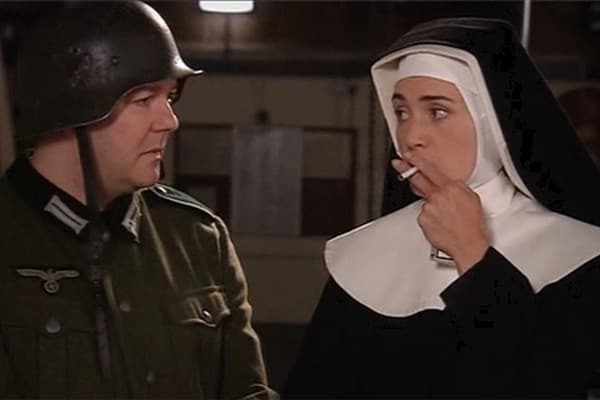
Kate Winslet and Ricky Gervais in Extras

When I sent her the Larry David article to read, I thought it was well executed and she would see parallels. But she had an immediately visceral reaction that I did not. I should have known! There are vast numbers of movies and TV shows we never ever watched because she felt that these stories were better told as documentary fact, rather than fiction or comedy in any form. 

But humour can say things that non-fiction can’t. Take the sketch in Extras, where Kate Winslet, (who has famously never won an Oscar) playing a particularly gross caricature of an actress, opines that she really needs a part in a “Holocaust movie” so she can finally get her hands on an Oscar. Through the humour, it tells us sharply that there is an issue with more gravitas than the Shoah.

Not all comedy touching on the Holocaust is funny. Not all of it is appropriate. 

But where it is applied sensitively and with grace, where we are using laughter to survive trauma rather than laughing at the trauma itself, I believe it can have a great power of healing.

You might also like
  • This might be the smallest synagogue in the world 
    György Polgár
  • Happiest man resurrected on stage
    Peter Kohn
  • Holocaust revenge story is far from pure fiction
    Peter Kohn
logomark.67a07ee3
We believe in the free flow of information

Republish our articles for free, online or in print, by using our Creative Commons licence

You might also like

    Amidah main
    FeatureArts & Culture

    A circle of communal healing on stage, with a dash of humour

    Miriam Hechtman
    Jewish word map
    FeatureArts & Culture

    Was the barmi a shemozzle? How Australians use Jewish words 

    Caroline Hendy & Emma Breslow 1
    Pearly Spurtle
    FeatureArts & Culture

    Israeli ingredients a recipe for ‘Pearly Spurtle’

    Gideon Cohen

Comments1

  • Avatar of Marie Lakos

    Marie Lakos8 May at 12:33 pm

    Hi there. Very well written thanks. Isabelle’s last paragraph resonates with me. My mum told me when she was in the camp with her best friend Szuszi they would laugh over the heiarchy of the prison guards as to who had the authority – and when – to hit the prisoners. The guards took themselves and their duties very seriously. Such a ridiculous concept when you think about it now – to fight over who does the hitting – over poor defenseless women – who have committed no crimes other than being Jewish! I think their jokes kept them sane! Nothing wrong with that wouldn’t you say?

About the author

Jeanette Lewis & Isabelle Oderberg

Jeanette Lewis was born in 1950-something, is a retired solicitor, a mum to two adult kids, an adored nana to two little kids and enjoys a heated intellectual debate with her daughter. Isabelle Oderberg was born in 1970-something, is a journalist, author, not-for-profit leader, activist, campaigner, charity founder, mum to two little kids and enjoys getting too hot under the collar during debates with her mother.