Aa
  • Read, Watch, Listen
  • TJI Series
  • Community Action
  • Events
  • Zedi
Follow us and continue the conversation
  • LinkedIn
  • Instagram
  • FaceBook
  • X
  • YouTube
Test yourself with the TJI Quiz!

Adjust size of text

Aa

Follow us and continue the conversation

  • LinkedIn
  • Instagram
  • FaceBook
  • X
  • YouTube

Your saved articles

You haven't saved any articles

What are you looking for?

Original reporting, insightful analysis and diverse views, delivered straight to your inbox

  • LinkedIn
  • Instagram
  • FaceBook
  • X
  • YouTube
Your support fuels our mission to inform, entertain and inspire.

The Jewish Independent is bound by the Standards of Practice of the Australian Press Council. If you believe the Standards may have been breached, you may approach The Jewish Independent or make a complaint to the Australian Press Council in writing at www.presscouncil.org.au. The Council may also be contacted on 1800 025 712.

  • Our Story
  • Contact us
  • Our Team
  • Support us
  • Guidelines
  • Pitch your idea
  • Republishing us
  • Community Action
  • Our Awards
  • LinkedIn
  • Instagram
  • FaceBook
  • X
  • YouTube
Aboriginal FlagTorres Strait Islanders Flag

The Jewish Independent acknowledges Aboriginal and Torres Strait Islander peoples as the Traditional Owners and Custodians of Country throughout Australia. We pay our respects to Elders past and present, and strive to honour their rich history of storytelling in our work and mission.

© The Jewish Independent 2026All Rights Reserved
Website design and development by Your Creative, MelbourneTerms & ConditionsPrivacy Policy
HomeRead, Watch, ListenArts & Culture
FeatureArts & Culture

A circle of communal healing on stage, with a dash of humour

Dealing with pain does not have to be all grim. Anna Hirst Friedman's Amidah infuses joy and hope into the collective trauma of the past three years
Miriam Hechtman
Print this
Amidah main

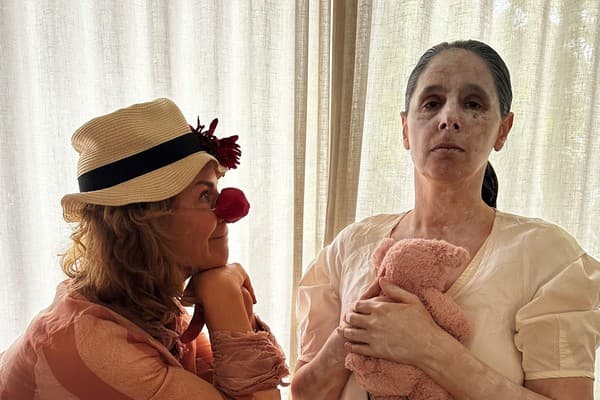
Joanna Weinberg (left) and Anna Hirst Friedman

Published: 23 July 2026

Last updated: 23 July 2026

Over 15 months, in the aftermath of October 7, 2023, composer Anna Hirst Friedman wrote Amidah A Silent Prayer, an original song cycle of 10 short works for male voice and piano. In January 2025, she felt the work was complete when there was a temporary ceasefire. “I thought, that's it, we're done,” says Hirst Friedman. The song cycle was first performed in March 2025 at Goethe-Institut Sydney. “And then a cascade of events, including (the hostage) Shiri’s story and Bondi compelled me to write more.’’ 

Hirst Friedman sees poignant connections in the song cycle between her October 7 work and the Bondi massacre. “There is a tragic thread of continuation. I found myself opening my Bondi piece similarly with some of the words I wrote for my October 7 piece many months before.”

Though she would have preferred to end on something more uplifting, Hirst Friedman says, “we are ending on a very Jewish note of ‘tikun olam’ to create a circle of healing on the stage.’’ 

At around the same time as Amidah’s first performance, Hirst Friedman saw multi-disciplinary artist Joanna Weinberg portray some of the women from the book Chutzpah Girls - 100 Tales of Daring Jewish Women at its Australian launch with NCJWA. Hirst Friedman could see the potential for Weinberg’s participation in a more theatrical performance of Amidah and approached her to consider collaborating on a reimagined staging of the song cycle.

A calling to bring joy

Weinberg watched the video footage of the original performance. The pain that runs through Amidah drew her to work with Hirst Friedman. “I have a calling to bring joy where I see pain. I instantly wanted to help and to heal. And I thought, there's so much pain in the Jewish community right now. What can I do to help? How can I make it better?” 
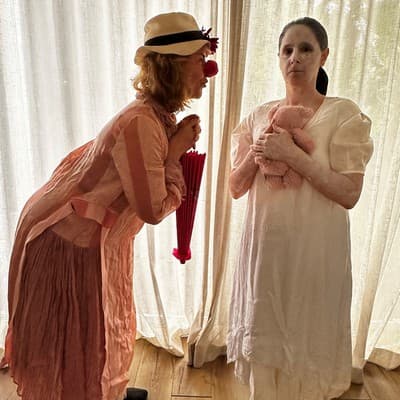
Leaning into the pain of the work, with a strong desire to add lightness, Weinberg came up with the idea of developing a Jewish clown and researched a precedent for this. She quickly discovered that there were several examples from which to draw inspiration, including documentaries and several stories of clowns cheering up children in war-torn countries. Weinberg also discovered the story of Marcel Marceau and how he helped Jewish children escape Nazi-occupied France using mime. 

“So there's a lot of precedent,” says Weinberg. “But I do think it's quite untried, untapped.”

Weinberg is also trained as a dementia clown and has worked for years in dementia units. “It’s been documented that just putting musicians and clowns with people who were in extreme distress can change the brain, change the mood. Everybody remembers their inner child and is able to play.” 

The Jewish Independent

Weinberg’s clown character was a new idea to Hirst Friedman, as she had originally suggested that Weinberg write a monologue. “The clown feels very universal and adds this most beautiful element of surprise and laughter, which I think the work needs,” says Hirst Friedman. 

Alongside Weinberg’s clown Hepzibah, the pair created Hirst Friedman’s character, the Pain Statue. “In some of the [musical] works, Anna likes to be quite direct and I found that quite difficult,” says Weinberg. “I thought it would be interesting to have something else for the audience to look at when they're listening to very direct words. So we developed this other version of Anna's grief. We ‘theatricalised’ it in this Pain Statue.” 

The result is a performance that will feature new compositions, backed by piano and violin, with projected digital images, to accompany Weinberg’s clown character Hepzibah alongside Hirst Friedman's Pain Statue.

“We all know we're in pain,” says Weinberg. “Do we need to be told we're in pain? Anna’s work is so evocative, the music just stirs you and it'll just put us all in that place. So I've set myself a very difficult task to see if I can harness that pain and just shift it. This is my challenge.”

There are several difficult scenes that Hirst Friedman performs as the Pain Statue, such as standing in a pose with a soccer ball and a teddy bear to grieve for the lost children of Majdal Shams, or entering a scene draped in a yellow satin cloth in the shape of the hostage pin.

“The October 7th work is the most confronting,” says Hirst Friedman. “The Pain Statue finds herself sitting on stage, covering her mouth with her hand. Both characters symbolise opposing archetypes of trauma and hope, finding a way back together in the culminating finalé.”

Both agree that the performance is an exploration of sorts, but are also comfortable with letting the art itself speak to the audience. 

Happy with controversy

“I’d like people to see something that they haven't seen before and have an appreciation for it, for the art of it,” says Weinberg. “And even if there is some controversy that comes out of it, I'm okay with that too, because that's how it goes.”

“I would like people to experience hope through humour in the middle of trauma and tragedy,” says Weinberg. “My mission is to bring joy. I would like people to feel that even in the midst of this difficult time, we can laugh together. We can have humour and there's healing through humour.”

Amidah A Silent Prayer will be performed on August 5 in Sydney. The work includes new compositions, including Bondi, for baritone performed by Dr Simon Lobelson, Natalya Valentyna on piano, Lara Goodridge on violin and projected digital images by Estelle Rozinski and Dan Friedman. 

Disclaimer: This work comes with a rating of 18+

Themes from October 7 are present in the work

Book: https://events.humanitix.com/amidah-a-silent-prayer-9mruht5q

You might also like
  • The PTSD novel that captured Israel’s wounded society
    Peter Kohn
  • The terrible compulsion to repeat the horror we have experienced
    Ruth Shmidt Neven
  • Trauma: a nation still suffocating in grief
    Esther Takac
logomark.67a07ee3
We believe in the free flow of information

Republish our articles for free, online or in print, by using our Creative Commons licence

You might also like

    haredi street guitar
    Photo EssayArts & Culture

    Jerusalemites through the lens

    Sharon Gabay
    MJBW main
    FeatureArts & Culture

    Melbourne writers fest a place of connection both outward and inward

    Peter Kohn
    Jewish word map
    FeatureArts & Culture

    Was the barmi a shemozzle? How Australians use Jewish words 

    Caroline Hendy & Emma Breslow 1

About the author

Miriam Hechtman

Miriam Hechtman

Sydney-based Miriam Hechtman is an Australian writer, creative producer and poet. She is the founder and creative director of Poetica, a live poetry and music initiative and co-presenter and producer of WORDSMITH – the poetry podcast.

More from the author

FeatureArts & Culture

New ‘spoken word’ festival in Sydney offers stories directly from creators

FeatureArts & Culture

Not so secret mother’s business

ReflectionAustralia

‘We are now all walking around with an invisible tear in our clothes’

Comments

No comments on this article yet. Be the first to add your thoughts.