Aa
  • Read, Watch, Listen
  • TJI Series
  • Community Action
  • Events
  • Zedi
Follow us and continue the conversation
  • LinkedIn
  • Instagram
  • FaceBook
  • X
  • YouTube
Test yourself with the TJI Quiz!

Adjust size of text

Aa

Follow us and continue the conversation

  • LinkedIn
  • Instagram
  • FaceBook
  • X
  • YouTube

Your saved articles

You haven't saved any articles

What are you looking for?

Original reporting, insightful analysis and diverse views, delivered straight to your inbox

  • LinkedIn
  • Instagram
  • FaceBook
  • X
  • YouTube
Your support fuels our mission to inform, entertain and inspire.

The Jewish Independent is bound by the Standards of Practice of the Australian Press Council. If you believe the Standards may have been breached, you may approach The Jewish Independent or make a complaint to the Australian Press Council in writing at www.presscouncil.org.au. The Council may also be contacted on 1800 025 712.

  • Our Story
  • Contact us
  • Our Team
  • Support us
  • Guidelines
  • Pitch your idea
  • Republishing us
  • Community Action
  • Our Awards
  • LinkedIn
  • Instagram
  • FaceBook
  • X
  • YouTube
Aboriginal FlagTorres Strait Islanders Flag

The Jewish Independent acknowledges Aboriginal and Torres Strait Islander peoples as the Traditional Owners and Custodians of Country throughout Australia. We pay our respects to Elders past and present, and strive to honour their rich history of storytelling in our work and mission.

© The Jewish Independent 2026All Rights Reserved
Website design and development by Your Creative, MelbourneTerms & ConditionsPrivacy Policy
HomeRead, Watch, ListenArts & Culture
FeatureArts & Culture

Yiddish poetry finds new audience through Bashevis Singers

Yiddish poetry written in Russia and translated in Melbourne drew sellout audiences in Canada thanks to the music of the Bashevis Singers.
Miriam Hechtman
Print this
Bashevis Singers

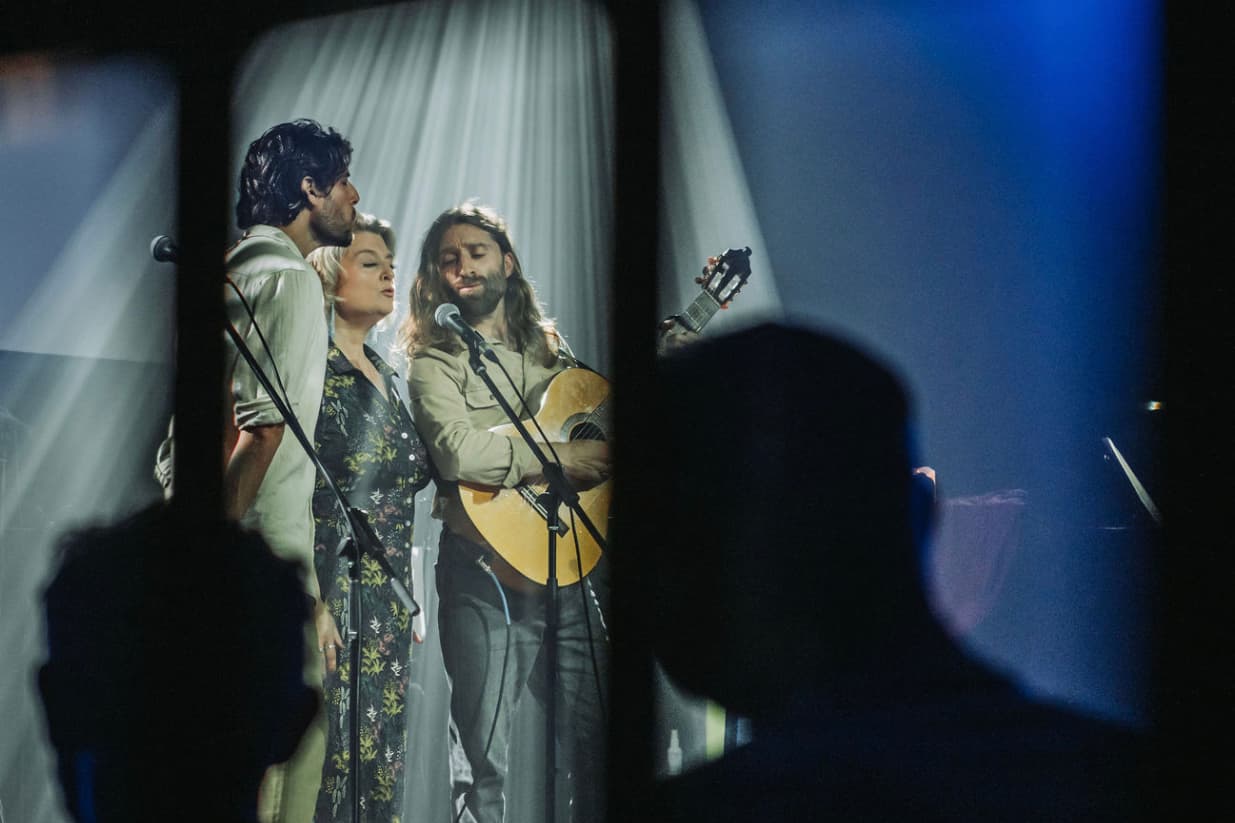
The Bashevis Singers (from left) Gideon Preiss, Evie Gawenda, Husky Gawenda

Published: 22 September 2026

Last updated: 22 September 2026

“What would Sutzkever say? What would Sutzkever do?” became catchphrases for band members of The Bashevis Singers while producing their latest album, “Moon’s Milk”, based on the poems of Yiddish poet Avrom Sutzkever, some of which have been translated for the first time by scholar of the Jewish mystical tradition, Dr Nathan Wolski.

“Sutzkever and his words certainly entered our hearts, and I think we did everything for this album with all of that in our hearts and souls,” says Husky Gawenda.

The band, which includes siblings Husky and Evie Gawenda and cousin Gideon Preiss, have recently returned from Canada where they performed songs from “Moon’s Milk” to sold out audiences in Montreal and Toronto.

“Our aim is to just make great Yiddish music,” says Husky. “We love Yiddish, and want to make songs in Yiddish, but we hope that through doing that, it brings people in who otherwise wouldn't have access to it at all, and perhaps it makes them interested in exploring Yiddish further.”

The Gawendas and Preiss all grew up in Yiddish speaking homes, AKA ‘Yiddishland’, listening to and singing the Yiddish musical greats with their grandparents and parents.

“I didn't realize that these songs were written by the greats at that time,” says Preiss. “They were deeply ingrained in us, just as folk songs, not necessarily as songs written by the great Yiddish writers.”

After performing Yiddish greats for family, friends and the community, the band first performed publicly at Mullumbimby Music Festival in 2014, singing only in Yiddish. “It was an awesome gig,” says Evie. “No one understood anything,” remembers Husky, “but they loved it and we had a great time.” The band then recorded their first album of these beloved songs in 2015.

Fast forward to 2026 and the band has five albums under their belts, with the latter three, collaborations with Wolski.

“A big step in the evolution of The Bashevis Singers was meeting Nathan Wolski,” says Husky. “We started learning Zohar with him during COVID on Zoom. And then he had this idea, because he comes from Yiddishland as well, and Yiddish is a big love of his as well, to do something together, to take some old Yiddish texts, poems and put them to music and create something new with something old.”

The first two albums, ‘Soul Joy’ and ‘Songs to Infinity’, the latter based on the mystical Yiddish poetry of Hillel Zeitlin, were deep dives into the text and the music. “We were so in love with Zeitlin's poems and the process of making that record, we thought there was never going to be anything else that would come close,” says Husky. “And then we found Sutzkever.”

Born in Smorgon (now Belarus) in 1913, Avrom Sutzkever was raised near Vilna, and was part of the “Young Vilna” literary group. He was imprisoned in the Vilna Ghetto during the Holocaust where he continued to write, joined the resistance, and helped rescue Jewish cultural treasures. After the war, he testified at the Nuremberg Trials and later settled in Israel, where he became a central figure in Yiddish literary life, editing the influential journal Di goldene keyt. He died in 2010 in Israel.

“We grew up on Wordsworth and Whitman and the Romantics, and we feel like Sutzkever is the Yiddish version of that,” says Husky. “A lot of his poetry, especially the earlier poetry, has not been translated, so it's not available to most people because not many people speak Yiddish.”

It took Wolski a mere 24 hours to respond to the band’s suggestion of Sutzkever, with a resounding yes.

“All of my research over the last 10 years has explored the intersection of Yiddish and Kabbalah. Sutzkever was no kabbalist and so he wasn't initially on my radar. Husky wanted to explore his poetry and when I began reading I was keen to move away from his Holocaust poems, and so I started at the very beginning of his poetic oeuvre,” says Wolski. “It didn't take long for me to fall in love with his pre-war collections Lider and Valdiks. Valdiks, in particular, which contains a long series of poems called 'Ecstasies' is considered by many to be the most mystical Yiddish poetry ever composed. I was hooked.”

All the songs on the album are performed in Yiddish, but the music itself can be described as ‘modern’.  Says Preiss: “A lot of people make Yiddish music from the past, which is fine. It's a historical enterprise, and for us it is partly a historical enterprise. [But] that said, we're trying to pull it with us, take it with us going forward.” Husky agrees, “Yiddish is living and breathing. It's alive. We're creating new music in Yiddish. People are hearing it, some people are enjoying it, and it's entering their lives and their hearts.”

When asked if Sustkever would have liked the album, the band is hopeful. “It’s quite a responsibility to carry,” says Preiss. “He actually refers in his own poetry, to his own artistic legacy, it's very important to him what he leaves behind. He talks about whether he's stained the earth, and whether he's stained it in a positive or a negative way. It's very beautiful the way that he describes it. That sentiment stayed with us a lot while we were writing the record.”

The Bashevis Singers have also been in touch with Sutzkever’s granddaughter, Hadas Kalderon, an Israeli actress. “I think she's pretty stoked about the album, and she wants to be involved, she wants us to launch it in Israel,” says Husky. “So that's a big thrill for us. That’s as close to knowing what Avrom thinks of Moon’s Milk as we’re gonna get, I guess.”

“I feel like he'd be proud of us, like he’s our grandfather,” says Evie. “We were very emotional in Montreal. We were standing there, singing in Yiddish , singing Sutzkever, on the other side of the world, and we had this feeling, imagine what our grandparents would feel about this. It's very special.”

Moon’s Milk is available on all streaming platforms and on vinyl at www.thebashevissingers.com

You might also like
  • A Yiddish response to October 7: a new song by the Bashevis Singers
    Husky Gawenda
  • Kabbalah and Yiddish harmonise for an old-new sound
    Miriam Hechtman
  • Jewish music festival comes to Sydney for one day
    Alan Hartstein
logomark.67a07ee3
We believe in the free flow of information

Republish our articles for free, online or in print, by using our Creative Commons licence

You might also like

    Pearly Spurtle
    FeatureArts & Culture

    Israeli ingredients a recipe for ‘Pearly Spurtle’

    Gideon Cohen
    Copy of Website books template (2)
    FeatureArts & Culture

    The winning Jewish books by Australians in the past year

    Gideon Cohen
    jiff26-cancelled.jpg
    ReflectionArts & Culture

    On despair: A reflection after watching ‘Cancelled’

    Deborah Stone

About the author

Miriam Hechtman

Miriam Hechtman

Sydney-based Miriam Hechtman is an Australian writer, creative producer and poet. She is the founder and creative director of Poetica, a live poetry and music initiative and co-presenter and producer of WORDSMITH – the poetry podcast.

More from the author

FeatureArts & Culture

New ‘spoken word’ festival in Sydney offers stories directly from creators

FeatureArts & Culture

A circle of communal healing on stage, with a dash of humour

FeatureArts & Culture

Not so secret mother’s business

Comments

No comments on this article yet. Be the first to add your thoughts.