Aa
  • Read, Watch, Listen
  • TJI Series
  • Community Action
  • Events
  • Zedi
Follow us and continue the conversation
  • LinkedIn
  • Instagram
  • FaceBook
  • X
  • YouTube
Test yourself with the TJI Quiz!

Adjust size of text

Aa

Follow us and continue the conversation

  • LinkedIn
  • Instagram
  • FaceBook
  • X
  • YouTube

Your saved articles

You haven't saved any articles

What are you looking for?

Original reporting, insightful analysis and diverse views, delivered straight to your inbox

  • LinkedIn
  • Instagram
  • FaceBook
  • X
  • YouTube
Your support fuels our mission to inform, entertain and inspire.

The Jewish Independent is bound by the Standards of Practice of the Australian Press Council. If you believe the Standards may have been breached, you may approach The Jewish Independent or make a complaint to the Australian Press Council in writing at www.presscouncil.org.au. The Council may also be contacted on 1800 025 712.

  • Our Story
  • Contact us
  • Our Team
  • Support us
  • Guidelines
  • Pitch your idea
  • Republishing us
  • Community Action
  • Our Awards
  • LinkedIn
  • Instagram
  • FaceBook
  • X
  • YouTube
Aboriginal FlagTorres Strait Islanders Flag

The Jewish Independent acknowledges Aboriginal and Torres Strait Islander peoples as the Traditional Owners and Custodians of Country throughout Australia. We pay our respects to Elders past and present, and strive to honour their rich history of storytelling in our work and mission.

© The Jewish Independent 2026All Rights Reserved
Website design and development by Your Creative, MelbourneTerms & ConditionsPrivacy Policy
HomeRead, Watch, ListenIsrael
Israel Votes 2026AnalysisIsrael

How two divergent views of Oct 7 could shape Israel’s election

Israelis are divided over whether Oct. 7 proved the conflict cannot be solved or made resolving it more urgent – a divide that could determine Benjamin Netanyahu’s political future.
Dan Perry
Print this
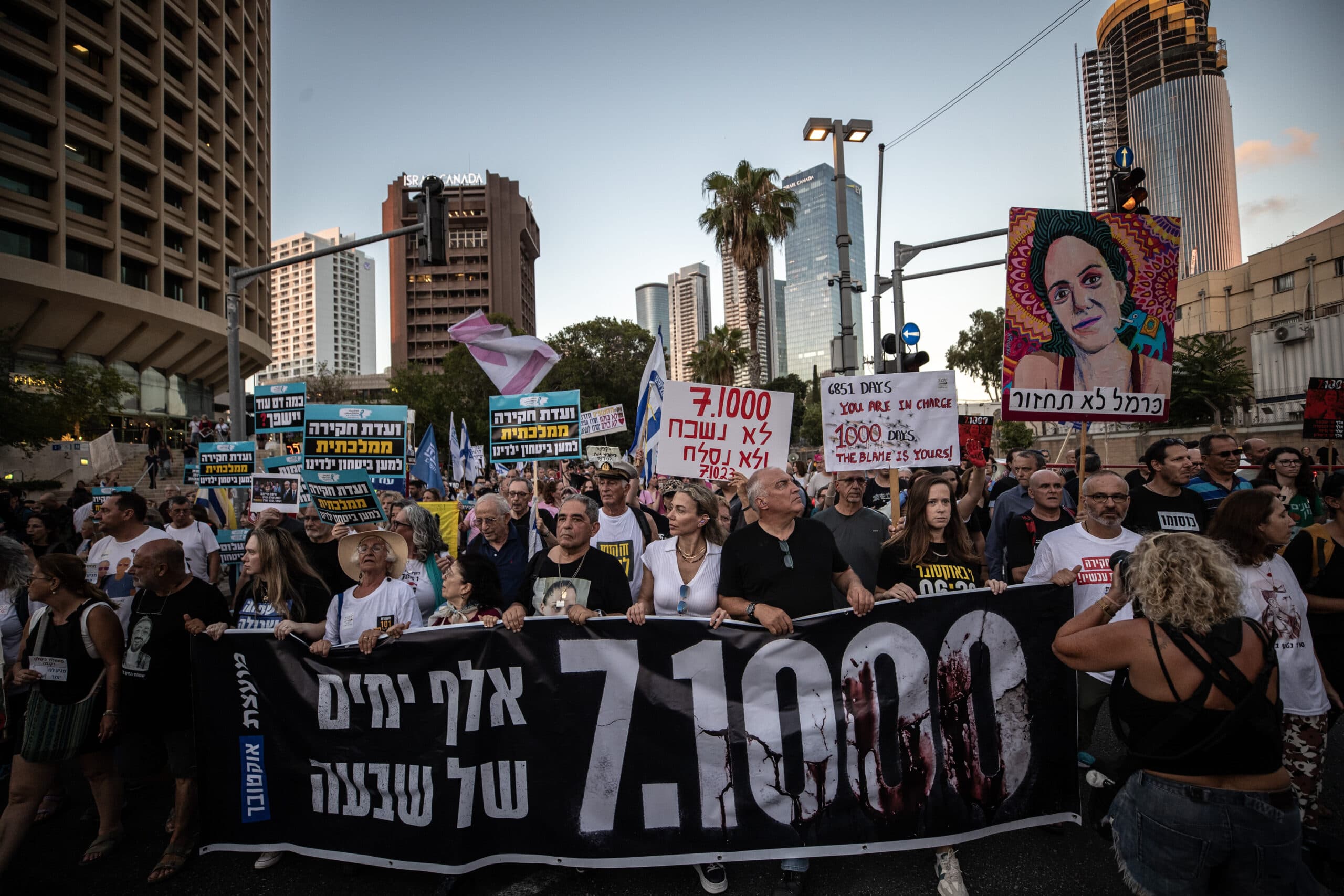
Protest held in Israel against Prime Minister Netanyahu and Israeli government

Israelis gather at Hostages Square to demand an official investigation into the events of October 7, 2023, in Tel Aviv, Israel, on July 2, 2026. (Photo by Mostafa Alkharouf/Anadolu via Getty Images)

Published: 19 October 2026

Last updated: 19 October 2026

This story was originally published in the Forward. Click here to get the Forward's free email newsletters delivered to your inbox.

There are two ways to look at the Oct. 7 attacks, and which way you do will determine, to a large degree, whether you want to see Israeli Prime Minister Benjamin Netanyahu survive the next election.

The first view is that Oct. 7 proved the Israeli-Palestinian conflict cannot be solved. The second is that it proved the conflict cannot be allowed to remain unresolved.

These conclusions point in almost opposite directions, yet both begin with something Israelis learned, or thought they learned, from the same horrific day. One says there is no point trying to mollify the Palestinians, because hatred of Israel runs too deep. The other says that leaving millions of Palestinians indefinitely in their current condition will produce catastrophe again and again. The tragedy is that Oct. 7 supplied powerful evidence for both.

The first view is not without foundation. Even to Israelis (and people across the world) who have long sought a peaceful accommodation, it was shocking to see the sheer joy of the Hamas terrorists as they butchered families while filming their own barbarism, calling parents to brag, then dragging innocents into Gaza where crowds wildly cheered.

But the real shock was the support for this in the West Bank and Gaza – polls showed two-thirds to three-quarters of Palestinians approved –  suggesting coexistence is impossible. Rarely have polls been more devastating. As a result, many Israelis lost sympathy for Palestinians and concluded that a cleansing inferno is required. The brutal war that followed certainly reflected that.

The second way to see Oct. 7 is that the Palestinian issue cannot be ignored – that the situation of the Palestinians was so unacceptable that something terrible was bound to happen. Many Israelis have trouble accepting this, because it does not really explain Hamas, which would fight Israel in any case, even if it were led by a far-left government willing to hand over to it every inch of the West Bank and Gaza and divide Jerusalem. But it might explain why so many Palestinians – even ones not in denial about the facts – were prepared to support it.

This view also offers at least one reason why the propaganda war waged by Hamas and its supporters has been so successful. There are others – including antisemitism and an outright denial of Israel’s right to exist . But the fundamentally unacceptable situation of the Palestinians is a big one, to be sure.

The combination of these factors yielded stunning results and contributed to an unfair vilification of the country that continues to frustrate Israeli voters.

By Oct. 9, before Israel had even identified all its dead or invaded Gaza, accusations of “genocide” were already circulating online, then among activists, NGOs, academics and eventually governments. By Oct. 13, protests denouncing “genocide” took place in London. On Oct 17, the Qatar-based Arab Center for Research & Policy Studies held a symposium called “The War on Gaza: Palestinian Defiance and Resistance against Orchestrated Genocide and Expulsion.”

Within weeks, South Africa accused Israel of “genocide” at the International Court of Justice in The Hague, invoking the “crime of crimes,” a term most associated with the Holocaust, the Armenian Genocide and Rwanda. “This libel is powered by a relentless campaign of incitement that engraves a lie into collective memory,” says Adam Fisher, one of Israel’s top venture capitalists, who has researched the propaganda campaign in detail.

When Israel’s military entered Gaza, it faced an enemy that had deliberately embedded weapons caches, command centers and rocket launchers in homes and crowded neighborhoods, including hospitals, schools, mosques and UN sites. Hamas fighters vanished into tunnels beneath civilian areas, turning every dead child, collapsed building and grieving parent into material for a global indictment of Israel on social media. The strategy was clear: maximize civilian suffering, isolate Israel internationally, weaken American Jewish support and ultimately erode U.S. backing.

The implication is that Oct. 7 was a response to Palestinian suffering. The suffering is real, but Hamas was never defending Palestinians. The Iran-backed jihadist group has long sought to destroy Israel rather than establish a Palestinian state, and its campaign of terrorism after the 1993 Oslo Accords helped destroy the peace process by driving Israelis to the right.

Still, none of this makes the pre-Oct. 7 reality acceptable. In the West Bank, three million Palestinians live alongside some 500,000 Jewish settlers without equal rights, largely under military occupation, while extremist settlers have increasingly engaged in violence with the government and military often looking the other way. In Gaza, more than two million Palestinians endured a devastating Israeli-Egyptian blockade because Hamas ruled the Strip. It failed to prevent Hamas from arming itself while making civilian life miserable.

On Al Jazeera recently I was placed opposite a young Gazan named Ahmed Abo Askar, introduced as a humanitarian activist and engineering student. He said he had gone three days without eating, and looked like it. He hoped an aid flotilla might get through and then smuggle out his ailing father.

I tried to put things in perspective, explaining about Hamas and the need to be rid of it. Ahmed answered emotionally: “Israel, not Hamas, they are the ones who killed my sister, killed their children and their entire family on 6 November 2023. Not all of Palestinian people are Hamas. The goods, why it’s not entering? ‘It’s because of Hamas.’ We are not Hamas. We are human in the end.”

Everything I said was true – but he won the argument anyway, because he was a decent person suffering. No history lesson trumps that.

The insane situation has traumatized Palestinians and Israelis in parallel ways. The Palestinians – who are rooted in a conservative society disinclined to compromise – have been made, in large numbers, desperate enough to support a nihilistic movement like Hamas, which is truly genocidal against Jews.

As for Israelis, it has made huge numbers of them stop wanting to think seriously about Palestinians except through the lens of security and punishment. Some openly fantasize about expulsion. Empathy is viewed as naïve. Oct. 7 made Israelis a little crazy too – exactly per the plan of Hamas.

So the Israeli opposition — people deeply hostile to Netanyahu and his extremist coalition — is mostly afraid to touch the Palestinian issue at all in the campaign ahead of the Oct. 27 election, preferring to focus on Netanyahu’s epic domestic failures. Politically, the calculation is correct.

That is where the two interpretations of Oct. 7 attach themselves to the choice Israelis face in this election. Netanyahu has spent much of his career arguing, in practice if not always explicitly, that the Palestinian problem can be managed rather than solved: Contain Gaza, maintain Israeli control of the West Bank, expand settlements, periodically use overwhelming force and resist international pressure for Palestinian statehood.

If the lesson of Oct. 7 is that Palestinian hostility is essentially immutable and territorial compromise merely brings the enemy closer, then Netanyahu’s basic worldview survives despite his catastrophic failure on Oct. 7. The answer is deterrence and permanent Israeli security control — not another attempt at political reconciliation.

Gadi Eisenkot, the main challenger on the center-left, is more complicated. He is hardly offering Israelis a new Oslo: He has explicitly rejected a Palestinian state in the near- or medium-term and says the old two-state formula is unrealistic after Oct. 7. But he has also opposed more West Bank settlements and other measures that would make eventual territorial separation impossible.And he has long warned against Israel sliding into a binational state.

The implication is less a peace plan than a direction: Preserve the possibility of separating Israelis and Palestinians, change the conditions that perpetuate the conflict, and leave open a political horizon even if nobody can presently say exactly when it nears and how it ends. In that sense, the choice is not between Netanyahu and a dove. It is between continuing to manage an apparently permanent conflict and a government that might at least begin trying to move toward a possible peace.

But if Israelis conclude that Palestinians only understand force – which, by the way, Hamas clearly doesn’t – we’re guaranteeing a death spiral. Such a problem left to fester, without any attempt to change the dynamic, will blow up again and again. So after the election, if Netanyahu and his destructive right wing coalition are mercifully gone, this will need to be addressed in new and creative ways.

Both views of Oct. 7 rest on a foundation of facts. The invasion and massacre – and the widespread support for it among Palestinians – simultaneously dismantled both the Israeli left’s confidence in Palestinian intentions, and the Israeli right’s belief that the Palestinian problem could be indefinitely managed.

But it also proved that distrust is not a policy. Israel can build fences, destroy armies, assassinate commanders and punish those who attack it. What it cannot do is make millions of Palestinians disappear. If there is no political answer to that reality, eventually there will be another violent one.

This story was originally published on the Forward.

You might also like
  • Do Israelis care that Trump has endorsed Netanyahu?
    Ruth Eglash
  • Security fears and incitement drive young voters toward far-right
    Ben Lynfield
  • ‘The Jewish Independent’ commentary makes finals in Walkley journalism awards
    The Jewish Independent
logomark.67a07ee3
We believe in the free flow of information

Republish our articles for free, online or in print, by using our Creative Commons licence

You might also like

    Gaza after street map
    Israel Hamas WarFeatureIsrael

    One year after the ceasefire, Gaza remains in ruins with no solution in sight

    Shahar Burla 2
    shahar nevo east jerusalem
    AnalysisIsrael

    Terror plot to kill hundreds of Arab Israelis thwarted

    Ben Lynfield
    Israel election posters
    Israel Votes 2026ExplainerIsrael

    Stalemate likely in Israel’s election: latest polls

    Shahar Burla 1

About the author

Dan Perry

Dan Perry

Dan Perry is the former chief editor of The Associated Press in Europe, Africa and the Middle East, the former chairman of the Foreign Press Association in Jerusalem, and the author of two books about Israel.

More from the author

OpinionIsrael

The biggest impediment to peace is not in Gaza

AnalysisIsrael

Lebanon ceasefire announced, now it’s time for Gaza

AnalysisIsrael

Israel’s calculated response in Iran was a signal, not an escalation

AnalysisWorld

Trump and Harris are both vague on Israel-Gaza, but in starkly different ways