Published: 21 October 2025
Last updated: 22 October 2025
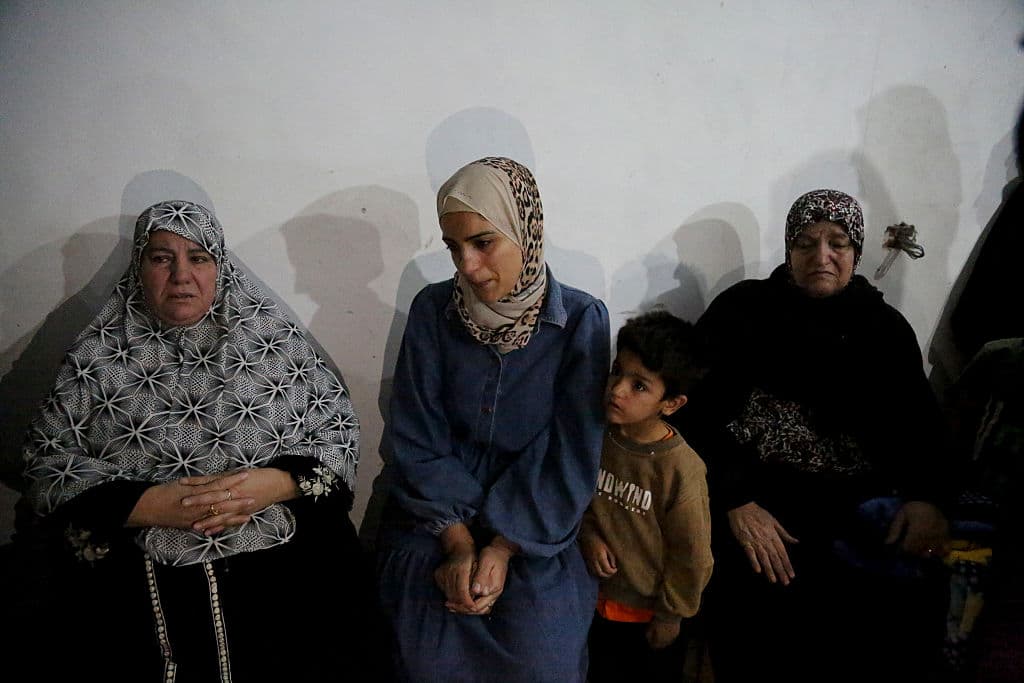
The mother of 10-year-old Mohammed Bahjat Al-Hallaq sits surrounded by relatives in the family home in the village of Al-Rihiyah, south of Hebron, on October 16, 2025, after her son was killed by the Israeli army, according to local sources. (MOSAB SHAWER/Middle East Images/AFP via Getty Images)
Published: 21 October 2025
Last updated: 22 October 2025
This story was originally published in the Forward. Click here to get the Forward's free email newsletters delivered to your inbox.
The Gaza war may finally be over, and the idea of a Palestinian state has returned to the center of global discourse. But before it can become a reality, Palestinians will need to carry less suspicion and hatred toward Israel — which means Israel must give them fewer reasons to cultivate those reactions.
An investigation from last week by my former colleagues at The Associated Press helps show how distant we are from that outcome — not just in Gaza, but also in the West Bank.
The investigation found that, according to United Nations data that Israel does not dispute, live Israeli fire has killed at least 18 children under the age of 15 in the West Bank this year. It killed 29 children in 2023, and 23 in 2024.
Some were killed during Israeli military raids in crowded neighborhoods, others by sniper fire in calm areas. The army told the AP that its open-fire regulations prohibit deliberate targeting and that it had launched some investigations. But it did not say whether anyone had been punished. The families of the deceased children report receiving little information from the army about the circumstances of their deaths, or any consequences meted out in reaction to them.
Israel’s security concerns about the West Bank are legitimate. The strategic ridge surrounds Jerusalem on three sides and overlooks Tel Aviv and the coastal plain. An attack from there could be catastrophic; if a group like Hamas were ever to take control there, the consequences would be dire.
But the need for Israel’s security cannot justify the killing of children — not one, not 18, not 29. So long as the Palestinians of the West Bank live in fear of their own children joining those grim ranks, there cannot be a chance for a real, lasting peace.
Consider just some of the children killed this year, whose stories the AP collected:
It goes on and on.
In Tulkarem, 10-year-old Saddam Rajab was caught on security footage standing on the sidewalk, turning, then being caught in a burst of gunfire and falling. He cried for his mother and died 10 days later. In Turmus Ayya, 14-year-old Amer Rabee, a Palestinian-American born in New Jersey, was shot while picking almonds with two friends, who were injured. His father said soldiers fired dozens of rounds, stripped the boy’s body, and carried it off; the army later described the victims as "three terrorists" throwing stones. In Hebron, 12-year-old Ayman al-Haimouni told his mother, "Mama, they shot me," before collapsing. Video shows soldiers approaching his body, recoiling, and walking away without offering aid. The military police opened an investigation that has yielded no result.
Although the situation has grown especially horrible under Prime Minister Benjamin Netanyahu’s government, the phenomenon is not new. The Israeli philosopher and academic Yeshayahu Leibowitz warned in the early days of the occupation of the West Bank and Gaza, after the 1967 War, that this new reality would corrupt Israeli society and devastate its moral standing.
He was not wrong. My own experience as a reporter working in and around the West Bank confronted me many times with this clear and painful fact.
The newborn baby of one Palestinian AP photographer, in the Nablus area, experienced a medical emergency; the baby died while the ambulance carrying it was delayed by Israeli troops at a checkpoint in 2002. A year later, a cameraman with whom I regularly worked, Nazeeh Darwazeh, was killed by a random bullet fired by an Israeli soldier. I remember visiting the family, and trying to console the widow and his children. They were heartbroken.
These kinds of things simply happen all the time.
Aren’t these stories, repeated so frequently after so many decades, enough to boil the blood of any normal person? How would any supporter of Israel react if this kind of indiscriminate, senseless violence happened in Israel, and the army responsible was Palestinian? If that army kept claiming that it would investigate these awful and useless slaughters, but it was obvious that any form of punishment was all but nonexistent?
Add to the mix that Netanyahu’s reckless government has normalized settler rampages, the perpetrators of which are almost never punished. Unforgivably, Israel has prosecuted few if any of the settlers who regularly rampage through Palestinian communities in what is a clear provocation aimed at creating mayhem. Settler violence, with the winks and nods of the government, is at a high — and when they are detained it is usually for assaults on Israeli soldiers, not Palestinians.
Many Israelis fear that these reckless settler provocations will unleash a third intifada. But to some far-right radicals, that would be a welcome development, as they hope for a massive war in which the Palestinians might be somehow expelled — the same outcome some far-right Israelis very plainly wished for in the Gaza war.
Israelis who have the courage to face the truth must ask themselves sincerely: How can we accept this state of affairs? How can we explain to the world — and to ourselves — that this is reasonable and moral? Is this "the fight against terror"? How can we expect our Palestinian neighbors to want to work with us toward peace?
Something is clearly sick to the core. The way out of this bloody cycle is through a true and clear separation between Israelis and Palestinians, with hope for a normal life on both sides. If this continues, more violence is likely, and the outcome may not be good for Israel — or anyone.
This story was originally published on the Forward.
RELATED STORIES
Israel Set to Deport 32 Foreign Activists Who Helped Palestinians Harvest Olives in a West Bank Village (Haaretz)
The IDF declared most of the land in the village of Burin a closed military area and arrested foreign activists who were there, eventually deciding to deport them all. Human rights activists say the order was issued to prevent assistance to Palestinians
Jewish extremists brutally assault Palestinian olive harvesters in West Bank (Times of Israel)
Masked assailant seen on video clubbing a Palestinian woman during the olive harvest in Turmus Ayya, vehicles set ablaze; police say investigation has been opened


Dan Perry is the former chief editor of The Associated Press in Europe, Africa and the Middle East, the former chairman of the Foreign Press Association in Jerusalem, and the author of two books about Israel.
More from the author