Aa
  • Read, Watch, Listen
  • TJI Series
  • Community Action
  • Events
  • Zedi
Follow us and continue the conversation
  • LinkedIn
  • Instagram
  • FaceBook
  • X
  • YouTube
Test yourself with the TJI Quiz!

Adjust size of text

Aa

Follow us and continue the conversation

  • LinkedIn
  • Instagram
  • FaceBook
  • X
  • YouTube

Your saved articles

You haven't saved any articles

What are you looking for?

Original reporting, insightful analysis and diverse views, delivered straight to your inbox

  • LinkedIn
  • Instagram
  • FaceBook
  • X
  • YouTube
Your support fuels our mission to inform, entertain and inspire.

The Jewish Independent is bound by the Standards of Practice of the Australian Press Council. If you believe the Standards may have been breached, you may approach The Jewish Independent or make a complaint to the Australian Press Council in writing at www.presscouncil.org.au. The Council may also be contacted on 1800 025 712.

  • Our Story
  • Contact us
  • Our Team
  • Support us
  • Guidelines
  • Pitch your idea
  • Republishing us
  • Community Action
  • Our Awards
  • LinkedIn
  • Instagram
  • FaceBook
  • X
  • YouTube
Aboriginal FlagTorres Strait Islanders Flag

The Jewish Independent acknowledges Aboriginal and Torres Strait Islander peoples as the Traditional Owners and Custodians of Country throughout Australia. We pay our respects to Elders past and present, and strive to honour their rich history of storytelling in our work and mission.

© The Jewish Independent 2026All Rights Reserved
Website design and development by Your Creative, MelbourneTerms & ConditionsPrivacy Policy
HomeRead, Watch, Listen
Opinion

Iraqi Jews and Muslims cross boundaries in Berlin

Mati Shemoelof
Print this

Published: 1 July 2022

Last updated: 5 March 2024

At Café de Bagh, Jews and Muslims share arak and sabich far away from the politics of Iraq and Israel

Under a recent law, Iraqi citizens are banned from having anything to do with Israel or Israelis. But here in Berlin, this Iraqi law feels like a parody.

At Café De Bagh, Israeli Jews from Iraq and Iraqi Muslims dance together to the music of Dudu Tasa, grandson of classical Iraqi composers Saleh and Daoud Al-Kuwaity.

They drink arak, Arab aniseed liqueur, and eat sabich, the Israeli sandwich based on Iraqi breakfast ingredients, which has an almost cult following in Berlin. Activist and writer Yossi Lampal compiled an anthology entitled The Influence of Sabich on German Culture, which was launched at Café De Bagh.

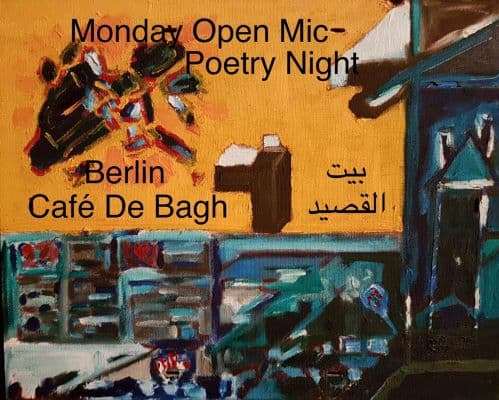
The cafe also hosts open mic and cultural events, like the multi-lingual collective Poetic Hafla, which brings together Israeli, Arab and other international performers.
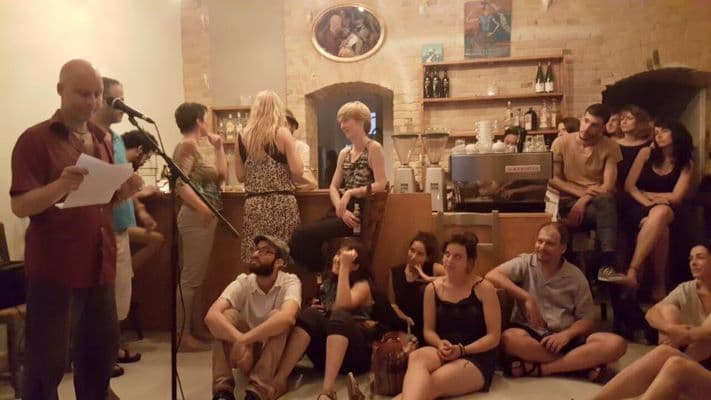
Listening to a reading at Cafe de Bagh

Café De Bagh is owned by Baghdadi Dury De Bagh, an Iraqi turned Berliner. When I arrive, he is sitting smiling in the doorway of his bar in a brown hat, dark shirt and colourful vest. He is on the phone with an Iraqi poet who had just returned from Berlin to Basra.

He introduces me in Arabic, describing me as “our brother, one of the beloved Jews of Baghdad”.

When I explain that, though my mother was born in Baghdad, I am an Israeli so have never been able to travel to the graves of our ancestors, the Basra poet responds, "Inshallah, one day you can travel. We also miss the Jews of Basra.”
Ninety-five per cent of Iraqi Jews left the country in 1950-51 for Israel. Many people here have memories of the Jews in Baghdad. Opposite the coffee window, facing the street, sits a retired Iraqi politician from the communist party, with a dark blazer and white hair. He has warm memories of his Jewish neighbours.

"I remember on your holiday that flour should not be eaten, how my family prepared sweet foods for them to celebrate the end of the holiday,” he says, referring to the tradition of the Mimouna, which Iraqi Jews celebrate immediately after Passover.

I tell him about the Muslim family in Baghdad who saved my grandmother from Iraqi rioters during the 1941 Farhud, and how my grandmother talked all her life about the house she left without a chance to come back or even sell it.

He moves a bit closer. “You know my father refused to buy one of the houses that belonged to the Jews, although it was offered to him with a cheap price. He believed that he hadn’t the right to do it.”

Café de Bagh is a long way from the tension between Iraq and Israel that exist at a political level.

Here Iraqi heritage is shared by Jews and Arabs. Here, too, Jews and Arabs sometimes have a common enemy.  The café is in Neukölln, not far from Sonnenallee, the street which is the centre of Arab culture and food in Berlin.

A poster dadvertising an event at Cafe de Bagh

De Bagh previously had a bar in the Alt-Tegel neighbourhood. Why did he move? “The Neo-Nazis did a demo and did a 'Heil Hitler' salute in front of my place. I swear to you.”

De Bagh was born in 1984 in Baghdad. When he was 14, he left to escape military service, unwilling to face the same fate as his five older brothers. With a forged passport, he fled to Turkey, Greece, and Syria, before coming to Berlin. Most of his family remain in Baghdad.

In Berlin, he became a musician. He filled clubs and performed at festivals in front of thousands of people. He was used to singing in front of big crowds: as a child of ten, he had already called for prayers as a muezzin. 

In January 2016, he decided to open Café De Bagh to bring together the artists he had got to know over the years.

The café celebrates the history shared by Iraqis of all religions. On the wall is a big painting by Britta Reinhardt, depicting a Baghdadi education institution, Al Mustansiriya School. The school was established in 1227, when Iraq was still called Babylon. By then, Jews had already been part of the country for 600 years.

“The whole world came from the ribs of Iraq,” De Bagh tells me while bringing me a drink.

I think of Berlin as a modern Babylonian city. As refugees from Baghdad, Israel, Syria or Ukraine, we have found a new Babylon where cultures meet.

Photo: A performer against the wall mural of Al Mustansiriya School (All images Cafe de Bagh, Facebook)

You might also like
  • Security fears and incitement drive young voters toward far-right
    Ben Lynfield
  • ‘The Jewish Independent’ commentary makes finals in Walkley journalism awards
    The Jewish Independent
  • Freedom Rides: Allyship for dark times
    Eliezer Rubenstein Sturgess
logomark.67a07ee3
We believe in the free flow of information

Republish our articles for free, online or in print, by using our Creative Commons licence

You might also like

    Feature

    Israel bows to pressure by restoring water flow, ICC investigates both sides

    TJI Wrap
    Australia’s Prime Minister Albanese Speaks After Bondi Shootings
    News

    What PM, Premier, Police say about Bondi antisemitic attack

    The Jewish Independent 1
    Feature

    While still holding off the ground invasion, Israel praises Qatar over hostage talks

    TJI Wrap

About the author

Mati Shemoelof

Mati Shemoelof

Mati Shemoelof is a poet and an author. His writing includes seven poetry books, plays, articles and fiction, which have won significant recognition and prizes. He has written a radio play for German radio WDR. A German edition of his bi-lingual poems was published by AphorismA Verlag.

More from the author

ReflectionIsrael

An Israeli abroad: grieving, alienated, ashamed

OpinionWorld

Israeli expats are becoming Diaspora Jews

OpinionWorld

The surprising trend among anxious Jewish parents in Berlin

OpinionWorld

How do Germans views Israelis who live among them?