Published: 10 May 2016
Last updated: 4 March 2024
JERUSALEM -- In any part of the world, hearing that your child has cancer is a frightening scenario. When your access to life-saving treatment is limited or non-existent, it can be downright terrifying.
This is the reality for some Palestinians living in the West Bank and the Gaza Strip. Part of the reason is the lack of trained specialists working at local hospitals and, in the case of Gaza, restrictions on imports of some medications and technologies that could be commandeered for purposes other than medicine.
In the realm of paediatric cancer care, the situation in the Palestinian Territories is especially dire. There’s only one paediatric cancer clinic in Gaza and one in the West Bank. Those clinics are hard-pressed to handle the 230 new paediatric cancer cases that are recorded each year in the Territories.
When the Palestinian Authority’s nationalised health care system decides that a child’s needs can’t be addressed locally, it refers them abroad for treatment, usually to Israel, Europe, Egypt, or Jordan.
It’s often more cost-effective for the Palestinian Authority to send them to Israel.
“If these kids get sent to Europe for example, it would cost twice as much,” Professor Michael Weintraub, the head of Hadassah Medical Center’s Department of Pediatric Hematology, Oncology and Bone Marrow Transplantation, told The Jewish Independent in a recent interview in his office.
Prof Weintraub leads a team of over 60 doctors, nurses, psychologists, social workers and others at Hadassah’s Ein Kerem campus, located in the hills outside Jerusalem. That team treats children with cancer, including about 50 each year who come from the Palestinian Territories. More Palestinian paediatric cancer cases are referred to Hadassah than to any other hospital in Israel. Hadassah was nominated for a Nobel Peace Prize in 2005. It remains the only hospital in the Middle East to be recognised by the Nobel committee for its commitment to cooperation and co-existence as reflected by the ethnic and religious diversity of its medical staff and patients.

The Mother and Child Pavilion at Hadassah Medical Center’s Ein Kerem campus, where Weintraub’s team works. (Hunter Stuart/The Jewish Independent)
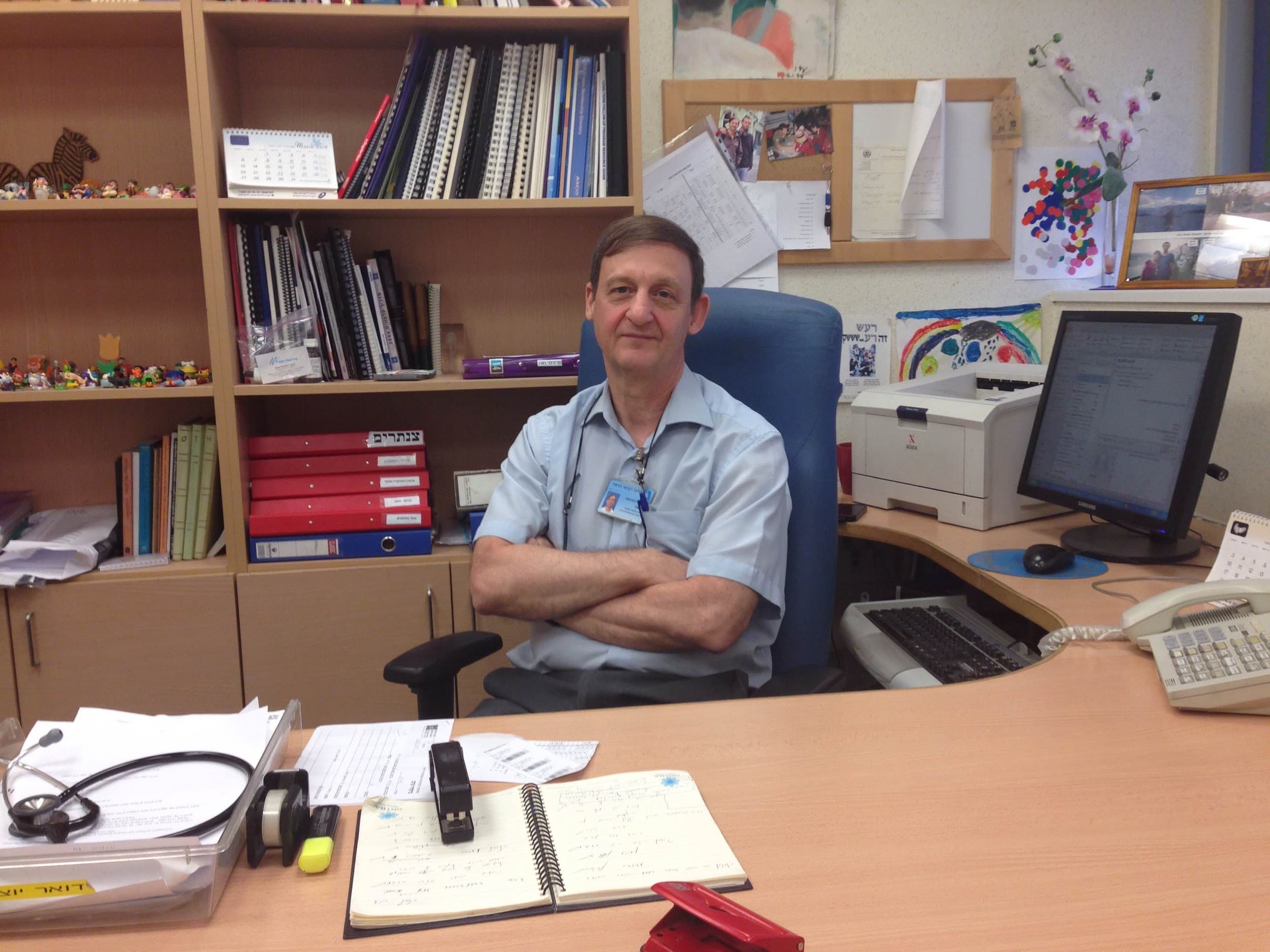
Sitting in his office at Hadassah’s Mother and Child Pavilion, which is strewn with stuffed animals, toys, stethoscopes and stacks of papers, Prof. Weintraub has the weathered look of someone who faces death on a regular basis.
He explains that his department treats Palestinian children with many different kinds of cancer - whatever the Palestinian Authority’s health system is not equipped to do.
“Almost all kids with brain tumours are referred here from Palestine, and most of the kids who have sarcomas and bone tumours, and also all those kids who need bone marrow transplantation are referred here, for the most part,” says Prof. Weintraub, who is scheduled to visit Sydney and Melbourne from May 13-23 to speak about Hadassah’s projects that are helping underprivileged Palestinians. He expects to meet a wide-ranging audience, among them business leaders, medical professionals, psychologists and others involved in palliative care and bereavement counselling.
His visit is being sponsored by Project Rozana, a multi-faith health initiative that was created by Hadassah Australia in 2013. Its purpose is to raise funds to provide transport for Palestinian children from the checkpoints to hospitals in Israel, to upskill Palestinian medical professionals who will return to build the health capacity of their communities, and to cover the cost of treatment of critically-ill Palestinian children at Hadassah once the Palestinian Authority’s funding basket has been exhausted. Project Rozana and The Jewish Independent will be jointly hosting one of the events during Prof. Weintraub’s Australian visit.
The Palestinian Authority made Hadassah its preferred provider for cancer care for children. “Relationships on an administrative level [with the PA] are very good,” Prof. Weintraub says.
But even Hadassah, one of the best hospitals in the Middle East, can’t always save kids with severe cancers. Typically, in such a situation, the patient is sent home so he or she can spend last days in a familiar environment among loved ones. Medical equipment is transferred to the home so that care can still be provided.
Because of the complicated political and security situation, Prof. Weintraub and Hadassah Hospital are creating a system to train Palestinian health professionals to provide end-of-life care at home for Palestinian kids with cancer.
 Hadassah Medical Center. (Hunter Stuart/The Jewish Independent)***
Hadassah is currently recruiting Palestinian nurses, doctors and social workers to participate in this unique programme. Once they’ve assembled the team, Hadassah will bring them to Israel for a few days of focus training on how to provide palliative care.
“For example, if a child who is sent home to Hebron needs oxygen and morphine, there will be a dedicated Palestinian health professional who will be the outreach professional for that family,” Prof. Weintraub says. That “outreach professional” would be a part of the Hadassah staff, but would travel two or three times a week to provide both medical and psychological care to the sick child and his or her family in the West Bank.
Hadassah also trains Palestinian physicians to identify and diagnose genetic immune deficiencies in children early enough so those children can get a bone marrow transplant, which can save their lives. “If you transplant early enough, before the child is six months old, the success rate is over 90 percent,” Prof.Weintraub says.
To teach Palestinian health professionals how to identify immune deficiencies in infants, Hadassah held a one-day seminar in March at the Jerusalem YMCA.
“We’re hoping this will increase awareness and improve cure rates,” Prof Weintraub says, “because infections that result from these deficiencies cause death in the majority of infants, if they’re not transplanted.”
Since its founding at the turn of last century, Hadassah has embraced everyone in need of health care, irrespective of their religion, gender or nationality. It’s as simple as this: “Any kid who comes here is like any other kid,” Prof. Weintraub says. “And we have to help them get better. No matter who you are, we train and we treat you to the best of our ability.”
This The Jewish Independent article may be republished if acknowledged thus: “This article first appeared on www.thejewishindependent.com.au and is reprinted with permission."