Aa
  • Read, Watch, Listen
  • TJI Series
  • Community Action
  • Events
  • Zedi
Follow us and continue the conversation
  • LinkedIn
  • Instagram
  • FaceBook
  • X
  • YouTube
Test yourself with the TJI Quiz!

Adjust size of text

Aa

Follow us and continue the conversation

  • LinkedIn
  • Instagram
  • FaceBook
  • X
  • YouTube

Your saved articles

You haven't saved any articles

What are you looking for?

Original reporting, insightful analysis and diverse views, delivered straight to your inbox

  • LinkedIn
  • Instagram
  • FaceBook
  • X
  • YouTube
Your support fuels our mission to inform, entertain and inspire.

The Jewish Independent is bound by the Standards of Practice of the Australian Press Council. If you believe the Standards may have been breached, you may approach The Jewish Independent or make a complaint to the Australian Press Council in writing at www.presscouncil.org.au. The Council may also be contacted on 1800 025 712.

  • Our Story
  • Contact us
  • Our Team
  • Support us
  • Guidelines
  • Pitch your idea
  • Republishing us
  • Community Action
  • Our Awards
  • LinkedIn
  • Instagram
  • FaceBook
  • X
  • YouTube
Aboriginal FlagTorres Strait Islanders Flag

The Jewish Independent acknowledges Aboriginal and Torres Strait Islander peoples as the Traditional Owners and Custodians of Country throughout Australia. We pay our respects to Elders past and present, and strive to honour their rich history of storytelling in our work and mission.

© The Jewish Independent 2026All Rights Reserved
Website design and development by Your Creative, MelbourneTerms & ConditionsPrivacy Policy
HomeRead, Watch, ListenWorld
FeatureWorld

This ambitious treasure trove could help us know our ancestors

A remarkable project to catalogue every Jewish record that has ever existed could change the world for both family historians and professional researchers.
Sidra Kranz Moshinsky
Print this
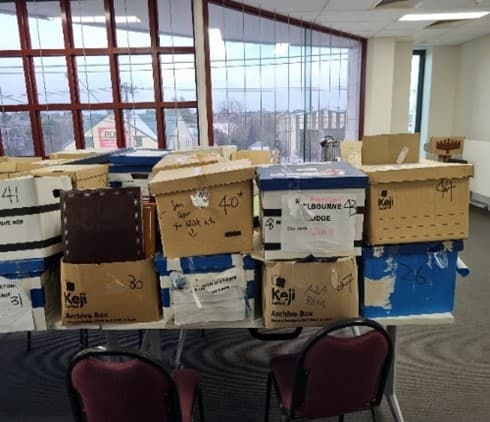
Bnai Brith records

B’nai B’rith records dating back to its inception in 1946 in Victoria (Courtesy Sabrina Elias)

Published: 27 February 2025

Last updated: 27 February 2025

My family’s history is so unknown to me, particularly the history going back more than a century.

Like so many in our community whose families came here as survivors of the Shoah in the years immediately following the end of the Second World War, I have very little in terms of tangible traces of the people and places that were: a few precious photos (the same number I nonchalantly take in a day); a handful of objects that were somehow preserved amid and through the mayhem.

Two out of four of my grandparents were willing and able to talk about their families and their lives. If only I had taken better notes and recordings. When you’re young, you think you’ll have time for these things. Alas. It’s as if a line were drawn across that world and the one in which I inhabit. For so long I’ve wanted to approach, look over, perhaps even step through it. Finally, I have the time and mental space to start the research process.

It is estimated that 85% of surviving Jewish records are being held by individuals or organisations, as opposed to within museums or official government institutions.

Having taken only a few baby steps on this journey of ancestry travels, I am grateful for any advice and direction I receive. I’ve spoken to a few fellow explorers, attended a couple of in-person and online talks, and made a start on a family tree. It seems to make sense to start with the basics of names, dates, places of birth and death as I populate the branches and leaves of a painfully stunted tree.

Yet I want to know more than simply, that they lived. I have a deeper desire to know how they lived. Who were these strangers, my ancestors? I know broadly where they situated themselves on the Jewish spectrum of belief and practice, but I am curious about their convictions and how they came to hold them. I want to know what sort of education they received. What were their livelihoods? How did their marriages work out? What were some of their strongest experiences of joy, love and grief? What did they eat? How did they like to spend whatever leisure time they had?
It was with these questions circling, questions to which I acknowledge I may never find answers, that I was intrigued to read about a worldwide project and its local extension that seeks to locate and document every Jewish record in every community that ever existed anywhere around the globe. A modest project it is not!

Records held by B’nai B’rith dating back to its inception in 1946 in Victoria (Photo courtesy of Sabrina Elias).

The project is known as the Documentation of Jewish Records Worldwide (DoJR) and is run by the L’Dor V’Dor Foundation and the International Association of Jewish Genealogical Societies. At its heart is building a digital catalogue (known as JCat) of all forms of records.

While births, deaths and marriage records provide important details, there are over 350 other types of historical records that are potentially available, ranging from membership applications and school records, to election forms for communal institutions and passenger lists. Some are specifically Jewish, others are not. Beginning with communal newspapers and Yizkor (Memorial) Book titles, the catalogue already has 10,000 entries. It is growing steadily, while giving priority to communities at risk, such as Venezuela, in an effort to document and preserve traces before they disappear.

It is estimated that 85% of surviving Jewish records are being held by individuals or organisations, as opposed to within museums or official government institutions. A set of committee minutes or organisation ephemera collecting dust in a backroom or in someone’s garage is a potential treasure trove for current and future family members and historians seeking to understand the work of that organisation broadly or of a particular individual’s role within it. With AI, documents written in foreign languages are becoming much more accessible, particularly if they are typed.

The Australian Jewish community may be relatively young and small but it has stories to tell and histories to preserve.

These records are invaluable. I might be able to find out what kind of student a great-grandparent was; if they sat on any committees in their towns; evidence of business dealings or legal issues. While the specific documents themselves are not being digitised (at least not yet), the very fact that the records themselves exist is an enormous start in a quest to uncover a lost relative’s lost past. We can start to know what we don’t know. The known unknowns…

The Australian Jewish community may be relatively young and small but it has stories to tell and histories to preserve. The Australian Jewish Genealogical Society (Vic) is an affiliate of the global project – indeed it was one of the first to come on board. Over the last few years and with a dedicated team of volunteers, led by Dr Helen Gardner, it has documented over 5,000 records for just Victoria alone.

One such example recently uncovered is a collection of applications for Jewish gravestone inscriptions at the Melbourne General Cemetery. These precious records, going back to the 1860s, provide crucial details of names and dates, including of the deceased’s father’s Hebrew name, taking researchers even further back in time. While the condition of the physical gravestones has deteriorated, with many now destroyed or completely indecipherable, these paper traces remain.

In an effort to preserve these and hundreds of other unique and fragile records, the AJGS (Vic), together with B'nai B’rith (Vic) and the JCCV, is calling on people who may be custodians to make contact. A team member sorts through the documents, catalogues what is there and provides the organisation with a summary of what they have, while, with consultation, entering the existence of these records on JCat. No individual details are made available, but global and future researchers will know that there are such records and can make contact.

Research demonstrates a correlation between knowing your family’s stories and resilience. The more questions you can answer about details of your ancestors’ lives, the higher the level of your resilience. There are many reasons we may be drawn to learning of our family’s history, among them finding in the past a steadying and fortifying foundation for the present.

You might also like
  • Facing a new year with the knowledge life can be better
    The Jewish Independent
  • UK’s dramatic policy change on Israel-Palestine
    Colin Shindler
  • ‘Your help is extremely needed’: Jewish aid group on the ground after Nepal flood
    Peter Kohn
logomark.67a07ee3
We believe in the free flow of information

Republish our articles for free, online or in print, by using our Creative Commons licence

You might also like

    Erdogan Turkey
    AnalysisIsrael

    Turkey emerges as military threat to Israel

    Dror Doron
    Jewish word map
    FeatureArts & Culture

    Was the barmi a shemozzle? How Australians use Jewish words 

    Caroline Hendy & Emma Breslow 1
    Rozana Beit Oula
    PeacebuildingOpinionIsrael

    Peacebuilding through the eyes of a sceptic

    Ron Finkel

About the author

Sidra Kranz Moshinsky

Sidra Kranz Moshinsky

Sidra Kranz Moshinsky is a writer, researcher, educational leader and museum professional, serving as the Director and CEO at the Jewish Museum of Australia. She has worked across Jewish schools and cultural organisations throughout her professional life and is a founder of the Jewish Educators’ Network of Australia. Sidra is also a freelance contributor to various publications, such as The Jewish Independent, and celebrates Jewish life through many avenues, including by being a board member of Kehilat Kolenu.

More from the author

ReflectionArts & Culture

Between Melbourne, Warsaw and Tel Aviv, where was I at home this week?

OpinionLifestyle

When they ask about…the tooth fairy

AnalysisLifestyle

When they ask about…TikTok

Comments

No comments on this article yet. Be the first to add your thoughts.