Aa
  • Read, Watch, Listen
  • TJI Series
  • Community Action
  • Events
  • Zedi
Follow us and continue the conversation
  • LinkedIn
  • Instagram
  • FaceBook
  • X
  • YouTube
Test yourself with the TJI Quiz!

Adjust size of text

Aa

Follow us and continue the conversation

  • LinkedIn
  • Instagram
  • FaceBook
  • X
  • YouTube

Your saved articles

You haven't saved any articles

What are you looking for?

Original reporting, insightful analysis and diverse views, delivered straight to your inbox

  • LinkedIn
  • Instagram
  • FaceBook
  • X
  • YouTube
Your support fuels our mission to inform, entertain and inspire.

The Jewish Independent is bound by the Standards of Practice of the Australian Press Council. If you believe the Standards may have been breached, you may approach The Jewish Independent or make a complaint to the Australian Press Council in writing at www.presscouncil.org.au. The Council may also be contacted on 1800 025 712.

  • Our Story
  • Contact us
  • Our Team
  • Support us
  • Guidelines
  • Pitch your idea
  • Republishing us
  • Community Action
  • Our Awards
  • LinkedIn
  • Instagram
  • FaceBook
  • X
  • YouTube
Aboriginal FlagTorres Strait Islanders Flag

The Jewish Independent acknowledges Aboriginal and Torres Strait Islander peoples as the Traditional Owners and Custodians of Country throughout Australia. We pay our respects to Elders past and present, and strive to honour their rich history of storytelling in our work and mission.

© The Jewish Independent 2026All Rights Reserved
Website design and development by Your Creative, MelbourneTerms & ConditionsPrivacy Policy
HomeRead, Watch, ListenLifestyle
ReflectionLifestyleZedi

My Jewish identity isn’t taking a holiday  

The differences between Israeli and Diaspora attitudes to Jewish safety was brought home to me on a Greek island holiday.
Leila Segal
Print this
My Jewish identity isn’t taking a holiday

(Image: TJI)

Published: 27 January 2026

Last updated: 17 February 2026

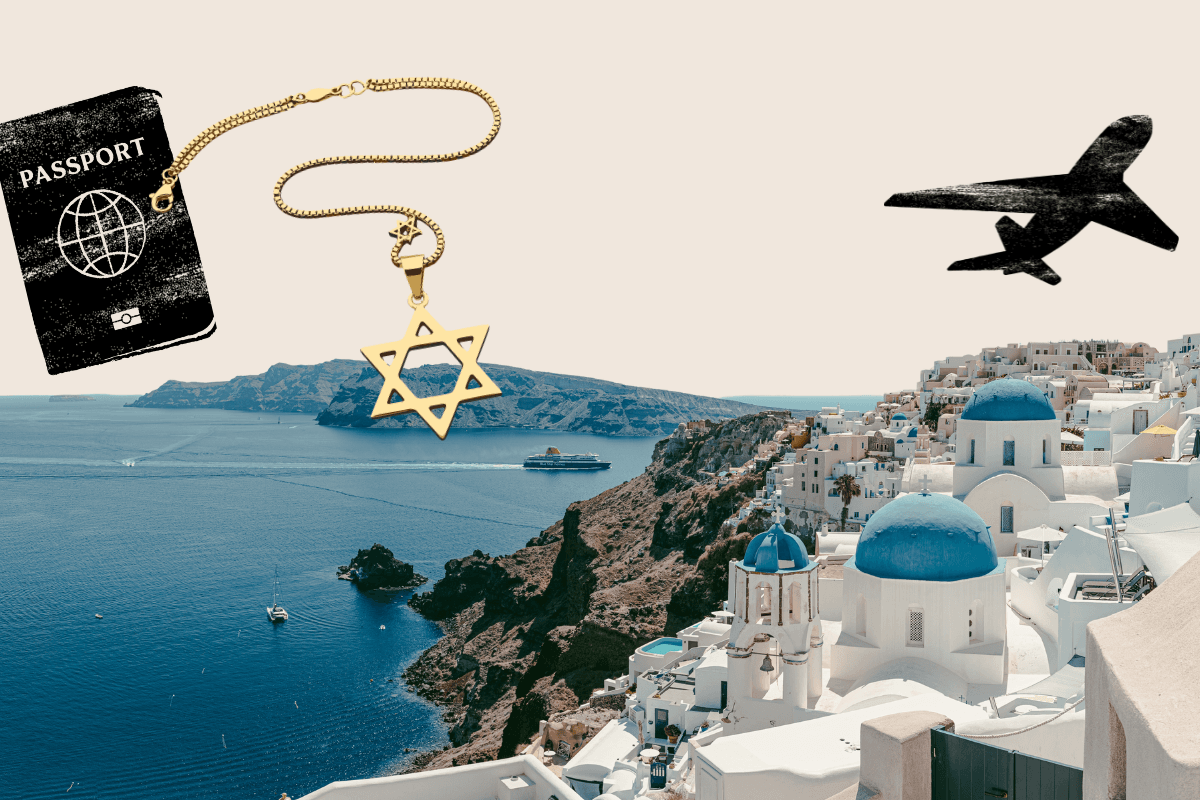
On a Greek Island holiday, I made loose plans to meet up with some friends from Tel Aviv. Before I even sat down, they noticed the Magen David (Star of David) around my neck. 

“Wow! I love that you’re wearing it!” an Israeli friend exclaimed, impressed but also a little concerned.  

Their necks were bare—no Jewish stars, not even a chai or chamsa. I felt a pang of sadness. Their desire to slip under the radar marked a shift from the borderline-obnoxious Jewish pride I’d come to associate with Israelis before October 7. 

What hadn’t changed was the ruach—the intoxicating energy I know and love. The table buzzed, ouzo flowed, and too much food was ordered. I sunk into the familiar rhythm of their banter, understanding more from their gestures and tone than the Hebrew itself. There’s something about the way Israelis relax—so confident, so alive. 

But the anxiety beneath that relaxed exterior was revealed when the conversation circled back to my necklace, which glinted against my freckled skin in the low afternoon sun. It was too hot to wear anything but bathers, and I was too content to even think about covering it up. 

“Don’t you feel scared?” they asked. 

The question struck me as surreal coming from people who’d just lived through months of sirens, missile strikes, and shelters. That was scary. 

But I had the privilege of saying “Australia” when asked where I was from. The neutrality of my home country (colonial origins notwithstanding) is not something I take for granted anymore. 

The global hostility toward Israel—and let’s be honest, toward Jews—has become loud and aggressive.  
In Greece, it was impossible to ignore. “Zionists not welcome” was scrawled on walls in Athens, and sometimes more extreme graffiti screamed “Fuck IDF” or “All Israeli soldiers are war criminals–occupiers – rapists – murderers. We don't want you here!” 

At times I have to consciously push against the inherited trauma and fear, to reclaim pride in being Jewish

I understood why Israelis would hesitate to reveal their Jewish identity outside Israel, but I found it heartbreaking. 

“What do you say when people ask where you’re from?” I asked one of the Israelis. 

He paused, trying to distill the weight of prejudice and propaganda into words. He didn’t have a clear answer. “It’s complicated,” he said. It shouldn’t be—but I knew exactly what he meant. I couldn’t think of any other nationality whose answer to that question comes with such baggage. 

These young, creative, generous people had come straight from a war zone, from running in and out of safe rooms under rocket fire. They showed me photos of Tel Aviv—entire buildings destroyed in central neighbourhoods.

 “This was my favourite bar,” one said, pointing to a pile of rubble at the base of an apartment block. 

My decision to wear a Magen David had come after October 7, to connect with and support our community in grief. 

I also felt a responsibility (in circumstances where I felt safe) to be visible outside of it, to represent my people, with warmth and kindness whenever I could. 

That decision became more loaded as I travelled. During a layover in Dubai, I gestured to two traditionally dressed Muslim women to take the empty seats at my crowded café table. They smiled and gratefully accepted. I noticed my Magen David was tucked into my top—and intentionally, I pulled it out. I wanted them to see me as Jewish, but just like them: another woman in transit, in desperate need of a coffee.  

The generations before me are always in mind, those like my grandparents who had been forced to wear a yellow star when the symbol I now chose was weaponised as a mark of shame. 

At times I have to consciously push against the inherited trauma and fear, to reclaim pride in being Jewish. I try to move through the anxiety and discomfort, drawing on generational chutzpah, which has served me well. 

Wearing my Magen David while travelling was an intentional choice. Still, I had my limits. 

I was relieved it was hidden under my jumper when I found a man in a keffiyeh already sitting in my assigned window seat. He looked annoyed, clearly not thrilled about the middle seat and the long-haul flight ahead. I didn’t need to give him another reason to blame it on the Jews—I mean, the “Zionists”. 

I texted a friend before take-off about the incident. Her reply was classic: 
“Does your seat smell like virtue signalling now?” I laughed out loud. 

It’s our fierce sense of humour, our chutzpah, and the way our community finds each other—even on a remote Greek island—that I’m most proud to be a part of. 

You might also like
  • Antisemitism, homophobia and a radical response to both
    Dennis Altman
  • Confronting Richard Flanagan and the myth of the Israel lobby
    Mary Garden
  • Court decision fails to understand when ‘Fuk Israel’ becomes antisemitic
    Jeremie Bracka
logomark.67a07ee3
We believe in the free flow of information

Republish our articles for free, online or in print, by using our Creative Commons licence

You might also like

    Neurodivergence panel
    VideoLifestyle

    Neurodivergence and inclusion in the Jcom

    The Jewish Independent
    Rosh Hashanah Customs
    FeatureLifestyle

    10 little-known Rosh Hashanah customs from around the world

    Menachem Posner
    original-6ACA4B6A-4208-4277-A4EE-E687C3C87523
    FeatureLifestyle

    The right to an ordinary Jewish life

    Jarod Rhine-Davis

About the author

Leila Segal

Leila Segal

Leila is a Sydney based Jewess who works in early childhood education and loves to travel.

More from the author

ReflectionLifestyle

I’m a Jewess and I’m owning the term 

OpinionArts & Culture

Broigus Like Beckham

Comments

No comments on this article yet. Be the first to add your thoughts.