Aa
  • Read, Watch, Listen
  • TJI Series
  • Community Action
  • Events
  • Zedi
Follow us and continue the conversation
  • LinkedIn
  • Instagram
  • FaceBook
  • X
  • YouTube
Test yourself with the TJI Quiz!

Adjust size of text

Aa

Follow us and continue the conversation

  • LinkedIn
  • Instagram
  • FaceBook
  • X
  • YouTube

Your saved articles

You haven't saved any articles

What are you looking for?

Original reporting, insightful analysis and diverse views, delivered straight to your inbox

  • LinkedIn
  • Instagram
  • FaceBook
  • X
  • YouTube
Your support fuels our mission to inform, entertain and inspire.

The Jewish Independent is bound by the Standards of Practice of the Australian Press Council. If you believe the Standards may have been breached, you may approach The Jewish Independent or make a complaint to the Australian Press Council in writing at www.presscouncil.org.au. The Council may also be contacted on 1800 025 712.

  • Our Story
  • Contact us
  • Our Team
  • Support us
  • Guidelines
  • Pitch your idea
  • Republishing us
  • Community Action
  • Our Awards
  • LinkedIn
  • Instagram
  • FaceBook
  • X
  • YouTube
Aboriginal FlagTorres Strait Islanders Flag

The Jewish Independent acknowledges Aboriginal and Torres Strait Islander peoples as the Traditional Owners and Custodians of Country throughout Australia. We pay our respects to Elders past and present, and strive to honour their rich history of storytelling in our work and mission.

© The Jewish Independent 2026All Rights Reserved
Website design and development by Your Creative, MelbourneTerms & ConditionsPrivacy Policy
HomeRead, Watch, ListenAustralia
InterviewAustralia

When human rights clash

How do you reconcile absolute and non-absolute human rights? VIC ALHADEFF catches up with former Human Rights Commissioner ED SANTOW.
Vic Alhadeff
Print this
Ed Santow

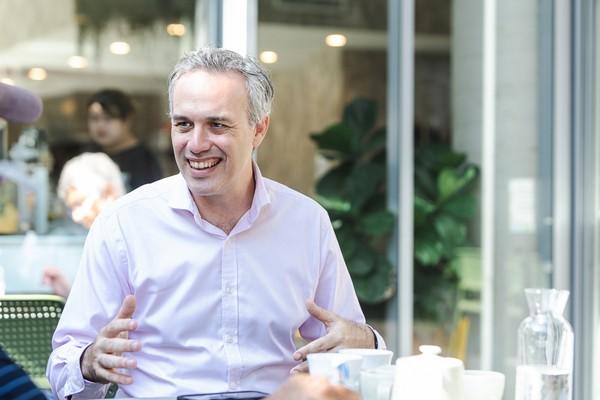
Ed Santow (Giselle Haber)

Published: 11 March 2024

Last updated: 21 March 2024

How do you reconcile absolute and non-absolute human rights? VIC ALHADEFF asks former Human Rights Commissioner ED SANTOW.

The youngest son of a giant of the law – NSW Supreme Court Justice Kim Santow and social worker Lee - Ed Santow blended key aspects of both parents’ careers. “A judge who is 6ft 4 is pretty imposing, but Dad didn’t wear his height in an overbearing way,” he points out laconically.

“The distance between law and social work isn’t that far. As a lawyer, a client often comes to you at a time of crisis. If you respond in a legalistic way, answering the legal question only, perhaps you’ve fulfilled your narrow duty as a lawyer, but most clients bring a tangle of concerns. 

“Disentangling that knot and getting to the heart of the issue is essential. A social worker, on the other hand, zooms out to look at the bigger situation. We need to integrate both worlds. That message was one that Dad applied, and it stuck with me.”

Armed with a Master of Laws from Cambridge University, Santow served as Australia's Human Rights Commissioner from 2016-21, leading its work on freedom of expression, national security, counterterrorism, torture, artificial intelligence (AI), refugees and the LGBTQI+ sector.

Emphasising that human rights are designed to compete with each other, he notes that “the right to free speech and the right to privacy pull in different directions. The question is how to reconcile those rights. You can’t allow one to swamp the other.”

 “There are two categories of human rights,” he says – “absolute and non-absolute. Freedom from torture, for example, is an absolute; there is no situation where it’s acceptable under international human rights law. 
the right to free speech and the right to privacy pull in different directions. You can’t allow one to swamp the other.

“But most rights are non-absolute, and both of these categories were an intended part of the architecture of human rights law in the aftermath of the Holocaust. They were designed to conflict. International law offers a mechanism for holding conflicting rights in tension so that we give voice to multiple rights at the same time.”

A key factor here is proportionality, he stresses. “It’s a principle that was developed in Prussian law in the 19th century, the idea being to find a legal way to compare apples and oranges. It means hate-speech law should be only as restrictive as absolutely necessary to combat antisemitism.” (Mr Santow told Plus61J he did not want to discuss these rights in relation to public debate in Australia since the events of October 7.) 

An allegory told in legal circles posits that as most violent crime is committed by men aged between 18 and 60, the offence would be significantly reduced if all men in that age group were locked up – “clearly, a disproportionate way of ensuring community safety”.

We also need to acknowledge that “while you can’t pretend you’re a robot, it’s important to be guided by professional responsibilities. As Human Rights Commissioner, my legal duty was to be impartial in applying human rights law. This meant I sometimes arrived at a result which I would not have reached if I was guided simply by personal beliefs.

“My dad and I didn’t talk much about law, but one of our conversations has stayed with me. I asked what makes a good judge; his response was someone who can suppress their prejudices. It acknowledges that we all have baggage which informs our perspective. I would ask myself if I’d reached a view because I was trying to help people who were like me, or – what was always a risk – was I over-compensating, had I gone too far the other way?”

I sometimes felt panic that we hadn’t done a good enough job imagining what it felt like for those affected. 

Endeavouring to apply thousands of pages of human rights law to real life, Santow says “in exercising the right to free speech, you need to consider the impact on those most affected by that speech. I’d hear things which were hurtful to a particular minority, but the impact isn’t appreciated if you don’t get into the shoes of the person being targeted.

“While it was wonderful to write policy or discuss legislation, the higher up the chain you go, the more removed you are from the people experiencing the pain. I sometimes felt panic that we hadn’t done a good enough job imagining what it felt like for those affected. 

“An example was the debate on Section 18c of the Racial Discrimination Act [about race hate]. Too often the debate was clouded by abstract discussion about the need for free speech without enough thought for the pain people endure if they are the victims of racially motivated hate speech. The risk is that you focus on principles and they become untethered from their impact.

“There is a distance between the principle and the practical; I’m more interested in the practical. What my dad did well was hold both notions in tension; the law matters, but you also have to think about what it means on the ground.”

Santow’s father, Justice Santow, served as Chancellor of the University of Sydney, was a Visiting Scholar at Harvard and represented Syd at rowing. His mother immigrated from South Africa in the 1960s when her father became concerned for the well-being of her twin brother, Bill Frankel, who was active in the anti-apartheid movement.

The shortest of their three sons, Ed is 188 cm, brother Will 193 cm and brother Simon a daunting 203 cm. Their mother is a mere 157 cm. Ed is currently Director of Policy and Governance at the Human Technology Institute at the University of Technology, Sydney (UTS), which he co-founded. The institute promotes human rights in the development and regulation of AI, “ensuring there are guard-rails”. He is also a member of the NSW Government AI Review Committee.

You might also like
  • ‘Israel is systemically eliminating Palestinian collective life’:  Israeli human rights report
    Deborah Stone
  • We must not look away from settler violence in the West Bank
    The Jewish Independent
  • Underlying beliefs override facts in shaping views of Jews, Israel
    Michael Visontay
logomark.67a07ee3
We believe in the free flow of information

Republish our articles for free, online or in print, by using our Creative Commons licence

You might also like

    Eva Geller
    Australia

    Bondi victim dies after almost 11 months fighting

    The Jewish Independent
    Menachem Vorchheimer
    InterviewAustralia

    Why Menachem Vorchheimer keeps taking people to court 

    Max Gross 1
    Planes Flying Over Barcelona
    Israel Votes 2026InterviewAustralia

    The Israelis who flew home to vote

    Gideon Cohen

About the author

Vic Alhadeff

Vic Alhadeff

Vic Alhadeff OAM is former CEO of the NSW Jewish Board of Deputies and former editor of the Australian Jewish News.

More from the author

InterviewAustralia

‘For 80 years we lived in a kind of fairyland. It’s over’

InterviewArts & Culture

‘The battle for the future of Jews will be fought in the cultural arena’

InterviewWorld

IHRA head: discrediting definition means ‘turning a blind eye’ to anti-Zionism

OpinionArts & Culture

40 years since Lanzmann’s Shoah, his central question remains: When is it too late?