Aa
  • Read, Watch, Listen
  • TJI Series
  • Community Action
  • Events
  • Zedi
Follow us and continue the conversation
  • LinkedIn
  • Instagram
  • FaceBook
  • X
  • YouTube
Test yourself with the TJI Quiz!

Adjust size of text

Aa

Follow us and continue the conversation

  • LinkedIn
  • Instagram
  • FaceBook
  • X
  • YouTube

Your saved articles

You haven't saved any articles

What are you looking for?

Original reporting, insightful analysis and diverse views, delivered straight to your inbox

  • LinkedIn
  • Instagram
  • FaceBook
  • X
  • YouTube
Your support fuels our mission to inform, entertain and inspire.

The Jewish Independent is bound by the Standards of Practice of the Australian Press Council. If you believe the Standards may have been breached, you may approach The Jewish Independent or make a complaint to the Australian Press Council in writing at www.presscouncil.org.au. The Council may also be contacted on 1800 025 712.

  • Our Story
  • Contact us
  • Our Team
  • Support us
  • Guidelines
  • Pitch your idea
  • Republishing us
  • Community Action
  • Our Awards
  • LinkedIn
  • Instagram
  • FaceBook
  • X
  • YouTube
Aboriginal FlagTorres Strait Islanders Flag

The Jewish Independent acknowledges Aboriginal and Torres Strait Islander peoples as the Traditional Owners and Custodians of Country throughout Australia. We pay our respects to Elders past and present, and strive to honour their rich history of storytelling in our work and mission.

© The Jewish Independent 2026All Rights Reserved
Website design and development by Your Creative, MelbourneTerms & ConditionsPrivacy Policy
HomeRead, Watch, Listen
Feature

You come to sing: Kehilat Kolenu, the Melbourne congregation with a difference

Benjamin Preiss
Print this

Published: 15 October 2021

Last updated: 4 March 2024

BENJAMIN PREISS: Kolenu has struck a chord with young Jews craving something different. Its co-founder talks about the secret of its success and post-Covid future

IN 2019 CROWD NUMBERS were soaring at Kehilat Kolenu’s Melbourne gatherings, culminating in a Yom Kippur service that attracted 750 people.  

Demand was so high that organisers introduced a ticketing system to make sure the venue, Habonim Dror’s hall in Elsternwick, was not completely swamped.  

Around this time the Shabbat services were regularly attracting about 110 people who were drawn to the secular congregation’s style of Judaism, which emphasised music and group singing rather than traditional prayers.  

Co-founder and community director Ash Densham says Kolenu, Hebrew for “our voice”, had evolved rapidly from the first service in 2012 held in the living room of his brother’s St Kilda share house. 

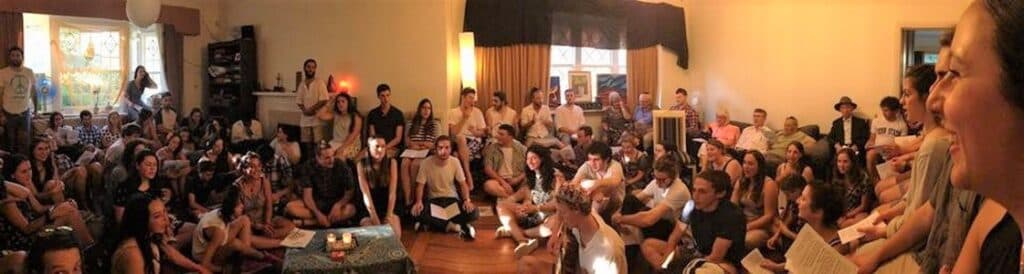
In those early days about 30 people (mostly former and current Habonim leaders) would gather on the wooden floor, the scent of incense wafting through the house as djembe drums, guitars and singing bounced off the walls on Friday evenings.  

Densham says they came together for Kabbalat Shabbat services that celebrated a Judaism that was free of religious rigmarole but fitted neatly with their contemporary moral values.  
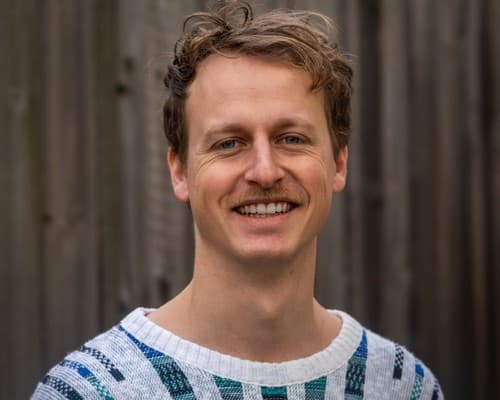
Kolenu co-founder Ash Densham

“We were tapping into that philosophy and bringing that to life in Melbourne,” he says. “The group of us who started it off were really just looking for more musicality.”  

The format was modelled on a religious Kabbalat Shabbat service and they made a siddur but it omitted almost all references to God.  
They retained the psalms, signifying the six days of creation, and the hymn Lecha Dodi for its traditional significance. 

We wanted it to be a participatory experience. You don’t come to Kolenu to talk to your friends. You come to sit and sing. You talk to them afterwards.

“We wanted it to be a very participatory experience,” he says. “You don’t come to Kolenu to talk to your friends. You come to sit and sing. You talk to them afterwards.”  

Kolenu was beginning to attract a wide range of age groups, including parents and grandparents.  

But in March last year the pandemic threatened to stall much of what the Kolenu founders had achieved in creating a unique expression of Judaism in Melbourne.  

The Jewish Independent

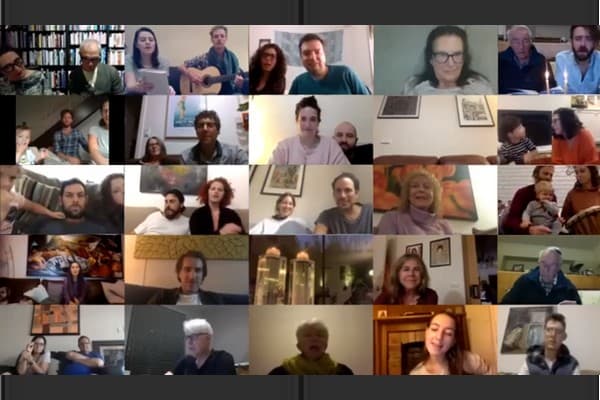
When the first lockdown was declared, like most organisations in Australia, the congregation was gripped briefly by a sense of paralysis. The atmosphere of singing in concentric circles was impossible to replicate online.  

When the first lockdown was declared, the congregation was gripped briefly by a sense of paralysis.

“The first three weeks we just didn’t do anything.”  

But on April 3 last year they held their first Shabbat service on Zoom and 130 people joined, exceeding previous average attendances.

“Everyone was craving some sort of connection.” 

Even though choir-like singing is all but impossible over zoom, Kolenu is still managing to strengthen the connection with its community.  

The online format also delivered some unexpected benefits, including unrestricted attendance numbers with Yom Kippur this year attracting about 1200 people.  

Kolenu's service under lockdown

Jews from Sydney, Perth, Israel and the United States also joined in.  

The online Shabbat services feature a five-member musical committee, which leads the singing but the congregation remains on mute. “We just assume they’re singing along,” Densham says.   

The online Shabbat service format is similar to those held in person with a rotating line-up of community members who discuss that week’s parshah from the Torah.  

The online format has delivered some unexpected benefits, including unrestricted attendance numbers. Yom Kippur this year attracted about 1200 people.

Melbourne historian and academic, Mark Baker, says over the past decade there has been a generation of disaffiliated youth seeking meaning in their religious Jewish practice.  

“The old institutionalised ‘cathedral’ synagogues didn’t answer their needs,” he says. “The phenomenon has reinvented the Chavura movement of 1960s America – a mixture of neo-Chasidism and hippie culture. The movement is generally lay-led, egalitarian and feminist, progressive in social values and reinfuses Jewish religious ritual with contemporary meaning.”  

Densham rejects any suggestion that Kolenu offers a lesser version of Judaism because of its secular perspective. If anything, he says, it has expanded the organisation’s reach across age groups.    

“Grandparents and parents want to sing with their kids. They don’t want to just go to shule alone.”  

He insists Jewish religious practice and culture have changed over the centuries and found ways to remain meaningful in modern life.  

As Melbourne prepares to emerge from lockdown when Victoria reaches 80 per cent double dose vaccination, Kolenu will have to find a way to adapt its services again to meet Covid safety requirements.  

Densham says they will probably meet in Caulfield Park over summer until the rules allow them to return to Waks House, which is home of the Jewish Labor Bund in Melbourne.  

But Densham admits he is unsure how post-lockdown services will recapture the intimacy of previous in-person Shabbats while tight restrictions are in place.  

“When you’re in a big space or Caulfield Park a lot of that … tone gets lost and it’s less of an immersive experience.”  

Yet he still expects congregants will be keen to return to Kolenu services post-lockdown.  

He says Kolenu will continue providing a space for reflection and contemplation in a Jewish context, which may become even more important when we return to our busy lives as restrictions ease.  

“As humans we’re so prone to forgetting important things,” Densham says, “We need time in our week or month to revisit those things.”  

Photo: a Kehilat Kolenu service, pre-Covid (courtesy)

You might also like
  • Ash Densham: Building community through Humanistic Judaism
    Gideon Cohen
  • When the state faltered, civil society and Diaspora Jewry stepped up
    Shahar Burla
  • The case for leaving graffiti up for a while
    Adam Slonim
logomark.67a07ee3
We believe in the free flow of information

Republish our articles for free, online or in print, by using our Creative Commons licence

You might also like

    Feature

    Israel bows to pressure by restoring water flow, ICC investigates both sides

    TJI Wrap
    Israel Hamas War

    IDF: Hamas will steal fuel for tunnel ventilation systems and rockets

    TJI Wrap
    Jewish-diversity copy
    Feature

    The three questions that will define the Jewish future

    Shahar Burla 1

About the author

Benjamin Preiss

Benjamin Preiss

Benjamin Preiss is a journalist with The Age in Melbourne

More from the author

InterviewArts & Culture

Grappling with Mark Baker’s last words

FeatureArts & Culture

‘My mother is German-Jewish and my father is Arab-Israeli which makes me Sri Lankan’

Australia

Mira’s insight: ‘In the Holocaust I learnt about the goodness of people’

Australia

New means-assessed places at Melbourne Jewish schools are in demand