Aa
  • Read, Watch, Listen
  • TJI Series
  • Community Action
  • Events
  • Zedi
Follow us and continue the conversation
  • LinkedIn
  • Instagram
  • FaceBook
  • X
  • YouTube
Test yourself with the TJI Quiz!

Adjust size of text

Aa

Follow us and continue the conversation

  • LinkedIn
  • Instagram
  • FaceBook
  • X
  • YouTube

Your saved articles

You haven't saved any articles

What are you looking for?

Original reporting, insightful analysis and diverse views, delivered straight to your inbox

  • LinkedIn
  • Instagram
  • FaceBook
  • X
  • YouTube
Your support fuels our mission to inform, entertain and inspire.

The Jewish Independent is bound by the Standards of Practice of the Australian Press Council. If you believe the Standards may have been breached, you may approach The Jewish Independent or make a complaint to the Australian Press Council in writing at www.presscouncil.org.au. The Council may also be contacted on 1800 025 712.

  • Our Story
  • Contact us
  • Our Team
  • Support us
  • Guidelines
  • Pitch your idea
  • Republishing us
  • Community Action
  • Our Awards
  • LinkedIn
  • Instagram
  • FaceBook
  • X
  • YouTube
Aboriginal FlagTorres Strait Islanders Flag

The Jewish Independent acknowledges Aboriginal and Torres Strait Islander peoples as the Traditional Owners and Custodians of Country throughout Australia. We pay our respects to Elders past and present, and strive to honour their rich history of storytelling in our work and mission.

© The Jewish Independent 2026All Rights Reserved
Website design and development by Your Creative, MelbourneTerms & ConditionsPrivacy Policy
HomeRead, Watch, ListenAustralia
AnalysisAustralia

Antisemitism is a problem. We don’t need to cry wolf.

Deborah Stone
Print this

Published: 31 January 2023

Last updated: 5 March 2024

DEBORAH STONE analyses the ECAJ’s latest report on antisemitic incidents in Australia and concludes we need not be too alarmed.

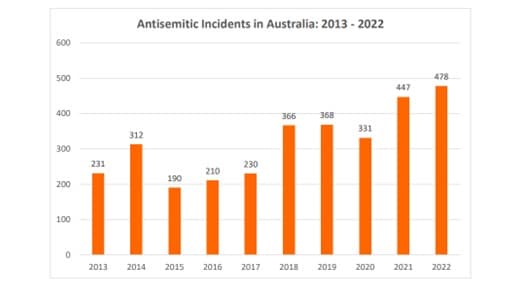
The Australian media reported this week on a 42% increase in antisemitism over the past two years.

The reported increase was accurate but odd. Annual reports normally report annual increases. In fact, the Executive Council of Australian Jewry (ECAJ) annual report on antisemitism in Australia in 2022, released on Friday, shows a 7% increase in antisemitism in the past year. There was a 35% increase in the preceding year.

The ECAJ’s media release collapsed the two figures together in its lead finding, making the numbers look worse than they would on an annual accounting, though it broke them down to their constituent parts in the same sentence.  

Interviewed on the ABC, ECAJ Co-CEO Peter Wertheim explained the breakdown and contextualised it in terms of a long-term trend of increasing incidents. We have indeed seen a disturbing growth in the raw numbers, as the graph below makes clear.
EC<em>ECAJ Report on antisemitism in Australia 2022</em>
ECECAJ Report on antisemitism in Australia 2022

Not only Jews but anyone committed to a just and cohesive Australia should be concerned by this trend.

But we should refrain from using cheap tricks with statistics to create alarm: that is an unnecessary and dangerous practice which has the potential to backfire.

We also need to drill down into the nature of the incidents to understand properly what is going on and how worried we should be.  
The report categorised the incidents as:

  • Physical assault: 5 (down from 8)
  • Vandalism: 11 (unchanged)
  • Verbal abuse: 138 (down from 147)
  • Messages: 76 (down from 103)
  • Posters and stickers: 125 (up from 72)
  • Graffiti: 125 (up from 106)

There is some good news in these figures. There is no increase in the serious incidents. There were fewer physical assaults and the same number of acts of vandalism – both very low.

Obviously, one act of assault is too many. It is distressing and frightening for all Jews that there were five occasions this year when Jewish people were hurt by thugs because they were Jewish.

But we do need to keep this in perspective. There are at least 10,000 Haredi or modern Orthodox men in Australia, whose daily attire makes them identifiably Jewish. Many other Jews are identifiable at times in other ways – Jewish school uniforms, Hebrew t-shirts, Star of David jewellery or context, such as standing outside a synagogue. The chance of being attacked because you identify as Jewish is still very small indeed.

The overwhelming majority of incidents are minor, and the increase in the past year occurred solely in posters, stickers and graffiti. In other words, while we are more likely to come across a swastika drawn on an Israeli flag or “Fuck Jews” painted on a random wall, we are no more likely to face either personal or property attack.

There are very good reasons to stay alert to even the most minor of antisemitic incidents. They betray disturbing attitudes and reveal an underbelly of hate which is likely to be much more widespread. Many of us have been raised with the stories of German Jews who refused to believe they could be victims in a “civilised” country until it was too late. Some of us exist only because our grandparents believed it and left.  

But not every swastika scratched on a fence post is a harbinger of a Holocaust. Sometimes it is no more than the action of an oppositional teen raising a finger to society.

Stickers and posters, on the other hand, need to be prepared, which makes them considered, often political, acts. The ECAJ report reveals a proliferation of libertarian material related to Covid-19 regulations and to right-wing extremist activity.

Neither of these groups is focused exclusively, or even primarily, on Jews but like all who care about Australia, we should maintain a careful watch on these far-Right elements.

Nothing is to be gained, however, by seeing antisemitism where it does not exist.

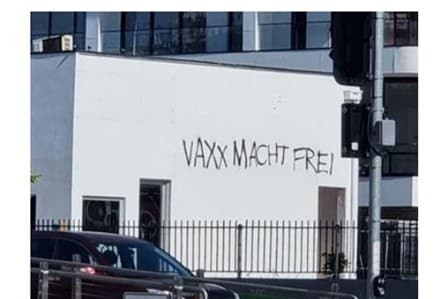
Graffiti of “Vaxx Macht Frei” on Swan St and Punt Rd, Richmond, Melbourne (ECAJ)

Graffiti with the words "vaxx macht frei" invokes Auschwitz and is offensive to the memory of the Holocaust. But it is not meant to be an attack on Jews. It is a libertarian sentiment which ignorantly and stupidly compares public health requirements to the totalitarianism of Nazism.

On the other hand, the image (at top) which combines the Israeli flag with traditional antisemitic stereotyping of the Jew as vermin epitomises the merging of “old” and “new” antisemitism. Worn on a t-shirt at an anti-vax rally it indicates antisemitic strains in the anti-vax movement.

Then there is the difficult territory where antisemitism and criticism of Israel meet. The IHRA definition of antisemitism attempts to disentangle this web by stating that criticism of Israel is not antisemitism but giving several examples where attacks on Israel cross over into antisemitism.

The fraught debate over the legitimacy of the definition notwithstanding, the ECAJ has clearly erred on the side of caution and excluded plenty of grey material in the anti-Israel space, which is appropriate.

But some cases remain ambiguous. Calls to boycott Israel are included in antisemitism according to the IHRA definition and some make it into the ECAJ report. A “Free Palestine” sticker is not antisemitic when it is on a telegraph pole but what about when it is posted on the kosher section of a Woolworths? The placement means the sticker functions as a message to – or about – Jews, not just a political statement. But does that make it antisemitism?

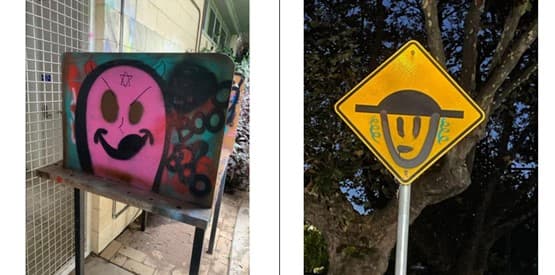
Some of the ECAJ’s inclusions on more trivial matters are questionable. A cartoon of a Hasid formed out of a speedbump sign is simply a visual joke that could well have been made by Jew. A Star of David doodled on a cartoon face is meaningless.

Graffiti in Brisbane (left) and Melbourne (ECAJ)

There are real cases of antisemitism that should concern us in the ECAJ report. But there is a danger they could be dismissed if we cry wolf whenever we see a cub - or a kitten. It might look like some incidents are being included to boost numbers rather than because they really indicate a trend.

For the same reason, Jewish leaders need to temper their rhetoric and save fire for the issues that really matter. If Dr Dvir Abramovich, Chair of the Anti-Defamation Commission, is "shattered” by the revelation that the NSW Premier once wore a Nazi costume to his 21st birthday party, what is he going to say when a window is broken in a synagogue? And is anyone going to listen?

Measuring incidents also has its limitations. A growth in stickers or graffiti could simply mean a handful of individuals is more active. While such activity bears watching, it doesn’t indicate widespread or even growing antisemitism.

The Crossroads21 survey, conducted by The Jewish Independent, gives a deeper understanding of attitudes. It found a large majority of respondents indicate a positive attitude to Jewish Australians and disagree with antisemitic statements.

Australian remains a very good place to be Jewish. We shouldn’t let fear make us forget that.

Top image: Cartoon of a rat with a Star of David and the words "The Real Plague" worn on a t-shirt at by man at a Covid-related street protest, in Sydney (ECAJ)

You might also like
  • Strategies for cohesion final focus of Royal Commission hearings
    Peter Kohn
  • Now is the time for the Royal Commission to deliver, not be politicised
    Dean Sherr
  • Prime minister’s absence exposes weakness in Royal Commission hearings
    Michael Visontay
logomark.67a07ee3
We believe in the free flow of information

Republish our articles for free, online or in print, by using our Creative Commons licence

You might also like

    how to sell a genocide
    Israel Hamas WarOpinionAustralia

    Cancellation backfires but we are at it again

    Nomi Kaltmann 1
    Scopus main
    NewsAustralia

    Rediscovered in Melbourne: the 75-year odyssey of Nazi-looted Jewish books

    Jason Schulman 4
    chanukah by the sea bondi
    Royal CommissionOpinionAustralia

    Safety not just security: the last word to the Royal Commission

    Yehoram Ulman

About the author

Deborah Stone

Deborah Stone

Deborah Stone is Editor-in-Chief of TJI. She has more than 30 years experience as a journalist and editor, including as a reporter and feature writer on The Age and The Sunday Age, as Editor of the Australian Jewish News and as Editor of ArtsHub.

More from the author

NewsAustralia

Humanitarian organisations fail on antisemitism: new research

NewsAustralia

AJN pulls article criticising abuse of Sarah Schwartz

NewsIsrael

Israel leads use of military AI: a threat to global peace

NewsAustralia

NSW government marks six months since Bondi with $8.3 million in community support