Aa
  • Read, Watch, Listen
  • TJI Series
  • Community Action
  • Events
  • Zedi
Follow us and continue the conversation
  • LinkedIn
  • Instagram
  • FaceBook
  • X
  • YouTube
Test yourself with the TJI Quiz!

Adjust size of text

Aa

Follow us and continue the conversation

  • LinkedIn
  • Instagram
  • FaceBook
  • X
  • YouTube

Your saved articles

You haven't saved any articles

What are you looking for?

Original reporting, insightful analysis and diverse views, delivered straight to your inbox

  • LinkedIn
  • Instagram
  • FaceBook
  • X
  • YouTube
Your support fuels our mission to inform, entertain and inspire.

The Jewish Independent is bound by the Standards of Practice of the Australian Press Council. If you believe the Standards may have been breached, you may approach The Jewish Independent or make a complaint to the Australian Press Council in writing at www.presscouncil.org.au. The Council may also be contacted on 1800 025 712.

  • Our Story
  • Contact us
  • Our Team
  • Support us
  • Guidelines
  • Pitch your idea
  • Republishing us
  • Community Action
  • Our Awards
  • LinkedIn
  • Instagram
  • FaceBook
  • X
  • YouTube
Aboriginal FlagTorres Strait Islanders Flag

The Jewish Independent acknowledges Aboriginal and Torres Strait Islander peoples as the Traditional Owners and Custodians of Country throughout Australia. We pay our respects to Elders past and present, and strive to honour their rich history of storytelling in our work and mission.

© The Jewish Independent 2026All Rights Reserved
Website design and development by Your Creative, MelbourneTerms & ConditionsPrivacy Policy
HomeRead, Watch, ListenAustralia
FeatureAustralia

How Australian trade unions are backing Palestinian activism

While they have expressed a range of nuanced views, there is a clear pattern of pro-Palestinian solidarity among both professional and trade unions.
Oscar Kaspi-Crutchett
Print this
Aust unions Palestine Solidarity Australia

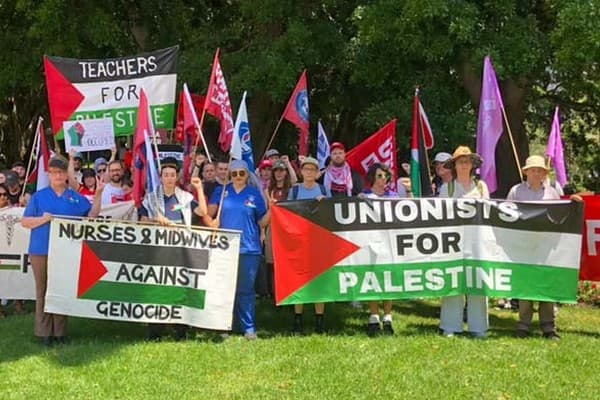
Australian unions rally for Palestine, December 2023 (Solidarity Australia website)

Published: 17 February 2024

Last updated: 21 March 2024

While they have expressed a range of nuanced views, there is a clear pattern of pro-Palestinian solidarity among both professional and trade unions.

In recent months, Australia’s trade unions have grappled with how to respond to the Israel-Hamas War. Whilst some have been silent on the issue or have limited their intervention to a media release, others have extended concrete support to pro-Palestine activism in Australia.

Trade unions are concerned with wages, conditions and workplace rights. To understand why some have become so outspoken on the Israel-Hamas conflict, and why some have not, a cursory glance at Australian history is necessary.

Since Federation, Australian unions have rallied in response to countless international events and humanitarian crises. From the conscription referenda to the boycott of fascist Japan, to the Korean and Vietnam Wars, unions have often proved pivotal in translating public disapproval into systematic pressure, and occasionally, major policy change.

The union movement considers its core principle to be “solidarity” – identifying with exploited people and supporting their fight against injustice. This principle has been complicated by the unresolved question of how far solidarity extends: does it cease at the border or stretch across continents?  

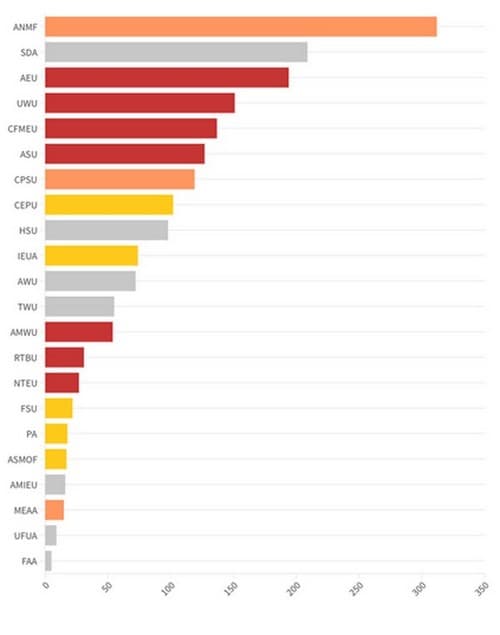
This perennial question has been reanimated by the Israel-Hamas war. Since October 7, Australian unions have responded in one of four ways, as the chart below indicates: silence (grey), calling for restraint or mixed (yellow), demanding a ceasefire (orange), or by advocating a ceasefire and becoming involved in pro-Palestine activism (red).

Graphic: Oscar Kaspi-Crutchett

The largest group comprises those calling for a ceasefire – ten unions are either orange or red. On October 20, the International Trade Union Confederation (ITUC) issued a statement calling for the return of all hostages, an immediate ceasefire and a two-state solution. An open letter by the Australian Centre for International Justice in solidarity with Gaza was signed by leading unions including the Australian Manufacturing Workers Union, the National Union of Students, Australian Services Union (Victorian Private Sector Branch), and the Rail, Tram and Bus Union.

The National Tertiary Education Union (NTEU) immediately backed the ITUC’s declaration. On October 22, the Australian Council of Trade Unions (ACTU) issued a more extensive statement: “The ACTU condemns the bombing, killing and kidnapping of Israeli civilians by the terrorist organisation Hamas on 7 October… all hostages must be released immediately and Hamas must be held accountable… The ACTU joins the ITUC in calling for… an immediate de-escalation and ceasefire. We reiterate the Australian union movement’s strong opposition to war, violence, and racism including antisemitism and Islamophobia… [and] call for an end to the occupation of Palestine and a just and sustainable peace.”

As the humanitarian crisis in Gaza worsened and a ceasefire was endorsed by the ACTU, more labour organisations called for a suspension of hostilities in Gaza.

On October 24, the almost 200,000-member Australian Education Union called for an unconditional ceasefire and expressed mourning for the losses suffered on both sides. Similar statements were made by the executive of the Electrical Trades Union (Queensland & Northern Territory Branch), branches of the Australian Services Union and the Independent Education Union (Victoria-Tasmania Division). The organisation ‘Trade Unionists for Palestine’ appeared on social media on October 23, amassing 3,000 followers on Facebook and 7,000 on Instagram over the following months.

On October 31, Australia’s largest union, the Nursing and Midwifery Federation, released a statement that  expressed solidarity with Israeli, Palestinian and Ukrainian nurses, called for an immediate ceasefire and the release of all the hostages.

By the end of November, the Financial Services Union, Community and Public Sector Union, the Media Entertainment and Arts Alliance, the Australian Services Union had all called for a ceasefire.

However, not all unions or their leaders have chosen to affirm the ACTU’s ceasefire position. Some have instead urged restraint on both sides, while stopping short of calling for an end to hostilities.

Mark Diamond, National Secretary of the Rail, Tram and Bus Union, issued a statement on October 19 which condemned Hamas terrorism and the occupation, while calling on both sides to exercise restraint. He did not mention a ceasefire and distanced the union from an anti-Israel petition being circulated among its members.

On November 6, the United Services Union made a similar call for restraint, drawing protests from some of the union’s membership. The Australian Salaried Medical Officer’s Federation also condemned the violence on both sides and issued its support for the ITUC declaration, while refraining from explicitly calling for a ceasefire.

A third group of unions have abstained from declaring a position on the conflict entirely: the Australian Workers Union, Transport Workers Union, Health Services Union and the Shop Distributive Associates Alliance (SDA). Many of these are historically associated with right-wing Labor and a more isolationist approach to international affairs.

They have each made only limited public statements about the conflict, with the exception of the AWU, whose National Secretary signed an open letter against antisemitism on November 28. Gerard Hayes, President of the Health Services Union, has even expressed disdain at the “absurd” use of HSU banners at pro-Palestine events. These organisations are not insignificant – the SDA is the second largest union in the country – but their response has been in the minority.

The fourth and final group of unions are those which have called for both a ceasefire in Gaza and for people to take to the streets here in Australia: the CFMEU Construction and General Division, the Maritime Union of Australia, the Electrical Trades Union, the Australian Services Union, the AMWU Victoria Branch, the NTEU Victoria Branch, the AEU Victoria Branch and the United Workers Union.

These unions have together opened up their facilities for use by pro-Palestine organisers, addressed major pro-Palestine demonstrations, actively encouraged their membership to attend protests, and condemned Israel in sharper terms than the ACTU or the ITUC.

In November it was reported that Palestinian flags were being flown at CFMEU construction sites. The response from the CFMEU leadership could not differ more from that of the HSU. In a statement to radio 3AW, the CFMEU (Construction & General Division) asserted: “flying these flags [on site] is consistent with the union’s position in calling for an immediate ceasefire to protect all working class people in the Middle East”. In a separate statement, the same division of the CFMEU formally endorsed domestic demonstrations calling for ceasefire.

The Secretary of the Maritime Union of Australia, Christy Cain, has addressed pro-Palestine rallies and described Israel’s actions in Gaza as “an annihilation”. The MUA has permitted its Melbourne Hall to be used several times as a meeting space for “Trade Unionists for Palestine”. Former MUA officials have also participated in an initiative to block Israeli ships from docking in Australian ports.

The United Workers’ Union and the Australian Services Union have also encouraged their members to participate in demonstrations for Palestine. On December 16, the UWU’s Brisbane office hosted an event with the General Delegation of Palestine marking the International Day of Solidarity with the Palestinian People. The organisation is also affiliated with the Australia Palestine Advocacy Network.

The composition of unions in this fourth, actively involved group is not random. These are largely organisations in which “international solidarity” is a concept with very deep roots; servicing sectors with a vivid history of radicalism: maritime, education, services and construction.

Although there is clearly a spectrum of opinion within Australia’s union movement on how to respond to the Israel-Hamas War, there is a clear pattern of widespread concern with Israel’s military conduct in the Gaza Strip and its occupation of the Palestinian Territories. This concern has been serious enough, in some quarters, to encourage organisational support for pro-Palestine activism in Australia.

The extent, intensity and effectiveness of union pressure depends as much on Israel’s future conduct as it does on the labour movement. Should civilian deaths continue to accumulate in the Gaza Strip, and illegal occupation continue in the West Bank, Australian unions will be pressured to act further upon their stated value of international solidarity. This could prove decisive in influencing public opinion on the issue well beyond union ranks.

You might also like
  • ‘Israel is systemically eliminating Palestinian collective life’:  B’Tselem
    Deborah Stone
  • Tame apologises – but with little grace
    Deborah Stone
  • Confronting Richard Flanagan and the myth of the Israel lobby
    Mary Garden
logomark.67a07ee3
We believe in the free flow of information

Republish our articles for free, online or in print, by using our Creative Commons licence

You might also like

    ANNIKA WELLS PRESSER
    Israel Hamas WarNewsAustralia

    No action to stop Hezbollah ally beaming antisemitic and anti-Israel content into Australia

    Michael Visontay
    Royal Commission final
    Royal CommissionNewsAustralia

    Strategies for cohesion final focus of Royal Commission hearings

    Peter Kohn 1
    Generation Change: Rachel Moshel
    Generation ChangeInterviewArts & Culture

    Rachel Moshel: Creating a space for Jewish art and joy

    Gideon Cohen

About the author

Oscar Kaspi-Crutchett

Oscar Kaspi-Crutchett

Oscar Kaspi-Crutchett formerly worked in the Commonwealth Parliament and now works as a senior researcher and organiser in the Victorian union movement.

More from the author

AnalysisAustralia

The conditions enabling neo-Nazis to proliferate in Australia

FeatureAustralia

School strikes for Palestine mark a generational watershed. Jewish leaders don’t get it

OpinionIsrael

Israeli Labor needs to say what it stands for – not against

Comments

No comments on this article yet. Be the first to add your thoughts.