Published: 26 November 2025
Last updated: 27 November 2025
Since the pandemic lockdowns, one sub-faction of the Australian far-right has exploited political events more successfully than any other: the neo-Nazi groups, and specifically the National Socialist Network, led by Thomas Sewell.
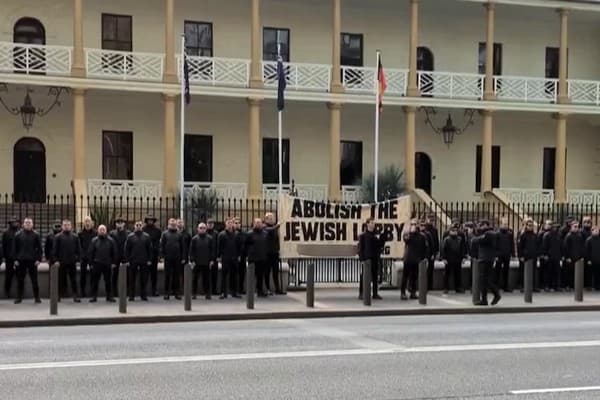
In the past six months, neo-Nazi leaders have occupied the front steps of two Australian Parliaments: the Victorian Parliament in August and the New South Wales Parliament in November.
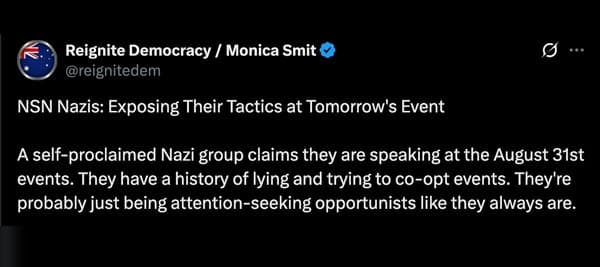
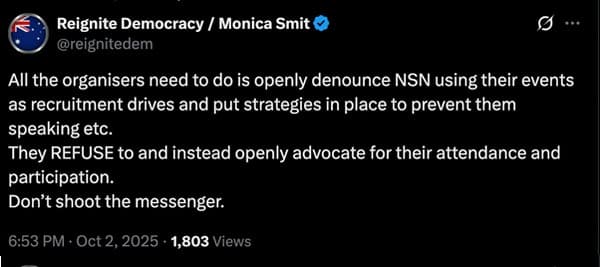
They have not acted alone, nor has their prominence emerged spontaneously. In Victoria, they were led onto the stage by a coalition of other right-wing organisations: the microphone was handed over, it didn’t have to be seized.
The Australian far-right is not a unified and distinct organisation. It is a competitive field where various factions, parties and media personalities struggle to impose their specific vision on each other so they can, down the line, impose it on the country.
For those looking in from outside, it isn’t easy to follow how political competition works on the fringe right. These groups are not yet in a position to run for parliamentary seats at scale. Instead of preselection, they compete for informal markers of legitimacy: speaking slots at major protests, follower counts, admin-status in large telegram groups, the adoption of their specific vocabulary amongst the wider movement and its followers.
Although this is typically subterranean, once in a while it bursts into the public eye when an event hits our streets that demonstrates something has shifted in this corner of the political spectrum.
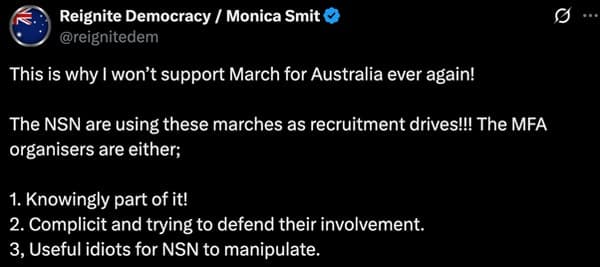
The March for Australia on August 31 was one such moment. The neo-Nazi rally outside NSW Parliament this month was another.