Aa
  • Read, Watch, Listen
  • TJI Series
  • Community Action
  • Events
  • Zedi
Follow us and continue the conversation
  • LinkedIn
  • Instagram
  • FaceBook
  • X
  • YouTube
Test yourself with the TJI Quiz!

Adjust size of text

Aa

Follow us and continue the conversation

  • LinkedIn
  • Instagram
  • FaceBook
  • X
  • YouTube

Your saved articles

You haven't saved any articles

What are you looking for?

Original reporting, insightful analysis and diverse views, delivered straight to your inbox

  • LinkedIn
  • Instagram
  • FaceBook
  • X
  • YouTube
Your support fuels our mission to inform, entertain and inspire.

The Jewish Independent is bound by the Standards of Practice of the Australian Press Council. If you believe the Standards may have been breached, you may approach The Jewish Independent or make a complaint to the Australian Press Council in writing at www.presscouncil.org.au. The Council may also be contacted on 1800 025 712.

  • Our Story
  • Contact us
  • Our Team
  • Support us
  • Guidelines
  • Pitch your idea
  • Republishing us
  • Community Action
  • Our Awards
  • LinkedIn
  • Instagram
  • FaceBook
  • X
  • YouTube
Aboriginal FlagTorres Strait Islanders Flag

The Jewish Independent acknowledges Aboriginal and Torres Strait Islander peoples as the Traditional Owners and Custodians of Country throughout Australia. We pay our respects to Elders past and present, and strive to honour their rich history of storytelling in our work and mission.

© The Jewish Independent 2026All Rights Reserved
Website design and development by Your Creative, MelbourneTerms & ConditionsPrivacy Policy
HomeRead, Watch, ListenWorld
FeatureWorld

Australian youth lend a hand, and an ear, in Ukraine

Ittay Flescher
Print this

Published: 19 July 2022

Last updated: 5 March 2024

Working with refugees on the Ukraine-Poland border was not what MONIQUE HIRSCHFELD expected from her Israel year but it was a remarkable experience, she tells ITTAY FLESCHER.

In a converted supermarket on the Polish Ukrainian border, 19-year-old Monique Hirschfeld spent hours listening to stories she couldn’t understand – but knowing she was somehow helping.

“One girl sat me down and told me two hours’ worth of stories. I think she was old enough to understand that I didn’t speak her language, but she kept talking.”

That girl was one of many children desperate to talk about their experiences of war so, with the some help from Google Translate, Hirschfield and her fellow Australian volunteers listened.

They also drew on their youth group techniques and the power of play to help the children come to terms with seeing their lives uprooted by the Russian invasion of Ukraine – and to distract them with some ordinary childhood activities.

“I saw a kid drawing his home being bombed and it was dreadful to see, all I could do to help him was to comfort him and play ball games to keep him distracted,” said Hirschfeld
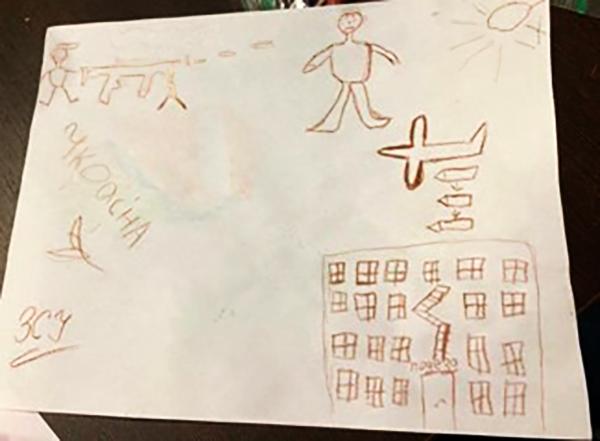
Drawing by a child at the refugee program

Hirschfield never expected that a trip to a city just 10 kilometres from a European war zone would be part of her gap year experience in Israel. In fact, she only found out she was going two days before leaving.

She was one of six Australian volunteers who went to volunteer as part Shnat, a year in Israel with Hashomer Hatzair (Hashy).

Hirschfeld told The Jewish Independent that her experience had opened her eyes to the refugee experience. Many people at the Tesco were constantly in tears. Many bore the signs of war, including amputated limbs. Distressed pets shared the space with their owners, resources scarce to provide needed vet care.

It was difficult for the Australian volunteers to see the trauma of the people in front of them.

The centre works hard to maintain the humanity of the Ukrainians whose lives have been turned upside down.“We were told not to call them refugees, only guests,” said Hirschfeld. “This choice of language made them feel more at home.”

The Hashy world movement has been among the organisations supporting Ukrainians fleeing their homes, in a converted Tesco supermarket in the Polish city of Przemysl, since March 2022. Tesco (which is how everyone refers to the centre) is the largest refugee camp in Poland, and tens of thousands of refugees have passed through there since the war began. The Tesco camp is the initial stopping point for refugees crossing the border into Poland and serves as a place where refugees figure out which country they will be continuing onwards to.

The vast majority of the refugees in the centre are women, children, and the elderly. While most ‘guests’ have a brief stay of under a week at the centre, some have remained for many weeks.

"The kids would sing it with such pride and joy because it was in the Ukrainian language... It honestly reminded me of singing Hatikva outside the concentration camps"

Monique Hirschfeld, refugee centre volunteer

As one enters the camp, there are booths with representatives from different countries across Europe and Asia working to resettle individuals, as well as booths from various humanitarian organisations providing immediate support. Families sleep on makeshift beds, sectioned into ‘rooms’ that were once a part of the storefront. Each room represents a country that will absorb those seeking refuge within.

The Socialist Zionist youth movement has been operating a children’s centre within Tesco. During the day, parents drop off their kids, aged 10 and under, for programs that include bracelet making, board games and colouring activities. In the evening, 11–18-year-olds come to play Xbox or card games and socialise with other teens.

The children’s centre allows parents time to go to the various agencies and figure out where their family will be moving to next, while providing a break from the stress of occupying their children in an unfamiliar and difficult environment. For the children, it provides a space of normalcy and joy, much needed in a context where war has disrupted so many parts of their childhood.

Hirschfeld said that one of the most special parts of her week-long volunteering experience was a daily noon parade, where the children loved to sing ‘Stefania’ by Kalush , the Ukrainian song which won this year’s Eurovision Song Contest.

“The kids would sing it with such pride and joy especially because it was in the Ukrainian language. It would give me goosebumps while we walked through the corridors of the Tesco centre. It honestly reminded me of my Machon Poland experience, singing Hatikva outside of the concentration camps, the feeling of pride and knowing that we are all still here to tell their stories and express our cultural and Jewish identities.”

Before going on Shnat, Hirschfeld wasn’t sure about what she would do upon her return within her youth movement. Initially, she felt her best way to contribute to Hashy would be to volunteer to cook on camp.

But the Ukrainian experience has made her want to be a youth leader, as she has realised the power of power of informal education to make a meaningful difference in the lives of others.

Photo: The Australian Hashomer Hatzair volunteers at the Tesco Refugee Centre

You might also like
  • The goring ox: who answers for ‘rogue’ AI?
    Yoni Genende
  • From antisemite to ally: the power of friendship
    Elana Benjamin
  • Russia’s campaign against Jewish targets in Europe
    Colin Shindler
logomark.67a07ee3
We believe in the free flow of information

Republish our articles for free, online or in print, by using our Creative Commons licence

You might also like

    Brazilian presidents
    AnalysisWorld

    Brazilian Jews treated as pawns in presidential election

    Karina Stange Calandrin
    Gab
    NewsWorld

    Traditional antisemitic myths dominate online antisemitism: new study

    Deborah Stone
    Passengers From Diverted Flydubai Flight To Arrive In Israel
    FeatureIsrael

    How ‘jihadist terror attack’ was averted on Israel-bound flight

    Tomer Almagor 2

About the author

Ittay Flescher

Ittay Flescher

Ittay Flescher is the Jerusalem Correspondent for The Jewish Independent. For over 20 years, he has worked as an educator, journalist, and peacebuilder in Melbourne and Jerusalem. His book, The Holy and the Broken: A Cry for Israeli-Palestinian Peace from a Land that Must Be Shared, was longlisted for the 2025 Walkley Book Awards.

More from the author

FeatureArts & Culture

The eight most Jewish songs of Leonard Cohen

OpinionIsrael

Even on October 7, we are not united

AnalysisArts & Culture

Fauda and the illusion of vengeance

AnalysisIsrael

What ‘Zionism’ means in Israel:  it’s not what you think