Aa
  • Read, Watch, Listen
  • TJI Series
  • Community Action
  • Events
  • Zedi
Follow us and continue the conversation
  • LinkedIn
  • Instagram
  • FaceBook
  • X
  • YouTube
Test yourself with the TJI Quiz!

Adjust size of text

Aa

Follow us and continue the conversation

  • LinkedIn
  • Instagram
  • FaceBook
  • X
  • YouTube

Your saved articles

You haven't saved any articles

What are you looking for?

Original reporting, insightful analysis and diverse views, delivered straight to your inbox

  • LinkedIn
  • Instagram
  • FaceBook
  • X
  • YouTube
Your support fuels our mission to inform, entertain and inspire.

The Jewish Independent is bound by the Standards of Practice of the Australian Press Council. If you believe the Standards may have been breached, you may approach The Jewish Independent or make a complaint to the Australian Press Council in writing at www.presscouncil.org.au. The Council may also be contacted on 1800 025 712.

  • Our Story
  • Contact us
  • Our Team
  • Support us
  • Guidelines
  • Pitch your idea
  • Republishing us
  • Community Action
  • Our Awards
  • LinkedIn
  • Instagram
  • FaceBook
  • X
  • YouTube
Aboriginal FlagTorres Strait Islanders Flag

The Jewish Independent acknowledges Aboriginal and Torres Strait Islander peoples as the Traditional Owners and Custodians of Country throughout Australia. We pay our respects to Elders past and present, and strive to honour their rich history of storytelling in our work and mission.

© The Jewish Independent 2026All Rights Reserved
Website design and development by Your Creative, MelbourneTerms & ConditionsPrivacy Policy
HomeRead, Watch, ListenIsrael
Israel Votes 2026AnalysisIsrael

What ‘Zionism’ means in Israel:  it’s not what you think

In Israel, the term ‘Zionism’ has been weaponised in a battle over the nature and identity of the state
Ittay Flescher
Print this
Democracy protest

Pro-democracy demonstrators co-opted Israeli flags in an attempt to reclaim Israeli identity from a narrower view of Zionism (Chuck Fishman/Getty Images)

Published: 17 August 2026

Last updated: 18 August 2026

The gap between what “Zionism” means to most Diaspora Jews and how it is used and abused in Israeli politics has never been wider.

For most Australian Jews, Zionism is a simple baseline: supporting the right of the Jewish people to self-determination in their ancestral homeland. Anti-Zionism, by extension, is the rejection of that principle. In this traditional Diaspora understanding, Zionism has little to do with specific policies, such as the two-state solution, Haredi conscription, or West Bank settlements. By this definition, anyone who supports Israel's right to exist as a Jewish state, fits under the umbrella.

In Israel's political arena, however, “Zionist” is no longer a shared consensus; it is a partisan weapon used to delegitimise rivals.

Consider the political discourse surrounding the upcoming elections. Few foreign observers would label the Prime Minister of Israel as an “anti-Zionist,” yet former Prime Minister Naftali Bennett called him precisely that after Netanyahu pushed through bills facilitating draft exemptions for the ultra-Orthodox and blocking an independent commission of inquiry into October 7.

On the other hand, prominent opposition figures like Gadi Eisenkot, Naftali Bennett, and Yair Lapid regularly insist that their factions will only form a government with “Zionist parties”, a clear political filter aimed at excluding Arab and Haredi parties. This stance directly sidelines Ra'am, despite the efforts of its leader, Mansour Abbas, to bridge the divide.

Abbas has established notable pragmatism within Israeli politics by openly acknowledging Israel’s status as a Jewish state in both Arabic and Hebrew, pledging support to restore a synagogue burned down in Lod during the 2021 intercommunal violence, and explicitly breaking with traditional Arab political precedent by unequivocally condemning attacks on Israeli civilians without appending qualifiers regarding the occupation. Even though he consistently advocates for shared Jewish-Arab civic partnership grounded in a commitment to common democratic and Abrahamic values, none of this makes him an acceptable coalition partner to even the leading liberal Zionist opposition leaders in Israel today.

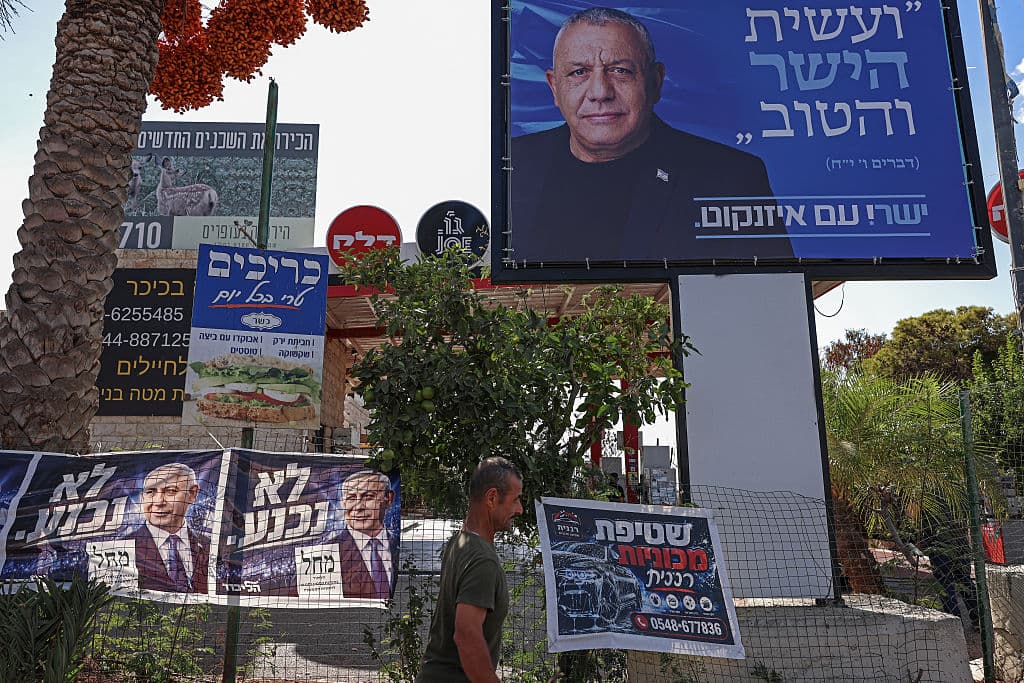
Gilad Erdan’s new right-wing party is in favour of what it calls a “broad Zionist government.” In his view, the word Zionist excludes UTJ, Shas, Ra'am, Hadash, and even the Democrats, but can include parties led by Netanyahu, Ben Gvir, or Smotrich. This definition creates a notable paradox among the so-called “change bloc” regarding the Democrats, a party that describes itself as “the most Zionist party in Israel,” on account of the fact that 90 per cent of the first 20 candidates served in the IDF, including 50 per cent who were officers, and its party leader, Yair Golan, who held the rank of Major General.

In response, members of the Democrats party have labelled Likud and Religious Zionism as “anti-Zionist,” arguing that their tolerance of settler violence, their divisive judicial overhaul, and their refusal to approve a hostage-release deal that could have saved the lives of the beautiful six and other deals run counter to core Zionist values. In another one of their ads shared by candidate Yaya Fink, they described the right-wing religious Shas party that is solidly part of the Netanyahu coalition as “undeniably anti-zionist”, over the fact that only 20 per cent of its sitting MKS served in the IDF. This is despite the fact that Shas has been a member of the World Zionist Organisation since 2010.

The right uses the exact same tactic. Finance Minister Bezalel Smotrich declared that Bennett’s past coalition with the Arab Ra'am party was “a thousand times worse” than the intelligence failures of October 7, accusing Bennett of selling out Zionism by legitimising the place of Mansour Abbas around the highest level of decision-making in the country. Right-wing figures routinely frame opposition to West Bank expansion as an abandonment of the Zionist mission itself, smearing even some mainstream critics of settler violence as anti-Zionist.

During a Knesset floor debate responding to MK Gilad Kariv (a Reform rabbi), Heritage Minister Amichai Eliyahu accused the Reform Movement of embedding “anti-Zionism on its flag”, saying that despite some Reform Jews in the US being ardent Zionists, the movement itself and especially its leadership is anti-Zionist, claiming they support protests in the US “in favour of Hamas and against the Jewish nation.”

Meanwhile, Haredi leaders, while participating fully in state institutions, vociferously reject laws that will drag Yeshiva students away from the Beit Midrash to force them to serve in what they call a “Zionist army.”

To cut through the confusion surrounding “Zionism,” Israeli peace activist Gershon Baskin suggests shifting the standard entirely. The benchmark for entering government should not be a loyalty test to a label, but adherence to democratic norms: respecting the law, upholding equality, rejecting political violence, recognising the legitimacy of political rivals, and believing that elected MK’s should serve all citizens. In Baskin's view, “A Jewish party that rejects those principles is less fit to govern than an Arab party that accepts them.”

Where does that leave the idea of a Jewish state? Ultimately, Israelis aren't locked in an academic debate over definitions; we are locked in a struggle over the state's true character.

The battle is over who serves, who governs, and whether Jewish sovereignty can coexist with democratic equality. If Zionism is to endure as a meaningful concept rather than a political slur, its true test will not be how fiercely politicians claim the brand, but whether they build a society worthy of its ideals as articulated in the Declaration of Independence.


READ MORE
The real anti-Zionists are at the highest levels of the Israeli government (Forward)

You might also like
  • UK’s dramatic policy change on Israel-Palestine
    Colin Shindler
  • Fear of Netanyahu victory may drive big surge in Palestinian voter turnout
    Ben Lynfield
  • Jerusalemites through the lens
    Sharon Gabay
logomark.67a07ee3
We believe in the free flow of information

Republish our articles for free, online or in print, by using our Creative Commons licence

You might also like

    Ofer_Winter_2026
    Israel Votes 2026AnalysisIsrael

    Who is Ofer Winter and could he upset Netanyahu’s election?

    Shahar Burla
    Protest
    AnalysisIsrael

    Western ‘Palestinianism’ colonises everything – and hurts Palestinians

    Andres Spokoiny 5
    settler outpost west bank
    NewsIsrael

    Israel is cementing its control over the West Bank and East Jerusalem while the world is distracted

    Martin Kear

About the author

Ittay Flescher

Ittay Flescher

Ittay Flescher is the Jerusalem Correspondent for The Jewish Independent. For over twenty years, he has worked as an educator, journalist, and peacebuilder in Melbourne and Jerusalem. His book, The Holy and the Broken: A Cry for Israeli-Palestinian Peace from a Land that Must Be Shared, was longlisted for the 2025 Walkley Book Awards.

More from the author

AnalysisIsrael

From haven to hotbed: how Israel’s perception of Australia has changed

FeatureIsrael

New wave of Russian-speaking migrants may be key to Israel’s future

AnalysisIsrael

How a new International Peace Fund could make a tangible difference

Comments1

  • Avatar of jtl

    jtl20 August at 11:20 pm

    To a goy interested enough to read a jewish media source, what made sense to me was this:
    The benchmark for entering government should not be a loyalty test to a label, but adherence to democratic norms: respecting the law, upholding equality, rejecting political violence, recognising the legitimacy of political rivals, and believing that elected MK’s should serve all citizens. In Baskin’s view, “A Jewish party that rejects those principles is less fit to govern than an Arab party that accepts them.”