Aa
  • Read, Watch, Listen
  • TJI Series
  • Community Action
  • Events
  • Zedi
Follow us and continue the conversation
  • LinkedIn
  • Instagram
  • FaceBook
  • X
  • YouTube
Test yourself with the TJI Quiz!

Adjust size of text

Aa

Follow us and continue the conversation

  • LinkedIn
  • Instagram
  • FaceBook
  • X
  • YouTube

Your saved articles

You haven't saved any articles

What are you looking for?

Original reporting, insightful analysis and diverse views, delivered straight to your inbox

  • LinkedIn
  • Instagram
  • FaceBook
  • X
  • YouTube
Your support fuels our mission to inform, entertain and inspire.

The Jewish Independent is bound by the Standards of Practice of the Australian Press Council. If you believe the Standards may have been breached, you may approach The Jewish Independent or make a complaint to the Australian Press Council in writing at www.presscouncil.org.au. The Council may also be contacted on 1800 025 712.

  • Our Story
  • Contact us
  • Our Team
  • Support us
  • Guidelines
  • Pitch your idea
  • Republishing us
  • Community Action
  • Our Awards
  • LinkedIn
  • Instagram
  • FaceBook
  • X
  • YouTube
Aboriginal FlagTorres Strait Islanders Flag

The Jewish Independent acknowledges Aboriginal and Torres Strait Islander peoples as the Traditional Owners and Custodians of Country throughout Australia. We pay our respects to Elders past and present, and strive to honour their rich history of storytelling in our work and mission.

© The Jewish Independent 2026All Rights Reserved
Website design and development by Your Creative, MelbourneTerms & ConditionsPrivacy Policy
HomeRead, Watch, ListenIsrael
FeatureIsrael

Biden’s Israel visit this week: more of a stopover than a destination

Dan Coleman
Print this

Published: 12 July 2022

Last updated: 5 March 2024

DAN COLEMAN: The US President's chief focus in his upcoming Middle East journey is Saudi Arabia; those hoping for progress on Palestine or human rights should not hold their breath

FOR THE JEWISH community, a visit to Israel by an American president is a very big deal. However, those hoping for some breakthrough this week when Joe Biden travels to Israel and the West Bank are likely to be disappointed. As the American-born, Israeli journalist Herb Keinon argued in the Jerusalem Post, “Israel is just a stopover on the way to Riyadh.”

Biden himself seems to agree, titling his Washington Post op-ed last Saturday: Why I’m Going to Saudi Arabia.

Indeed, it is in Saudi Arabia, where Biden will meet with eight Arab heads of state, that the stakes are high.

Among the items on the agenda are the diminishing prospects for reviving the Iran nuclear deal, increasing OPEC oil production to meet global demand, and addressing thorny issues of human rights.

By contrast, conversations with Yair Lapid may amount to little more than a symbolic expression of bonds and friendship, a meeting in which, according to a White House briefing, they will “discuss Israel’s security, prosperity, and its increasing integration into the greater region”.

The US pro-Israel advocacy body AIPAC, rather overenthusiastically, called it “an important affirmation of President Biden’s iron-clad commitment to advance the solid alliance between the two democratic allies”.

Lapid, as a caretaker prime minister, is hardly able to make significant commitments on behalf of Israel. And the Israelis would be aware that, after the upcoming Congressional elections, Biden’s ability to move treaties or legislation through Congress may be diminished.
Lapid, as a caretaker prime minister, is hardly able to make significant commitments. And after the Congressional elections, Biden’s ability to move legislation may be diminished.

Inclusion of more Arab nations under the Abraham Accords will be a concern of Lapid, one he will urge Biden to carry forward to his meetings with Arab heads of state. Commenting on the normalisation of relations, Biden pointed out that he will be the first US president to fly directly from Israel to Saudi Arabia.

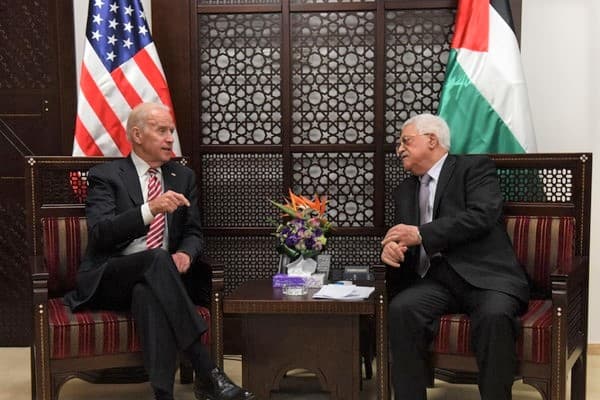
Biden will also meet with Mahmoud Abbas, which will be some comfort to the Palestinians, given the Trump Administration’s virtual cancellation of the Palestinian people. According to the White House, Biden will “reiterate [his] strong support for a two-state solution, with equal measures of security, freedom, and opportunity for the Palestinian people”.

High on Abbas’ agenda will be Biden’s as-yet unfulfilled promise to reopen a US consulate in East Jerusalem.

Despite these modest expectations, progressive American Jews have not been shy about articulating objectives for Biden’s trip. Daniel Sokatch of the New Israel Fund wrote that the President’s message to Lapid “should reflect the fact that the United States — as well as most American Jews — disapproves of the Israeli government’s settlement policies, viewing them as an obstacle to peace and contrary to international law”.

J-Street agrees, arguing that it is vital that Biden “unequivocally oppose these harmful actions and the pattern of displacement of Palestinian communities in the occupied West Bank… [and] reverse moves by the previous administration that attempted to legitimize and bolster the settlements”.

Georgia senator Jon Ossoff, a former investigative journalist himself, is concerned about the May killing of Palestinian-American journalist Shireen Abu Akleh. Ossoff told Haaretz “the US government has a profound obligation to ensure that justice is served for [Abu Akleh]’s death. We cannot accept the killing of an American journalist killed in the course of reporting without accountability”.

On Friday, the family of Abu Akleh decried Biden's "abject response" to the killing, writing to him of their "grief, outrage and sense of betrayal [at] the extrajudicial killing of [their] sister and aunt by Israeli forces on May 11, 2022, while on assignment in the occupied Palestinian city of Jenin in the West Bank.”

Accountability for the killing of another journalist also casts a pall over Biden’s visit to Saudi Arabia, in this case the 2018 murder of Washington Post contributor Jamal Khashoggi. The CIA has placed responsibility for Khashoggi’s death squarely at the feet of Saudi Crown Prince Mohammed bin Salman (MBS), a charge the Saudis vigorously deny.

The Jewish Independent

As a candidate, Biden promised he would make the Saudis “pay the price, and make them in fact the pariah that they are”. In response, MBS said “simply, I do not care” what Biden thinks, adding that, if Biden wants to alienate the Saudi monarchy, he should “go for it”.

Yet Biden has not gone for it, a stance that has led Sarah Leah Whitson, executive director of Democracy for the Arab World Now, to criticise the Biden administration for “kowtowing to a murderous dictator”.

Many would agree with candidate Biden on the “pariah” designation.

Those include Khashoggi’s fiancée, who has brought charges against MBS in a US civil proceeding. The Saudi government is also embroiled in a lawsuit in the US District Court brought by families of September 11 victims. New video evidence emerged in April linking the hijackers with a Saudi official.

Meanwhile, human rights groups and many Congressional Democrats are calling for an end to US military support to Riyadh over the numerous Yemeni civilians killed by Saudi airstrikes. On June 1, a bipartisan group of 50 House members introduced a war powers resolution with that objective. 

However, Biden is not in a position to lay strong charges against the Saudis or attempt to isolate them as he has done with Vladimir Putin’s Russia. America shares a strong interest with Saudi Arabia, along with Israel and most Arab nations, in countering the threat of a nuclear-armed Iran.

Biden is not in a position to lay charges against the Saudis or isolate them as he has done with Vladimir Putin’s Russia.

The latest talks on reviving the 2015 Joint Comprehensive Plan of Action (JCPOA), under which Iran had limited its nuclear program, ended recently without progress. A senior US official told Reuters that any negotiations over JCPOA should be understood to be “at best as treading water, at worst as moving backwards”.

Since Donald Trump scuttled JCPOA in 2018, Iran is believed to have amassed sufficient nuclear material to build a bomb very quickly. The emphasis, whether from the US, Israel, or the Gulf states, will move from preventing a nuclear Iran to deterring any threat of nuclear attack.

Also high on Biden’s agenda is his strong interest in seeing OPEC increase oil production to offset supplies lost through the international embargo of Russian fuel, a concern that dovetails with Biden’s domestic agenda.

As Keinon put it in the Jerusalem Post, “in the American effort to balance values against interests, values are taking a back seat as gasoline prices in the US now average an unprecedented $US5 a gallon”.

This has contributed to a US inflation rate of over eight per cent, a number that casts a pall over Democratic prospects in the mid-term elections. Keinon concludes that “Biden is in need of the Saudis” to boost oil production, thereby reducing prices globally and mitigating inflationary pressures in the US.

Those, like Ossoff and Sokatch, who seek progress on human rights, whether in Yemen or Palestine, may find that, this week, as so often is the case, realpolitik is likely to win out.

Photo: A worker unfurls a US flag to be placed on a light pole ahead of a visit by US President Joe Biden to Jerusalem (AAP)

You might also like
  • The leadership a wounded society needs
    Esther Takac
  • Fauda and the illusion of vengeance
    Ittay Flescher
  • Israel election explainer: the main parties
    Shahar Burla
logomark.67a07ee3
We believe in the free flow of information

Republish our articles for free, online or in print, by using our Creative Commons licence

You might also like

    Woman with land and houses behind her
    NewsAustralia

    Australia to increase sanctions against West Bank settlements

    Deborah Stone 2
    ISRAEL-LGBTQ-PRIDE-PARADE-PALESTINIAN-CONFLICT-HOSTAGES
    NewsIsrael

    LGBT asylum seekers caught between Palestinian violence and Israeli bureaucracy

    Jarod Rhine-Davis
    Rozana Beit Oula
    PeacebuildingOpinionIsrael

    Peacebuilding through the eyes of a sceptic

    Ron Finkel

About the author

Dan Coleman

Dan Coleman

Dan Coleman is a former member of the Carrboro, North Carolina Town Council, and a former political columnist for the Durham (NC) Morning Herald. He is the author of Ecopolitics: Building A Green Society. He lives in Melbourne.

More from the author

AnalysisWorld

Young Republicans show alarming rise in antisemitic views

FeatureWorld

Controversial frontrunner makes mayoral race a test for Jewish New Yorkers 

AnalysisWorld

Trump and MAGA turn on Israel over scale of bombing and settler attacks

AnalysisWorld

On heels of the ceasefire, Trump II era begins