Aa
  • Read, Watch, Listen
  • TJI Series
  • Community Action
  • Events
  • Zedi
Follow us and continue the conversation
  • LinkedIn
  • Instagram
  • FaceBook
  • X
  • YouTube
Test yourself with the TJI Quiz!

Adjust size of text

Aa

Follow us and continue the conversation

  • LinkedIn
  • Instagram
  • FaceBook
  • X
  • YouTube

Your saved articles

You haven't saved any articles

What are you looking for?

Original reporting, insightful analysis and diverse views, delivered straight to your inbox

  • LinkedIn
  • Instagram
  • FaceBook
  • X
  • YouTube
Your support fuels our mission to inform, entertain and inspire.

The Jewish Independent is bound by the Standards of Practice of the Australian Press Council. If you believe the Standards may have been breached, you may approach The Jewish Independent or make a complaint to the Australian Press Council in writing at www.presscouncil.org.au. The Council may also be contacted on 1800 025 712.

  • Our Story
  • Contact us
  • Our Team
  • Support us
  • Guidelines
  • Pitch your idea
  • Republishing us
  • Community Action
  • Our Awards
  • LinkedIn
  • Instagram
  • FaceBook
  • X
  • YouTube
Aboriginal FlagTorres Strait Islanders Flag

The Jewish Independent acknowledges Aboriginal and Torres Strait Islander peoples as the Traditional Owners and Custodians of Country throughout Australia. We pay our respects to Elders past and present, and strive to honour their rich history of storytelling in our work and mission.

© The Jewish Independent 2026All Rights Reserved
Website design and development by Your Creative, MelbourneTerms & ConditionsPrivacy Policy
HomeRead, Watch, ListenAustralia
Australia

Call of the Outback for a wondering, wandering Australian Jew

Sidra Kranz Moshinsky
Print this

Published: 10 June 2022

Last updated: 5 March 2024

SIDRA KRANZ MOSHINSKY travelled solo across the Nullarbor, drawn by country as distant as possible from the birthplace of her parents

As missiles pound towns and cities in Ukraine, a strange twisting goes on inside me.

I live conscious of the vagaries of time and place that mean that I was born safe and free, spared the agony of the Shoah - luck not granted to much of my family.

It also becomes apparent how quickly our sense of place and deep connection to land can shift. While I feel for the people of Ukraine and am horrified by what is going on, it is Australia to which I am rooted.

Now, as violence and destruction at the hands of another powerful tyrant sweeps those parts, I’m conscious that I’m safe and free because the Shoah means that I live here and not there ... but could have…if not for…

The desert is midbar in Hebrew, coming from the same letters that make up medaber, to speak. These distant places speak to me, giving voice to messages that get drowned out in our noisy city lives.

My grandparents honeymooned in Zakopane, a town in the Carpathian mountains, and spoke wistfully of pine forests, rivers and alps. There is no way that at the start of their lives in Warsaw, Radom, Boreslaw and Lvov they could ever have imagined that the forces of history would mean they would end their lives buried under swaying gum trees in Melbourne. Yet there they are.

And here am I, an Australian-raised Jewish woman with a strong desire to connect to this land. It moves me and calls to me in ever-deepening ways.

As a teenager, I went on a school trip up the Birdsville Track to the Simpson Desert, getting my first taste of the outback.

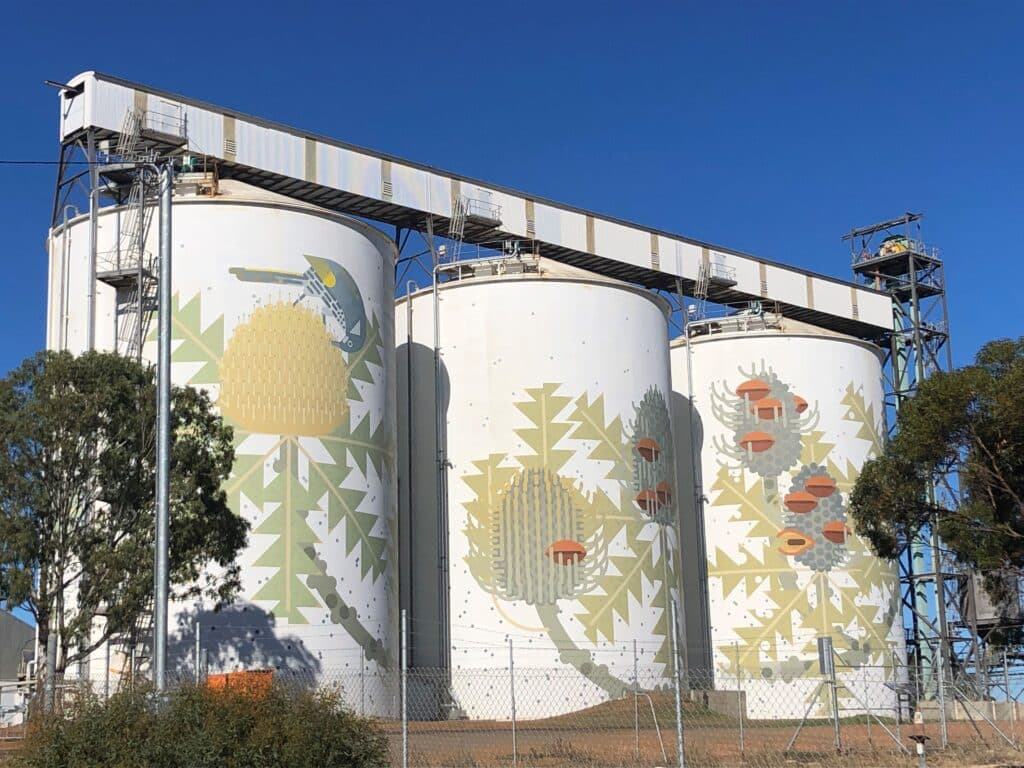
The Jewish Independent

Nearly 20 years ago, with my partner and three young children, I took three months to travel and camp through parts of Western Australia and the Northern Territory.

At the time I was also researching the history of the Jewish community in rural and remote parts of the country. Wherever we stopped, I looked for traces. In Coolgardie, in Western Australia, where a Jewish community and synagogue briefly flourished during the 1880s and 90s gold rush, I asked the person at the cemetery office where I might find the Jewish section. “We don’t have any Jewish graves here,” came the reply. Knowing they were there, I persisted. “Oh, the Hebrew graves. We’ve got them,” and I find my way to what remained of the headstones, weathered marble on the signature red, red dirt.

For the first time, or at least since that vague point when I became a "proper grown up", I am taking some time for myself. It is fitting that this is a shmita year, a sabbatical year. Like the land being given time to lie fallow and rest deeply, I am giving myself the same opportunity.

The past few years have been intense, screen-dominated, with a narrow circumference around us for much of the time. I need to exhale and as soon as I do so and let the noise subside enough for other parts of me to rise to the surface, I find I have a strong need for space, quiet, natural beauty, movement, and solitude.

I may be the child of parents born in Boleslaw and Warsaw, but it is Esperance, a small West Australian town that calls me. To get there I drive 3000 kilometres, including across the Nullarbor. The idea of travelling solo is strangely appealing. Ideas quickly take root and very soon become a vision realised, a treasure unfolding.

In 1912, The Bulletin magazine published a poem by Nathan F. Spielvogel, a Jewish resident of Ballarat. In The Call of the Wandering Jew, voices of Jewish figures over the ages appear before him, mostly rooted in persecution and exile, calling him to wander. He resists: “I was born in this Southland sweet,” he answers, “I love this land as I love my life”. Nevertheless, “as the gumtrees sigh”, wanderlust takes hold, his blood runs mad and he surrenders, staff in hand.

I think of this poem as I, too, succumb to wanderlust and wonderment.

“It is not good to be alone,” we are taught in Genesis. But sometimes it is. I didn’t wander staff in hand, but rather in a well-packed car with ample food, extra water, creature comforts, spare tyre, reading materials (poetry, novels, personal development and great trucking stories), music and podcasts but also a commitment to experience at least a few hours of complete quiet every day.

The Jewish Independent

On a trip such as this, it’s part longing to explore new parts - ancient parts for the traditional owners, the Noongar nations in Southern Western Australia - and part longing for a form of release that allows for return.

The desert, or wilderness, is midbar in Hebrew, coming from the same letters that make up medaber, to speak. These distant places speak to me, giving voice to messages that get drowned out in our noisy city lives. In their quiet insistence we learn perspective based on the vastness of scale and depths of time, they affirm, provoke, uproot, pacify, astonish, and belittle in equal measure.

One of the small towns through which I passed early on was Renmark, situated on the Murray River in South Australia. I had never heard of it before, but when I mentioned it to my mother it turns out she had been there with her parents on one of their first holidays after arriving as refugees in 1947.

I try to imagine what my grandparents would have thought of this remote and quiet town with its majestic river gums and incongruous palm trees. After the war years in Poland, they must have felt that they had succeeded in getting as far away from Europe as possible. Renmark could not be further away from Radom in distance and sensibility.

I have visited Poland and one day I will get to Ukraine, although that time has been extended dramatically given its tragically ruined state. Meanwhile, I forge new tracks in this ancient land, encountering breath-taking beauty, drawing on insights shared by our First Nations People, grateful for the peace and abundance, and enlarging a sense of home.

Photos: Outback images by Sidra Kranz Moshinsky (supplied)

You might also like
  • ‘L’chaim for the next 1,500’: Israeli drummer celebrates Cirque Du Soleil milestone
    Gideon Cohen
  • A lonely, wandering voice for peace in troubled times
    Sharon Berger
  • Israel to decide for Palestinians which foreign lecturers can teach at West Bank unis
    TJI Pick
logomark.67a07ee3
We believe in the free flow of information

Republish our articles for free, online or in print, by using our Creative Commons licence

You might also like

    Penny Wong
    DebateAustralia

    Sanctions must influence, not just perform disapproval

    Adam Slonim
    chai necklace copy
    ReflectionAustralia

    Facing my mortality, the Book of Life is no metaphor

    Talia Slonim 4
    Article Image
    OpinionAustralia

    Mind the mentality: not every rejection is antisemitism

    Nomi Kaltmann

About the author

Sidra Kranz Moshinsky

Sidra Kranz Moshinsky

Sidra Kranz Moshinsky is a writer, researcher, educational leader and museum professional, serving as the Director and CEO at the Jewish Museum of Australia. She has worked across Jewish schools and cultural organisations throughout her professional life and is a founder of the Jewish Educators’ Network of Australia. Sidra is also a freelance contributor to various publications, such as The Jewish Independent, and celebrates Jewish life through many avenues, including by being a board member of Kehilat Kolenu.

More from the author

ReflectionArts & Culture

Between Melbourne, Warsaw and Tel Aviv, where was I at home this week?

OpinionLifestyle

When they ask about…the tooth fairy

FeatureWorld

This ambitious treasure trove could help us know our ancestors

AnalysisLifestyle

When they ask about…TikTok