Aa
  • Read, Watch, Listen
  • TJI Series
  • Community Action
  • Events
  • Zedi
Follow us and continue the conversation
  • LinkedIn
  • Instagram
  • FaceBook
  • X
  • YouTube
Test yourself with the TJI Quiz!

Adjust size of text

Aa

Follow us and continue the conversation

  • LinkedIn
  • Instagram
  • FaceBook
  • X
  • YouTube

Your saved articles

You haven't saved any articles

What are you looking for?

Original reporting, insightful analysis and diverse views, delivered straight to your inbox

  • LinkedIn
  • Instagram
  • FaceBook
  • X
  • YouTube
Your support fuels our mission to inform, entertain and inspire.

The Jewish Independent is bound by the Standards of Practice of the Australian Press Council. If you believe the Standards may have been breached, you may approach The Jewish Independent or make a complaint to the Australian Press Council in writing at www.presscouncil.org.au. The Council may also be contacted on 1800 025 712.

  • Our Story
  • Contact us
  • Our Team
  • Support us
  • Guidelines
  • Pitch your idea
  • Republishing us
  • Community Action
  • Our Awards
  • LinkedIn
  • Instagram
  • FaceBook
  • X
  • YouTube
Aboriginal FlagTorres Strait Islanders Flag

The Jewish Independent acknowledges Aboriginal and Torres Strait Islander peoples as the Traditional Owners and Custodians of Country throughout Australia. We pay our respects to Elders past and present, and strive to honour their rich history of storytelling in our work and mission.

© The Jewish Independent 2026All Rights Reserved
Website design and development by Your Creative, MelbourneTerms & ConditionsPrivacy Policy
HomeRead, Watch, ListenAustralia
Israel Hamas WarOpinionAustralia

Cancellation backfires but we are at it again

'How to sell a genocide' alleges media conspiracy in support of Israel. Banning it will only create a bigger platform for the ideas it is pushing
Nomi Kaltmann
Print this
how to sell a genocide

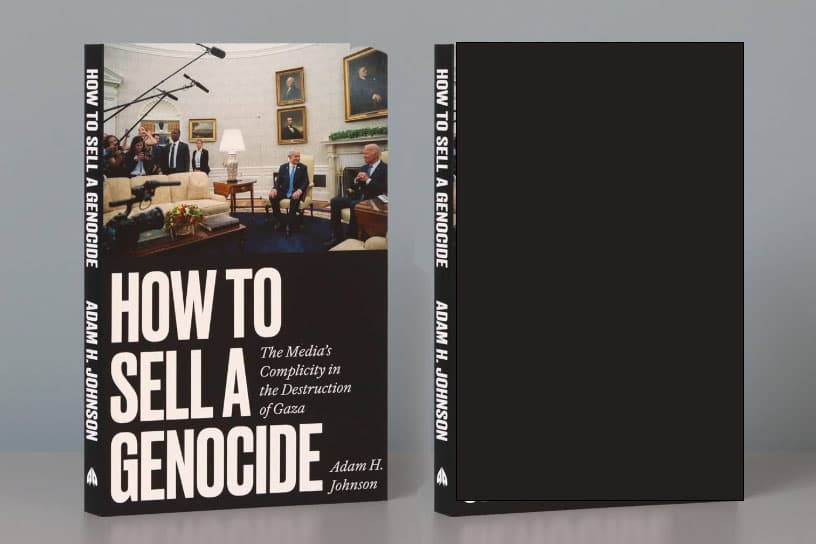
How to Sell a Genocide was removed from Waverley Library after complaints (Image: TJI)

Published: 24 August 2026

Last updated: 27 August 2026

Our community has not learned from our mistakes. The cancellation of Randa Abdel-Fattah from Adelaide Writers' Week made her a freedom of speech cause celebre. The removal of Antoinette Lattouf from her ABC contract enabled her to win a Federal Court case that delivered her a legal victory and a huge profile.

The latest controversy centres on a book that was placed on a recommended reads display at Waverley Library in Sydney. How to Sell a Genocide, by American author Adam H Johnson, was one of several books recommended on a prominent display when patrons walked into the library.

A Jewish patron of the library, who identified themselves as a survivor of the Bondi terror attack, complained on a Facebook group that this book was part of the display, prompting Jewish media company J-Wire to reach out to the council. Soon afterwards, the library removed the book to review its suitability.

The resulting brouhaha has been covered in international newspapers, including The Guardian and The Independent, spreading the news of this book’s cancellation at Waverley Library into a global news story.

Here we are again, adopting precisely the tactics that have been used against us. We seem to have developed an almost pathological inability to understand that trying to cancel people, books and ideas we dislike rarely makes them disappear. More often, it gives them a much bigger platform than they ever would have had otherwise.

Every time we do this, we hand our opponents a gift. We give them a story about Jewish censorship; we give them a martyr


Before this controversy, few people had heard of How to Sell a Genocide. It was released in Australia without much fanfare. Now, the author has suddenly been given a national platform to talk about censorship and cancellation.

Two bookshops I visited last week were already out of stock, days after the issue hit the headlines. Both had received numerous requests for the book and put in large orders, which will arrive in October. When I told one of the sales assistants why so many people were now requesting the book, she said: “Oh, well, I guess that book is going to get many more sales than we would have expected.”

The irony is painful.

How to Sell a Genocide argues that mainstream American media companies, newspapers like The Wall Street Journal and TV companies like MSNBC shaped their media coverage to prime the American people to accept a genocide of Palestinians in Gaza. The book cites the way Palestinians were referred to in mainstream television programs and newspapers (“barbaric” and “savage”) and compares it to how Israelis killed on October 7 are characterised more favourably (“victims of a massacre”).

“The general premise that US media is biased against Palestinians isn’t, we will argue, lefty dogma or a vague feeling driven by ideological preferences,” the author Adam H Johnson writes, “it is an empirical claim that can be proven conclusively.”

While in Jewish circles we tend to hear claims that the media is biased against Israel, Johnson claims Palestinian voices have been suppressed and represented less favourably than Israeli voices.

The book certainly has some problematic content. For example, it has been authoritatively found that the Al Ahli Arab Hospital bombing on October 17, 2023, initially attributed to an Israeli strike, was the result of a misfired Palestinian missile. The book characterises the whole incident as proof that Israel controls the media narrative and claims Israel was probably responsible for the bombing of the hospital. “Somehow Israel managed to control the narrative … then Biden came out and basically supported it, and that was that.”

However, despite finding the book less than satisfactory, I do not think it should have been removed.

Cancelling authors and removing books is ideologically problematic and strategically counterproductive.

As Jews, we know where this road leads. We are a people with an extraordinarily long history of our books being banned, burned and destroyed. We know what it means when somebody else decides that an idea is too dangerous, too offensive or too upsetting to be allowed to circulate.

Yet somehow, when it is a book on a topic we dislike, we seem to convince ourselves that censorship is different. This argument becomes even more absurd when we consider what happens next.

If a library removes a book because it potentially upsets members of one community, what happens when another community member complains about a book that supports Israel? Are we comfortable with libraries removing pro-Israel books because they make somebody else upset?

The attempts to cancel Randa Abdel-Fattah and Antoinette Lattouf delivered massive publicity victories, increased book sales, a literary prize to the former and a Federal Court case win to the latter.

How many times do we need to watch this same thing happen before we realise that cancellation is a terrible strategy?

There is a vast difference between saying, “This book is offensive to me,” and saying, “Therefore, the library should remove it.”

We can think an author is completely wrong and still believe that people should be free to read what he has written and make up their own minds.

In fact, I would argue that this is precisely what we should be doing. Because if we believe our arguments are stronger, why are we so frightened of the other side being heard?

Let people read the book, then argue with it. Tell them why it is wrong. Tell them what it leaves out. Tell them where its arguments fall apart. Give people better books, give people better arguments, give people facts.

But stop trying to make things you don’t like disappear. Every time we do this, we hand our opponents a gift. We give them a story about Jewish censorship; we give them a martyr. We give them publicity, and we give the very people whose ideas we want to challenge a much larger audience.

Otherwise, we risk making a hardly anyone has heard of into a bestseller.

We should have learned this by now.

You might also like
  • The new McCarthyism: Anti-Zionist witch hunts
    Isabelle Oderberg
  • Against purity tests for Zionists and anti-Zionists alike
    Nomi Kaltmann
  • Cancelled author caught between activist left and Israel solidarity
    Andrew Silow-Carroll
logomark.67a07ee3
We believe in the free flow of information

Republish our articles for free, online or in print, by using our Creative Commons licence

You might also like

    Tame
    Australia

    Tame apologises – but with little grace

    Deborah Stone
    funding handouts
    NewsAustralia

    Who will get the money from the Cranbourne windfall?

    Gideon Cohen
    Apple & rotten core Rosh hashanah
    EditorialAustralia

    Facing a new year with the knowledge life can be better

    The Jewish Independent

About the author

Nomi Kaltmann

Nomi Kaltmann

Nomi Kaltmann is an Australian lawyer and journalist. Her writing has appeared in major Australian and international publications including Crikey, Griffith Review, Mamamia, Tablet Magazine, The Australian Financial Review, The Daily Beast, The Forward, The Guardian, The Jewish Telegraphic Agency and The Spectator. She regularly appears on radio and podcasts to discuss Australia’s Jewish community, including NPR (USA), CBC (Canada), LBC (London), Call Me Back, Unholy: Two Jews on the News, SBS and The Times of Israel. An influential Orthodox feminist leader and founding president of the Jewish Orthodox Feminist Alliance (JOFA Australia), she is a sought-after speaker on religion, interfaith and contemporary Jewish life.

More from the author

OpinionWorld

From NY to Melbourne, local politicians are whipping up hate 

ReflectionAustralia

I have lost faith in our multicultural institutions 

InterviewIsrael

Dreams, nightmares and realities from a bereaved mother 

Comments2

  • Avatar of Barbara Swartz

    Barbara Swartz29 August at 10:59 pm

    Most public libraries accept borrower requests for new books. Rather than asking for a book to be removed from the library collection, a better strategy would be to put in a request for one or two new books with a pro-Israel perspective. Often the library staff are not even aware of those books and a request for pro-Israel titles is helpful for both the library and the Jewish community.

  • Avatar of Mark Ian

    Mark Ian27 August at 01:12 am

    There is now new terms for war morality involving civilian casualties .
    There are war crimes and genocides .
    But Holocaust and Genocide are now very different .
    Few have the been able to accuse Israel of have committed a Holocaust in Gaza but the Genocide accusations are prolific .
    This is because Genocide is defined as the intent to destroy a people in Whole or Part .
    Part can be one or two percent of the Population .
    So in Gaza with a PreOctober 7 population of over two million seventy five thousand is close to four percent .
    Over fifty percent of the toll were combat aged males .
    But the population of Gaza has not decreased it is still over two million
    People .
    Many wars are then subject to the definition of genocides .
    The attack on Israelis on October 7 is able to be defined as a Genocide .
    Also in the Arab-Israeli War of 1947-1948 there was the intent to genocide Jewish Israelis .
    So the accusation against Israel can be challenged.
    If you are committed to using the label
    Genocide you have explain Israeli Warnings to Civilians to Escape to Humane Zones .